
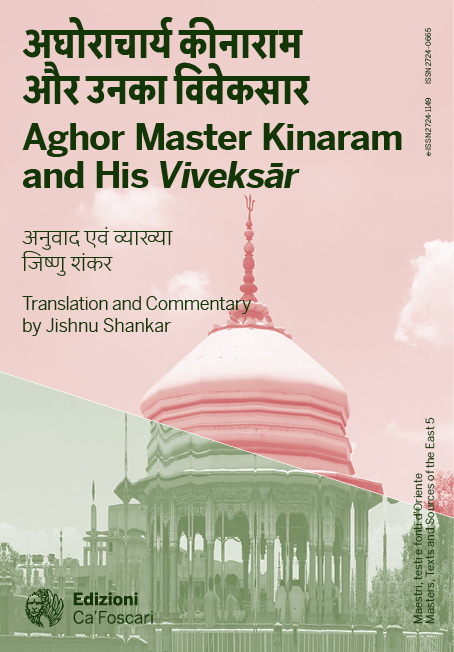
| Title | अघोराचार्य कीनाराम और उनका विवेकसार | Aghor Master Kinaram and His Viveksār |
|---|---|
| Subtitle | अनुवाद एवं व्याख्या | Translation and Commentary |
| Contributor | Jishnu Shankar (editor) |
| DOI | https://doi.org/10.30687/978-88-6969-892-7(opens in new tab) |
| Landing page | https://edizionicafoscari.it/en/edizioni4/libri/978-88-6969-892-7/(opens in new tab) |
| License | https://creativecommons.org/licenses/by/4.0/(opens in new tab) |
| Copyright | Jishnu Shankar |
| Publisher | Edizioni Ca’ Foscari – Venice University Press |
| Publication place | Venice, Italy |
| Published on | 2025-11-12 |
| Series |
|
| ISBN | 978-88-6969-892-7 (PDF) |
| Short abstract | Baba Kinaram is the recognized seventeenth-century proponent of the Aghor tradition in India, and Viveksār, composed in the year 1755, represents his summation of the Avadhūta philosophy which informs the Aghor practices. It shows the continuation into the seventeenth century of the formless and unitary view of God, conceptualized as an omnipresent, invisible and indivisible entity without category distinctions. This book presents the translation of Viveksār from medieval Hindi poetry into English with two commentaries, one in standard Hindi, the other in English, to be accessible to both, seekers of a spiritual path, and scholars with an academic interest. |
| Long abstract | Baba Kinaram is the recognized seventeenth-century proponent of the Aghor tradition in India, and Viveksār, composed in the year 1755, represents his summation of the Avadhūta philosophy which informs the Aghor practices. It shows the continuation into the seventeenth century of the formless and unitary view of God, conceptualized as an omnipresent, invisible and indivisible entity without category distinctions. This book presents the translation of Viveksār from medieval Hindi poetry into English with two commentaries, one in standard Hindi, the other in English, to be accessible to both, seekers of a spiritual path, and scholars with an academic interest. |
| Language | Italian (Original) |
| THEMA |
|
| BISAC |
|
| Keywords |
|