
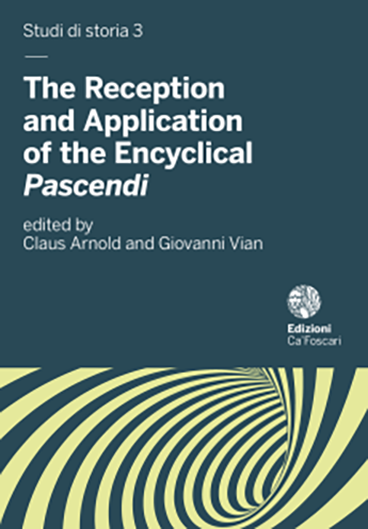
| Title | The Reception and Application of the Encyclical Pascendi |
|---|---|
| Subtitle | The Reports of the Diocesan Bishops and the Superiors of the Religious Orders until 1914 |
| Contributor | Claus Arnold(opens in new tab)(editor) |
| Giovanni Vian(opens in new tab)(editor) | |
| DOI | https://doi.org/10.14277/978-88-6969-130-0(opens in new tab) |
| Landing page | https://edizionicafoscari.it/en/edizioni4/libri/978-88-6969-131-7/(opens in new tab) |
| License | https://creativecommons.org/licenses/by/4.0/(opens in new tab) |
| Copyright | Giovanni Vian, Claus Arnold |
| Publisher | Edizioni Ca’ Foscari – Venice University Press |
| Publication place | Venice, Italy |
| Published on | 2017-03-29 |
| Series |
|
| ISBN | 978-88-6969-130-0 (PDF) |
| Short abstract | The aim of the volume is to analyze the ‘practical implementation’ of the anti-modernist measures of Pius X’s encyclical Pascendi (September 8, 1907) in the Roman Catholic Church. For the first time, the reports on Modernism produced by bishops and religious orders – and scattered in the Roman archives – are studied and compared, offering the reader an international picture of the widespread effect of anti-modernism until 1914 and, at least indirectly, of the general situation of the Catholic Church at the beginning of the twentieth century. At the same time, the various local interpretations and strategies come into focus, as well as the somewhat competition-driven inner-curial handling of the reports. |
| Long abstract | The aim of the volume is to analyze the ‘practical implementation’ of the anti-modernist measures of Pius X’s encyclical Pascendi (September 8, 1907) in the Roman Catholic Church. For the first time, the reports on Modernism produced by bishops and religious orders – and scattered in the Roman archives – are studied and compared, offering the reader an international picture of the widespread effect of anti-modernism until 1914 and, at least indirectly, of the general situation of the Catholic Church at the beginning of the twentieth century. At the same time, the various local interpretations and strategies come into focus, as well as the somewhat competition-driven inner-curial handling of the reports. |
| Language | English (Original) |
| THEMA |
|
| BISAC |
|
| Keywords |
|