
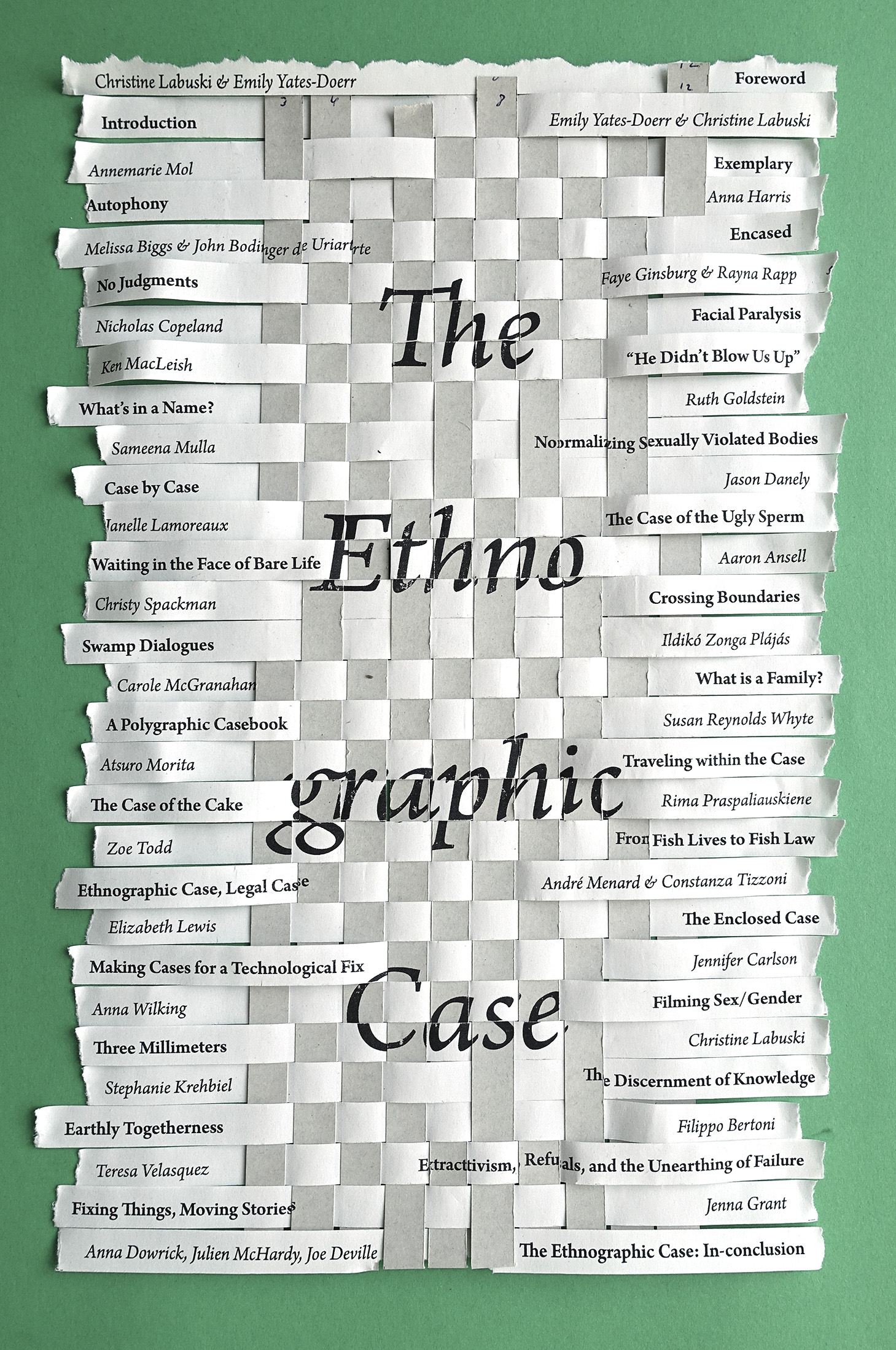
| Title | The Ethnographic Case |
|---|---|
| Contributor | Emily Yates-Doerr(opens in new tab)(editor) |
| Christine Labuski(opens in new tab)(editor) | |
| DOI | https://doi.org/10.28938/995527744(opens in new tab) |
| Landing page | https://www.matteringpress.org/books/the-ethnographic-case(opens in new tab) |
| License | https://creativecommons.org/licenses/by-nc-sa/4.0/(opens in new tab) |
| Publisher | Mattering Press |
| Published on | 2017-01-01 |
| ISBN | 978-0-9955277-4-4 (HTML) |
| Short abstract | The Ethnographic Case challenges a widespread academic inclination to treat concepts as immutable mobiles. The contributions to this volume develop “ethnographic casing” as a technique of attending to heterogeneities in systems of thought. Medical cases. Legal cases. Briefcases. Detective cases. Some cases featured are violent, others compassionate; some set stereotypes in motion, others break them down. Connected more by difference than similarity, the “cases” in this volume make a case for the virtue of relational science. This is a science that is not beholden to the masters’ narratives, but which embraces the double-work of caring for detail, while caring for the practices through which one learns to care. In 26 gripping and provocative installations, the volume showcases research from numerous influential feminist and decolonial scholars. Where anthropology has long sought to identify patterns in culture, this volume makes space for inquiry focused on particularities and advocates for an intellectual politics where that which doesn’t fit is still allowed to matter. |
| Long abstract | A doctor injects turpentine into the leg of a dying patient; the patient lives and years later a granddaughter uses this story of survival to write a story of her own. A refugee is questioned in court for falsifying paternity; a cultural expert intervenes to develop a legal case for kinship that exceeds DNA. A caring father lives a powerful truth, though a filmmaker must misrepresent Ecuadorian prostitutes in order to share it. In all three cases, “the case” shapes possibilities for action. In all three cases, “the case” is different than it was the case before. The Ethnographic Case challenges a widespread academic inclination to treat concepts as immutable mobiles. The contributions to this volume develop “ethnographic casing” as a technique of attending to heterogeneities in systems of thought. Medical cases. Legal cases. Briefcases. Detective cases. Some cases featured are violent, others compassionate; some set stereotypes in motion, others break them down. Connected more by difference than similarity, the “cases” in this volume make a case for the virtue of relational science. This is a science that is not beholden to the masters’ narratives, but which embraces the double-work of caring for detail, while caring for the practices through which one learns to care. In 26 gripping and provocative installations, the volume showcases research from numerous influential feminist and decolonial scholars. Where anthropology has long sought to identify patterns in culture, this volume makes space for inquiry focused on particularities and advocates for an intellectual politics where that which doesn’t fit is still allowed to matter. |
| Language | English (Original) |
| THEMA |
|
| BIC |
|
| BISAC |
|
Contents
- Annemarie Mol
- Anna Harris
- Melissa Biggs
- John Bodinger de Uriarte
- Faye Ginsburg
- Rayna Rapp
- Nicholas Copeland
- Ken MacLeish
- Ruth Goldstein
- Sameena Mulla
- Jason Danely
- Janelle Lamoreaux
- Aaron Ansell
- Christy Spackman
- Ildikó Zonga Plájás
- Carole McGranahan
- Susan Reynolds Whyte
- Atsuro Morita
- Rima Praspaliauskiene
- Zoe Todd
- André Menard
- Constanza Tizzoni
- Elizabeth Lewis
- Jennifer Carlson
- Anna Wilking
- Christine Labuski
- Stephanie Krehbiel
- Filippo Bertoni
- Teresa Velásquez
- Jenna Grant
- Emily Yates-Doerr
- Emily Yates-Doerr
- Christine Labuski
Contributors
Emily Yates-Doerr
(editor)Emily Yates-Doerr is assistant professor of Anthropology at the University of Amsterdam. She is carrying out a study of the UN’s efforts to improve human capital through maternal nutrition. She is author of The Weight of Obesity: Hunger and Global Health in Postwar Guatemala.
Christine Labuski
(editor)Christine Labuski is an anthropologist and assistant professor of Women’s and Gender Studies at Virginia Tech, where she also directs the Gender, Bodies & Technology initiative. Her book It Hurts Down There: The Bodily Imaginaries of Female Genital Pain, tracks the emergence and physiological realization of vulvar pain conditions in the contemporary United States.