
| Title | The Legacy of Elise Hall |
|---|---|
| Subtitle | Contemporary Perspectives on Gender and the Saxophone |
| Contributor | Kurt Bertels(opens in new tab)(editor) |
| Adrianne Honnold (editor) | |
| DOI | https://doi.org/10.11116/9789461665478(opens in new tab) |
| Landing page | https://chooser.crossref.org/?doi=10.11116%2F9789461665478(opens in new tab) |
| License | https://creativecommons.org/licenses/by-nc-nd/4.0/(opens in new tab) |
| Publisher | Leuven University Press |
| Publication place | Leuven, BE |
| Published on | 2024-02-22 |
| ISBN | 978-94-6270-397-1 (Paperback) |
| 978-94-6166-547-8 (PDF) | |
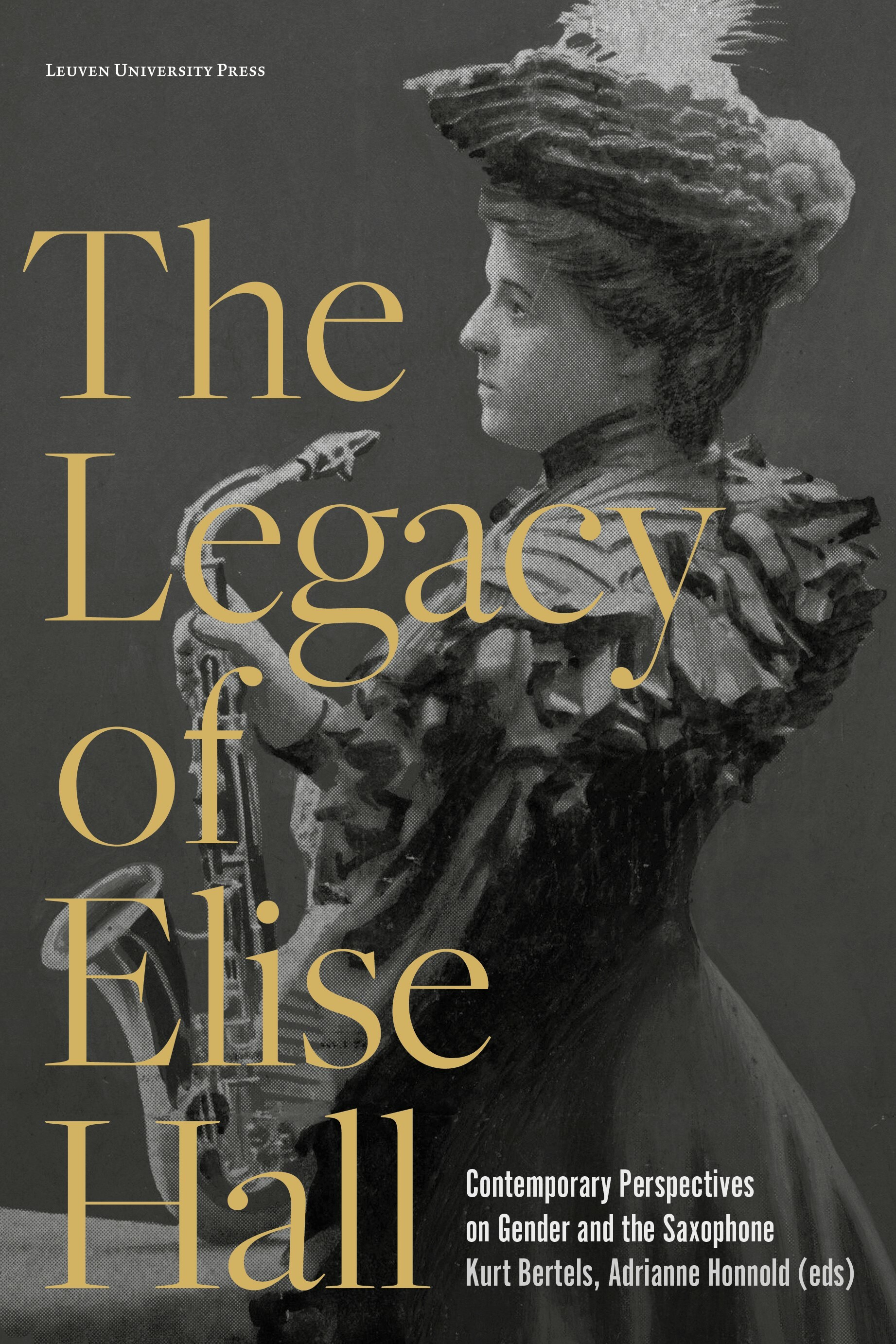
| Long abstract | On the occasion of the 100th anniversary of the death of Elise Hall, a pioneering musician in the history of the saxophone. The saxophone is a globally popular instrument, often closely associated with renowned players such as Charlie Parker, John Coltrane, or more recently, Kenny G. Less well known, however, is the historical presence of women saxophonists in the nineteenth century, shortly after the instrument’s invention. Elise Hall (1853–1924), a prominent wealthy socialite in Boston at the turn of the twentieth century, defied social norms by mastering the saxophone, an unconventional instrument for a woman of her time. Despite her career’s profound impact, Elise Hall remains relatively obscure in broader music communities. Her untiring work as an impresario, patron, and performer made a significant mark on the history of the instrument. Yet these contributions have been historically undervalued, largely due to gender bias. This collection of essays, written by mainly women saxophonists/scholars, re-evaluates Elise Hall’s legacy beyond a discrete history, updating the narrative by highlighting the ways in which her identity and the saxophone itself have influenced historical accounts. By analyzing the sociocultural factors surrounding this innovative musician through a contemporary lens, the contributors challenge previously held narratives shaped by patriarchal structures and collectively affirm her place as one of the pioneers in the history of the saxophone. Contributors: Andrew J. Allen (Georgia College & State University), Kurt Bertels (LUCA School of Arts - KU Leuven), Adrianne Honnold (Lewis University), Sarah McDonie (Indiana University Bloomington), Sarah V. Hetrick (University of Arkansas), Holly J. Hubbs (Ursinus College). Ebook available in Open Access. This publication is GPRC-labeled (Guaranteed Peer-Reviewed Content). |
| Language | English (Original) |
| Media | 14 illustrations |
| THEMA |
|
| BIC |
|
| BISAC |
|
| Keywords |
|
| Funding |
|
Contributors
Kurt Bertels
(editor)Kurt Bertels is a postdoctoral researcher at LUCA School of Arts (KU Leuven), Koninklijk Conservatorium Brussel, and Royal Conservatoire Antwerp, Belgium, where he works on nineteenth- and early-twentieth-century saxophone history and performance practice.
Adrianne Honnold
(editor)Adrianne Honnold is an assistant professor of Music at Lewis University in Romeoville, Illinois, USA where she teaches saxophone and music history courses.