
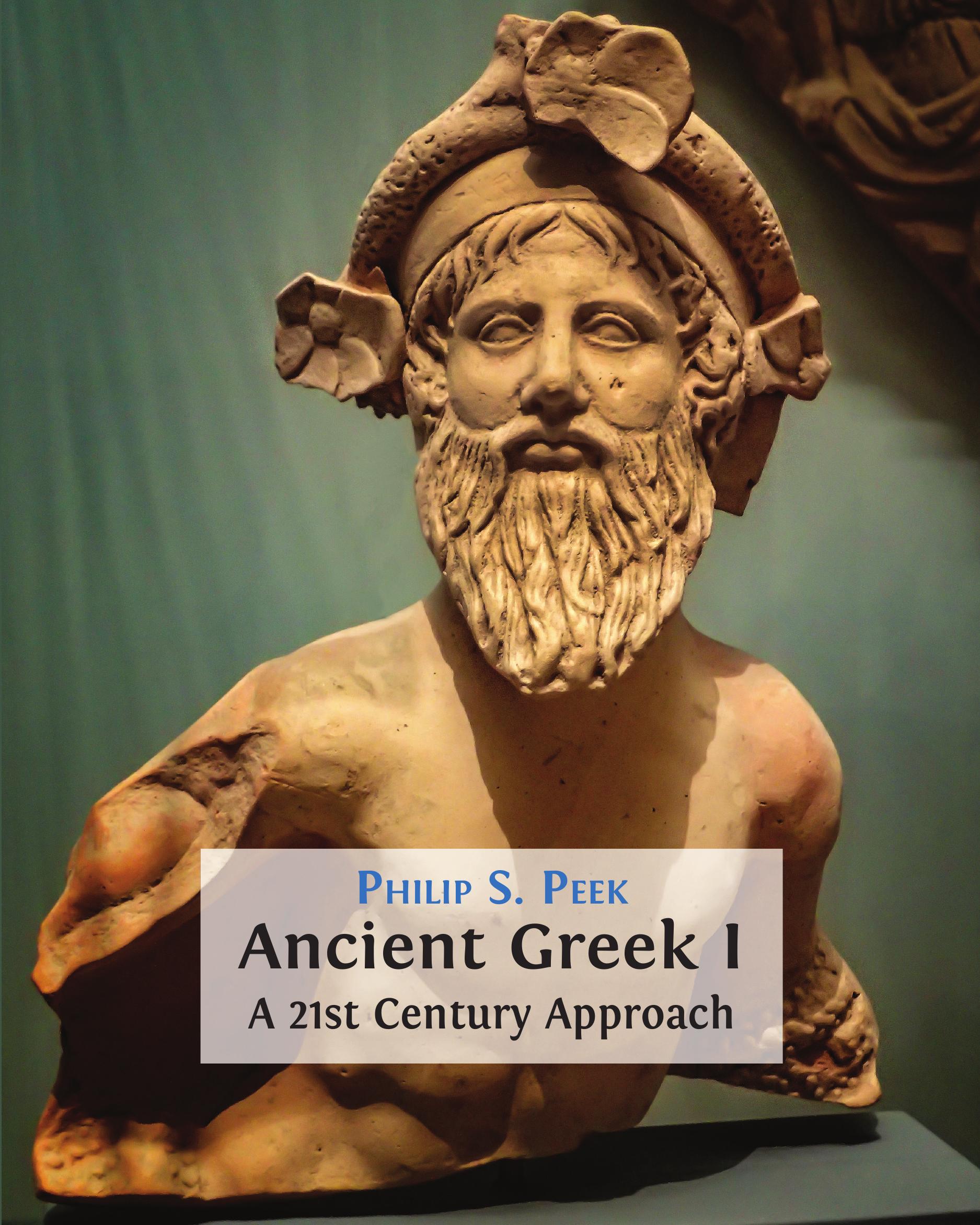
| Title | Ancient Greek I |
|---|---|
| Subtitle | A 21st Century Approach |
| Contributor | Philip S. Peek (author) |
| DOI | https://doi.org/10.11647/OBP.0264(opens in new tab) |
| Landing page | https://www.openbookpublishers.com/books/10.11647/obp.0264(opens in new tab) |
| License | https://creativecommons.org/licenses/by/4.0/(opens in new tab) |
| Copyright | Philip S. Peek |
| Publisher | Open Book Publishers |
| Publication place | Cambridge, UK |
| Published on | 2021-10-19 |
| ISBN | 978-1-80064-254-6 (Paperback) |
| 978-1-80064-255-3 (Hardback) | |
| 978-1-80064-256-0 (PDF) | |
| 978-1-80064-655-1 (HTML) | |
| 978-1-80064-259-1 (XML) | |
| 978-1-80064-257-7 (EPUB) | |
| 978-1-80064-258-4 (MOBI) | |
| Short abstract | In this elementary textbook, Philip S. Peek draws on his twenty-five years of teaching experience to present the ancient Greek language in an imaginative and accessible way that promotes creativity, deep learning, and diversity. |
| Long abstract | In this elementary textbook, Philip S. Peek draws on his twenty-five years of teaching experience to present the ancient Greek language in an imaginative and accessible way that promotes creativity, deep learning, and diversity. The course is built on three pillars: memory, analysis, and logic. Readers memorize the top 250 most frequently occurring ancient Greek words, the essential word endings, the eight parts of speech, and the grammatical concepts they will most frequently encounter when reading authentic ancient texts. Analysis and logic exercises enable the translation and parsing of genuine ancient Greek sentences, with compelling reading selections in English and in Greek offering starting points for contemplation, debate, and reflection. A series of embedded Learning Tips help teachers and students to think in practical and imaginative ways about how they learn. This combination of memory-based learning and concept- and skill-based learning gradually builds the confidence of the reader, teaching them how to learn by guiding them from a familiarity with the basics to proficiency in reading this beautiful language. Ancient Greek I: A 21st-Century Approach is written for high-school and university students, but is an instructive and rewarding text for anyone who wishes to learn ancient Greek. |
| Print length | 638 pages (xxiv+614) |
| Language | English (Original) |
| Dimensions | 203 x 44 x 254 mm | 8" x 1.74" x 10" (Paperback) |
| 203 x 48 x 254 mm | 8" x 1.88" x 10" (Hardback) | |
| Weight | 3722g | 131.29oz (Paperback) |
| 4294g | 151.47oz (Hardback) | |
| Media | 5 illustrations |
| OCLC Number | 1277513901 |
| BIC |
|
| BISAC |
|
| LCC |
|
| Keywords |
|
| Funding |
Contents
- Philip S. Peek
- Philip S. Peek
- Philip S. Peek
- Philip S. Peek
- Philip S. Peek
- Philip S. Peek
- Philip S. Peek
- Philip S. Peek
- Philip S. Peek
- Philip S. Peek
- Philip S. Peek
- Philip S. Peek
- Philip S. Peek
- Philip S. Peek
- Philip S. Peek
- Philip S. Peek
- Philip S. Peek
- Philip S. Peek
- Philip S. Peek
- Philip S. Peek
- Philip S. Peek
- Philip S. Peek
- Philip S. Peek
- Philip S. Peek
- Philip S. Peek
- Philip S. Peek
- Philip S. Peek
- Philip S. Peek
- Philip S. Peek
- Philip S. Peek
- Philip S. Peek
- Philip S. Peek
- Philip S. Peek
- Philip S. Peek
- Philip S. Peek
- Philip S. Peek
- Philip S. Peek
- Philip S. Peek
- Philip S. Peek
- Philip S. Peek
- Philip S. Peek
Contributors
Philip S. Peek
(author)Philip S. Peek is Distinguished Teaching Professor of Classics at Bowling Green State University, where he teaches Ancient Greek, Latin, and Classical Civilization. He is interested in the stories we tell ourselves, those we tell each other, and how we interpret those told to us. He believes in many truths and many fictions and is amazed by how the false and true interact with each other. He is fascinated by creativity, translation, and the process of creating a dialogue between different cultures and time periods. He has published a two volume elementary textbook on how to read and interpret Ancient Greek (Open Book Publishers, 2021, https://www.openbookpublishers.com/books/10.11647/obp.0264(opens in new tab) and 2024) and a textual commentary on book five of Herodotos’ Histories (U of O Press, 2018). He also has published in METAMORPHOSES three translations, the Alexis poem by Meleagros of Gadara (2019 Fall), Anakreon’s Thracian Filly poem (Spring 2020), and Meleagros’ poem, To A Bee (Spring 2020). He enjoys researching, teaching, translating, and writing about all things ancient Greek. When not at work, he may be found outside hiking, meditating, and enjoying the sounds of the multi-verse.