
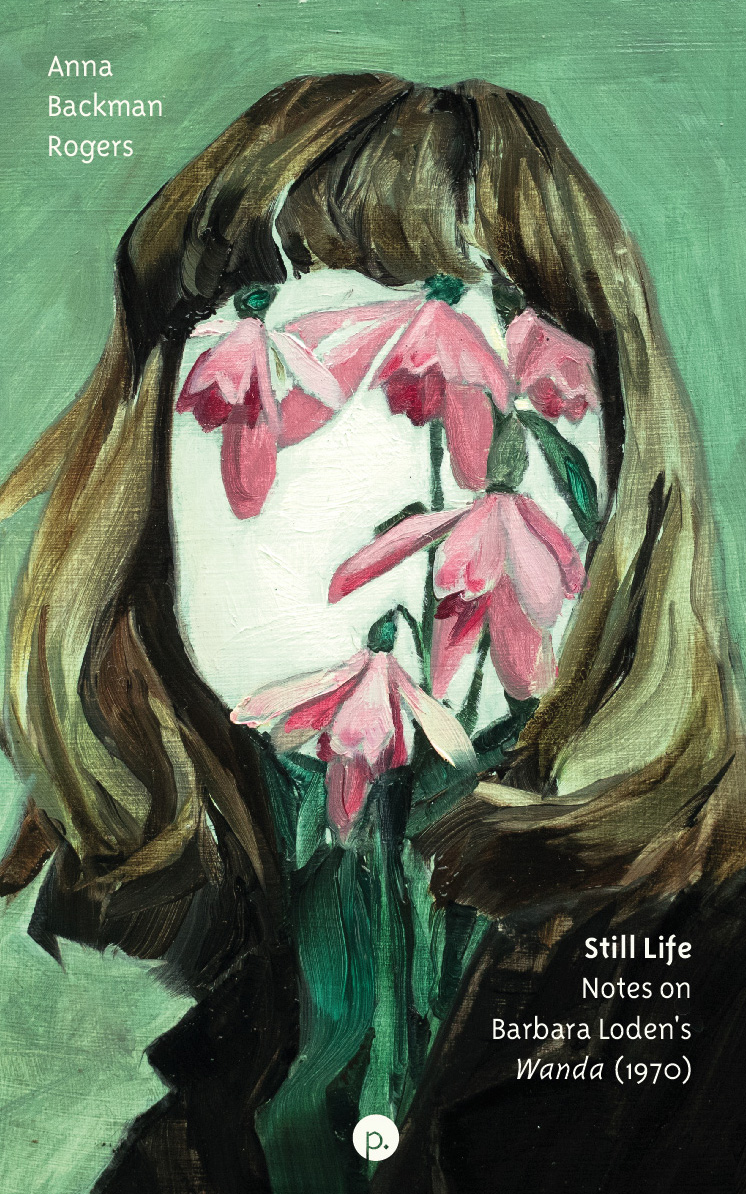
| Title | Still Life |
|---|---|
| Subtitle | Notes on Barbara Loden's "Wanda" (1970) |
| Contributor | Anna Backman Rogers(opens in new tab)(author) |
| DOI | https://doi.org/10.53288/0326.1.00(opens in new tab) |
| Landing page | https://punctumbooks.com/titles/still-life-notes-on-barbara-lodens-wanda-1970/(opens in new tab) |
| License | https://creativecommons.org/licenses/by-nc-sa/4.0/(opens in new tab) |
| Copyright | Backman Rogers, Anna (0000-0003-4909-7221) |
| Publisher | punctum books |
| Publication place | Earth, Milky Way |
| Published on | 2021-07-29 |
| ISBN | 978-1-953035-68-4 (Paperback) |
| 978-1-953035-69-1 (PDF) | |
| Long abstract | There is indeed a “miracle” in the 1970 film Wanda. This film has survived, despite decades of neglect, to emerge into the fuliginous light of an era that may just be ready to strain at grasping its harsh and brutal truths—truths that reveal the imbrication of the psychic in the social and the experiential in political structures. Barbara Loden’s film dares to suggest that the social and ethical functions of art should not necessarily be redemptive—that salvation is a cheap and spurious form of consolation that few can afford in this world. This film, made by a woman who knew all too well what it means to be defined through and by her material circumstances (and her relationships to men), and that is so relentlessly ferocious in its refusal to assuage and comfort the viewer, has always been a form of future feminism. Wanda does not brook the comforts of positivity, of aspiration, or even the luxury of selfhood. Loden’s film, Still Life contends, is so radical in its feminist-anti-capitalist politics of refusal that we are still struggling to keep up with it. It delineates precisely how the personal is political and why this matters now more than ever. Wanda, a film about a woman who refuses to be saved or to save herself, who lacks the means and energy to alter anything in her life, who lives in a permanent state of blockage, impasse and failure is, as this book suggests, the film of our contemporary moment. |
| Print length | 154 pages |
| Language | English (Original) |
| Dimensions | 127 x 203 mm | 5" x 8" (Paperback) |
| LCCN | 2021941494 |
| THEMA |
|
| BIC |
|
| BISAC |
|
| Keywords |
|
Contributors
Anna Backman Rogers
(author)Anna Backman Rogers is the author of American Independent Cinema: Rites of Passage and the Crisis-Image (Oxford, 2015) and Sofia Coppola: The Politics of Visual Pleasure (Berghahn, 2019). She is the co-founder and editor-in-chief of the open-access, online academic journal MAI: FEMINISM AND VISUAL CULTURE(opens in new tab), and teaches at the University of Gothenburg, Sweden.