
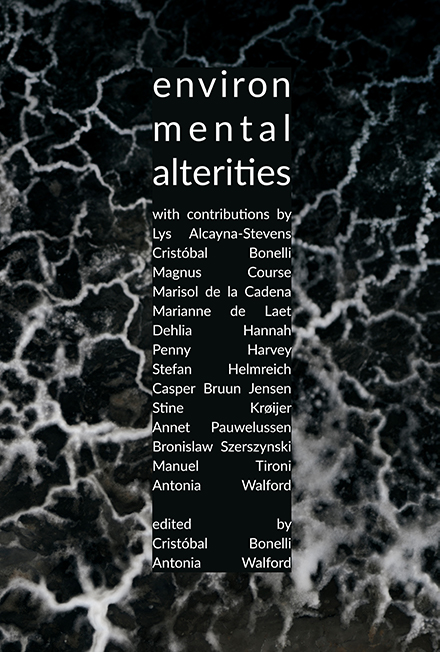
| Title | Environmental Alterities |
|---|---|
| Contributor | Cristóbal Bonelli(opens in new tab)(editor) |
| Antonia Walford (editor) | |
| DOI | https://doi.org/10.28938/9781912729142(opens in new tab) |
| Landing page | https://www.matteringpress.org/books/environmental-alterities(opens in new tab) |
| License | http://creativecommons.org/licenses/by-nc-sa/4.0/(opens in new tab) |
| Copyright | Cristóbal Bonelli; Antonia Walford |
| Publisher | Mattering Press |
| Publication place | Manchester, UK |
| Published on | 2021-10-06 |
| ISBN | 978-1-912729-14-2 (Paperback) |
| 978-1-912729-15-9 (PDF) | |
| 978-1-912729-17-3 (HTML) | |
| 978-1-912729-16-6 (EPUB) | |
| Short abstract | In the context of accelerating environmental crises and exhausted intellectual paradigms, this book asks what comes after ‘after nature’. Instead of demanding new models and approaches, it invites its readers to look to the endpoints and failures of what is already known, in order to generate alternative forms of ethical engagement with worlds both on this planet, and beyond it. Drawing together scholarship from across science and technology studies, philosophy, and anthropology and bringing it into conversation with rich ethnographic and empirical material, the book asks how we might potentialise the contradictions and oppositions of critical social scientific thinking in order to develop a mode of paradoxical engagement that is in constant movement between knowledge and its edges, practices and their limits, and which allows us to relate to that which is excessive to relations and relationality. |
| Long abstract | In the context of accelerating environmental crises and exhausted intellectual paradigms, this book asks what comes after ‘after nature’. Instead of demanding new models and approaches, it invites its readers to look to the endpoints and failures of what is already known, in order to generate alternative forms of ethical engagement with worlds both on this planet, and beyond it. Drawing together scholarship from across science and technology studies, philosophy, and anthropology and bringing it into conversation with rich ethnographic and empirical material, the book asks how we might potentialise the contradictions and oppositions of critical social scientific thinking in order to develop a mode of paradoxical engagement that is in constant movement between knowledge and its edges, practices and their limits, and which allows us to relate to that which is excessive to relations and relationality. The chapters in the book range across very different empirical settings and communities of people, from fishermen in the Scottish seas, the sea folk of Indonesian archipelagos, indigenous peoples in forests in Lowland Ecuador, primatologists in the jungle of DR Congo, the personal and domestic space of living with dogs and the cosmological scale of planetary interactions. Each chapter explores different modes of environmental relationality and alterity by grappling with the spaces in-between – the contradictions, uncertainties, limits, excesses and liminalities which make up people’s everyday relations with their environments. The chapters are accompanied by in-depth conversations between scholars who frankly discuss the proposals of the book and the arguments of each chapter, with a view to inviting further reflection and discussion amongst the book’s readers. As the chapters and conversations in this book show, admitting that we still do not know what the environment is, even in times of crisis, can be a form of hopeful, humble environmental politics. |
| Print length | 248 pages |
| Language | English (Original) |
| Dimensions | 152 x 229 mm | 5.98" x 9.02" (Paperback) |
| Media | 3 illustrations |
| BISAC |
|
| Keywords |
|
Contents
- Magnus Course
- Annet Pauwelussen
- Penny Harvey
- Stefan Helmreich
- Stine Krøijer
- Lys Alcayna-Stevens
- Marisol de la Cadena
- Casper Bruun Jensen
- Marianne de Laet
- Bronislaw Szerszynski
- Dehlia Hannah
- Manuel Tironi