
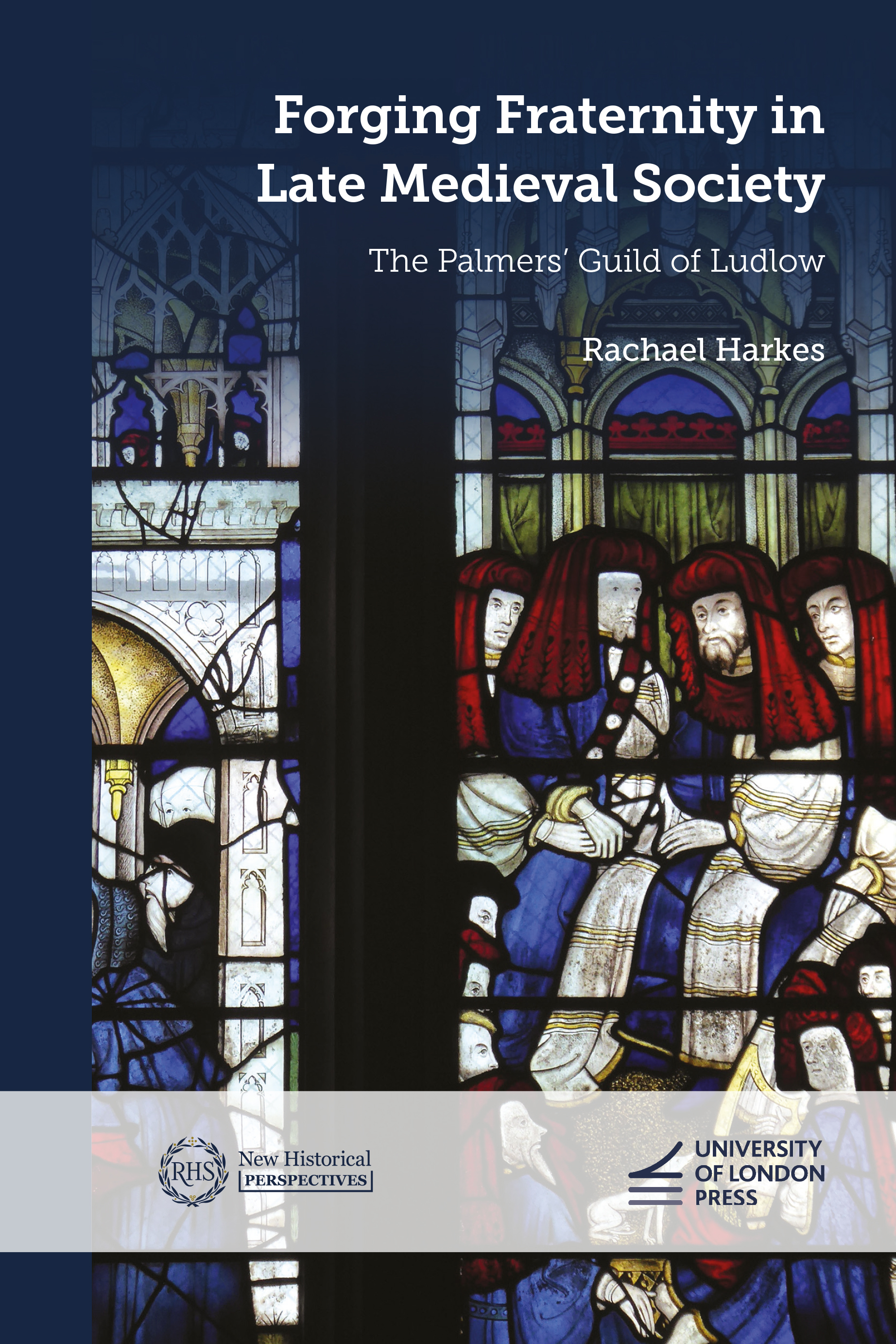
| Title | Forging Fraternity in Late Medieval Society |
|---|---|
| Subtitle | The Palmers' Guild of Ludlow |
| Contributor | Rachael Harkes(opens in new tab)(author) |
| DOI | https://doi.org/10.63674/ssgx3409(opens in new tab) |
| Landing page | https://uolpress.co.uk/book/forging-fraternity-in-late-medieval-society/(opens in new tab) |
| License | https://creativecommons.org/licenses/by-nc-nd/4.0/(opens in new tab) |
| Copyright | Rachael Harkes |
| Publisher | University of London Press |
| Publication place | London, GB |
| Published on | 2025-11-06 |
| Series |
|
| ISBN | 978-1-908590-67-1 (Paperback) |
| 978-1-908590-66-4 (Hardback) | |
| 978-1-908590-68-8 (PDF) | |
| Short abstract | Departing from traditional guild studies, Forging Fraternity crosses conventional historiographical boundaries to reconceptualise guild membership as both a structure for complex social relations and identities. With over 18,000 members recorded in the guild’s massive extant archive, the Palmers offer a unique opportunity to investigate the interplay between institutions and individuals in the Middle Ages. |
| Long abstract | The untold story of how a medieval guild united the worlds of commerce and religion and changed local life and international influence on the eve of the Reformation. Forging Fraternity in Late Medieval Society is an ambitious and innovative study of the social, political and religious histories of medieval England and Wales. Using the Palmers’ Guild of Ludlow as a prism, it sets out to consider the almost ubiquitous membership of religious guilds in both urban and rural society on the eve of the Reformation. With over 18,000 members recorded in the guild’s massive extant archive, drawn from across the social spectrum and spread throughout Wales, England, Iberia, Ireland and France, the Palmers offer a unique opportunity to investigate the interplay between institutions and individuals in the Middle Ages. Why did thousands of men and women join this particular organization in the fifteenth and sixteenth centuries? What influenced people’s decision to become a member, how can we reconstruct these decisions from surviving documents, and what do they reveal about the communities that made up late medieval society? By posing these questions, this book charts individual and collective experiences, reconstructing the life-stages, political circumstances, and social pressures incumbent on individuals as they engaged in a moral and fiscal commitment to a guild. Departing from traditional guild studies, Forging Fraternity crosses conventional historiographical boundaries to reconceptualise guild membership as both a structure for and mirror of complex social relations and identities, demonstrating with ingenuity how medieval sources can be put to use in unconventional ways. |
| Language | English (Original) |
| Dimensions | 156 x 234 mm | 6.14" x 9.21" (Paperback) |
| 160 x 240 mm | 6.31" x 9.44" (Hardback) | |
| Media | 21 illustrations |
| THEMA |
|
| BIC |
|
| BISAC |
|
| Keywords |
|
Contributors
Rachael Harkes
(author)Rachael Harkes is currently a Postdoctoral Research Associate at the University of Bristol on the ERC Advanced Grant/UKRI project 'Mapping the Medieval March: Wales and England, c. 1282–1550'. Her research focuses on processes of decision-making in medieval society, with a specific interest in border regions and digital humanities.