
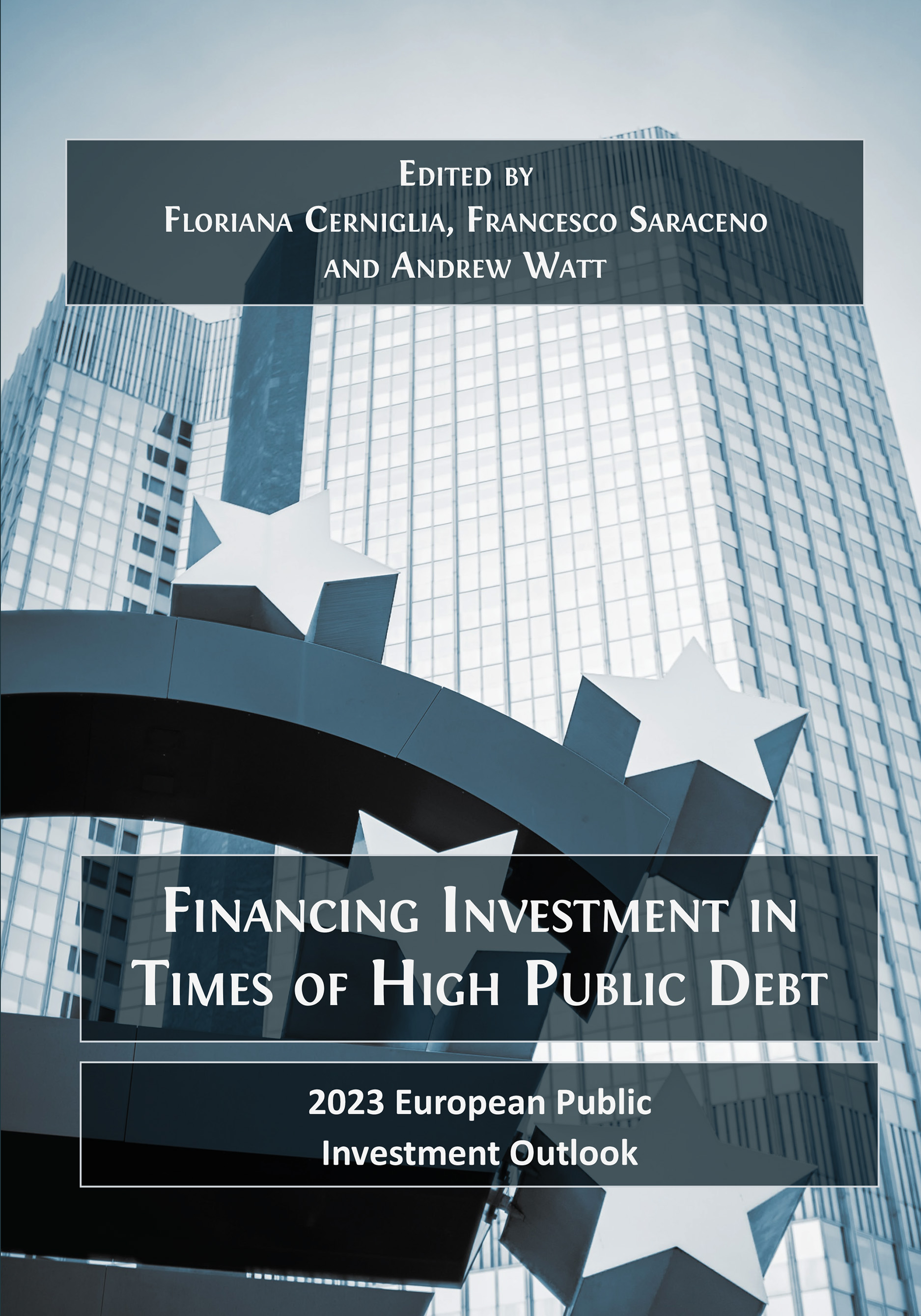
| Title | Financing Investment in Times of High Public Debt |
|---|---|
| Subtitle | 2023 European Public Investment Outlook |
| Contributor | Floriana Cerniglia(opens in new tab)(editor) |
| Francesco Saraceno(opens in new tab)(editor) | |
| Andrew Watt (editor) | |
| DOI | https://doi.org/10.11647/OBP.0386(opens in new tab) |
| Landing page | https://www.openbookpublishers.com/books/10.11647/OBP.0386(opens in new tab) |
| License | http://creativecommons.org/licenses/by-nc/4.0/(opens in new tab) |
| Copyright | Floriana Cerniglia; Francesco Saraceno; Andrew Watt |
| Publisher | Open Book Publishers |
| Publication place | Cambridge, UK |
| Published on | 2023-12-12 |
| Series |
|
| ISBN | 978-1-80511-200-6 (Paperback) |
| 978-1-80511-201-3 (Hardback) | |
| 978-1-80511-202-0 (PDF) | |
| 978-1-80511-205-1 (HTML) | |
| 978-1-80511-204-4 (XML) | |
| 978-1-80511-203-7 (EPUB) | |
| Short abstract | The fourth book in the ‘European Public Investment Outlook’ series focuses on the urgent issue of how to finance needed investment in critical tangible and intangible infrastructure given high levels of public debt, a thorny problem facing many governments across Europe. Drawing on expertise from academics, researchers at public policy institutes and international governance bodies, the contributors analyse the current situation and prospects and propose feasible solutions. |
| Long abstract | The fourth book in the ‘European Public Investment Outlook’ series focuses on the urgent issue of how to finance needed investment in critical tangible and intangible infrastructure given high levels of public debt, a thorny problem facing many governments across Europe. Drawing on expertise from academics, researchers at public policy institutes and international governance bodies, the contributors analyse the current situation and prospects and propose feasible solutions. Financing Investment in Times of High Public Debt offers a powerful combination of high-level analysis of cross-continental policies and trends, with close examination of specific contexts in France, Italy, Germany and Spain. The chapters in Part II explore challenges including how to finance climate investments, the extent to which national promotional banks can offer solutions, EU budget reform and recent trends in tax progressivity. This book is essential reading for economists, policymakers, and anyone interested in implementing and financing public policy in Europe and wanting to better understand the intricacies of EU governance and institutions. |
| Print length | 248 pages (xiv+234) |
| Language | English (Original) |
| Dimensions | 178 x 18 x 254 mm | 7.01" x 0.71" x 10" (Paperback) |
| 178 x 21 x 254 mm | 7.01" x 0.83" x 10" (Hardback) | |
| Weight | 614g | 21.66oz (Paperback) |
| 802g | 28.29oz (Hardback) | |
| Media | 52 illustrations |
| 17 tables | |
| OCLC Number | 1414210799 |
| LCCN | 2022361257 |
| THEMA |
|
| BIC |
|
| BISAC |
|
| LCC |
|
| Keywords |
|
Contents
- Introduction
- Floriana Cerniglia
- Francesco Saraceno
- Andrew Watt
- Europe
- Andrea Brasili
- Atanas Kolev
- Debora Revoltella
- Jochen Schantz
- Annamaria Tueske
- Financing Public Investment in France
- Mathieu Plane
- Francesco Saraceno
- Germany Lacks Political Will to Finance Needed Public-Investment Boost
- Katja Rietzler
- Andrew Watt
- Ekaterina Juergens
- Italy’s Public Investments: The NRRP and Beyond
- Giovanni Barbieri
- Floriana Cerniglia
- Enzo Dia
- Public Investment, Deficit and Public Debt in Spain, 1995–2022
- Francisco Perez
- Eva Benages
- Escaping Fragmentation and Secular Stagnation: The EU Policy Mix and Investment Financing
- Pier Carlo Padoan
- From Crisis to Crisis, Can Europe Count on National Promotional Banks as Silver Bullets?
- Laurent Zylberberg
- Making Green Public Investments a Reality in the EU Fiscal Framework and the EU Budget
- Atanas Pekanov
- Margit Schratzenstaller-Altzinger
- Financing Climate Investment in the EU: The Role of Monetary and Financial Policies
- Yannis Dafermos
- Maria Nikolaidi
- In Search of Lost Time: An Ensemble of Policies to Restore Fiscal Progressivity and Address the Climate Challenge
- Demetrio Guzzardi
- Elisa Palagi
- Tommaso Faccio
- Andrea Roventini
- European Public Goods
- Marco Buti
- Alessandro Coloccia
- Marcello Messori
- Options for a Permanent EU Sovereign Fund: Meeting the Climate-Investment Challenge and Promoting Macroeconomic Stability
- Phillip Heimberger
- Andreas Lichtenberger
Contributors
Floriana Cerniglia
(editor)Floriana Cerniglia is a full professor of Economics at Università Cattolica del Sacro Cuore (Milan) and Director of CRANEC (Centro di ricerche in analisi economica e sviluppo economico internazionale). She is the Co-Editor-in-Chief of EconomiaPolitica, Journal of Analytical and Institutional Economics. She received her PhD from the University of Warwick (UK) and her research interests are in Public Economics and in macroeconomic policies. She has published in leading international journals and she has coordinated and participated in a number of peer-reviewed research projects.
Francesco Saraceno
(editor)Francesco Saraceno is Deputy Department Director at OFCE, the research centre in economics at Sciences Po in Paris. He holds PhDs in Economics from Columbia University and the Sapienza University of Rome. His research focuses on the relationship between inequality, macroeconomic performance, and European macroeconomic policies. From 2000 to 2002, he was a member of the Council of Economic Advisors for the Italian Prime Minister’s Office. He teaches international and European macroeconomics at Sciences Po, where he manages the Economics concentration of the Master’s in European Affairs, and at Luiss in Rome. He is Academic Director of the Sciences Po-Northwestern European Affairs Program. He advises the International Labour Organisation (ILO) on macroeconomic policies for employment and participates in IMF training programmes on fiscal policy.
Andrew Watt
(editor)Andrew Watt is Head of the Unit of European Economic Policy at the Macroeconomic Policy Institute (IMK), part of the Hans-Böckler Foundation. He holds a PhD from the University of Hamburg. His main research fields are European economic and employment policy and comparative political economy, with a particular interest in the interaction between wage-setting and macroeconomic policy. Recent work has focused on reform of the economic governance of the euro area, emphasising the need to coordinate monetary, fiscal, and wage policy in order to achieve balanced growth and favourable employment outcomes. He has served as advisor to numerous European and national institutions, including the European Commission, the European Economic and Social Committee, and Eurofound.