
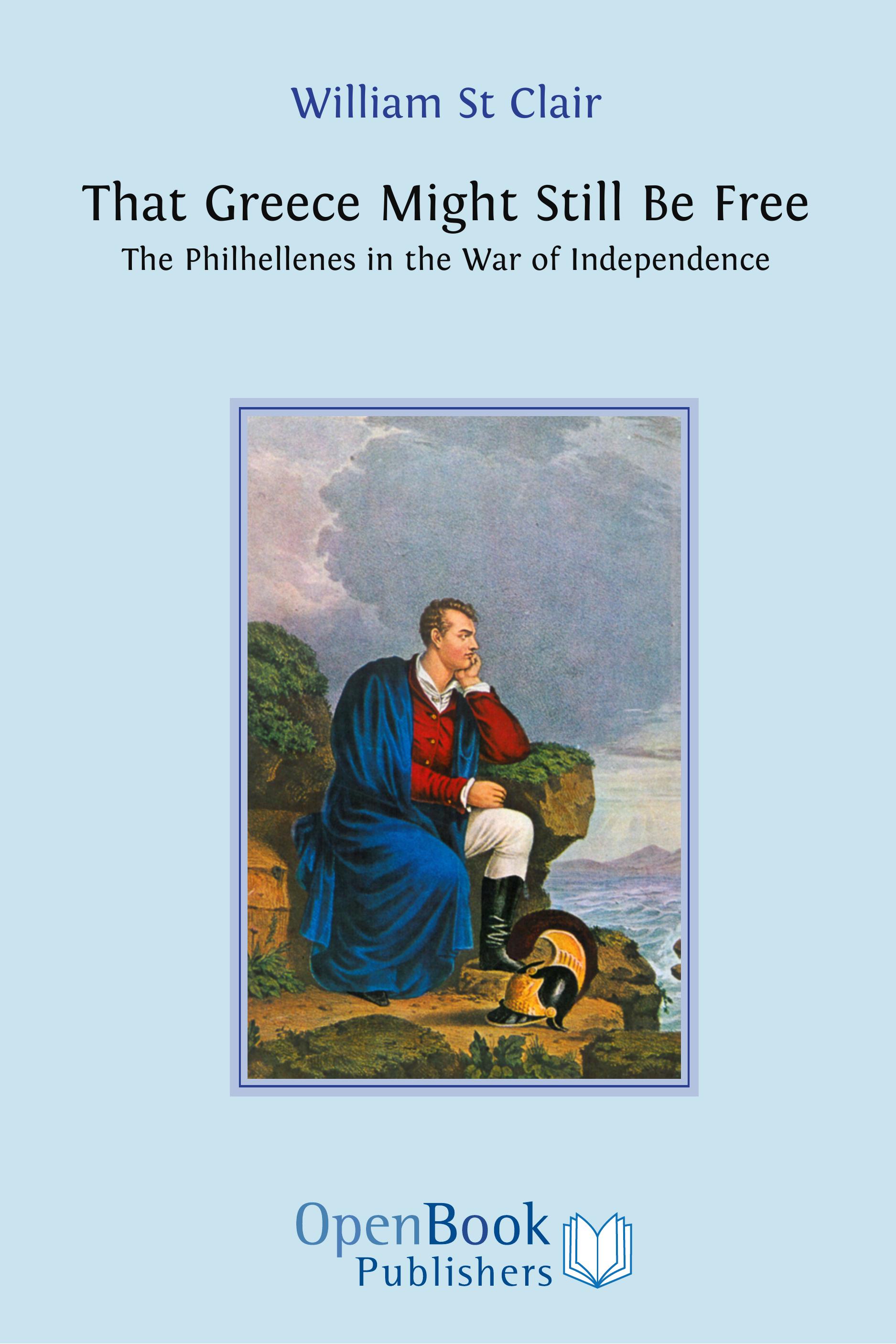
| Title | That Greece Might Still Be Free |
|---|---|
| Subtitle | The Philhellenes in the War of Independence |
| Contributor | William St Clair (author) |
| DOI | https://doi.org/10.11647/OBP.0001(opens in new tab) |
| Landing page | https://www.openbookpublishers.com/books/10.11647/obp.0001(opens in new tab) |
| License | http://creativecommons.org/licenses/by-nc-nd/2.0/(opens in new tab) |
| Copyright | William St Clair |
| Publisher | Open Book Publishers |
| Publication place | Cambridge, UK |
| Published on | 2008-11-01 |
| ISBN | 978-1-906924-00-3 (Paperback) |
| 978-1-906924-01-0 (Hardback) | |
| 978-1-906924-02-7 (PDF) | |
| 978-1-80064-428-1 (HTML) | |
| 978-1-906924-02-7 (EPUB) | |
| 978-1-906924-02-7 (MOBI) | |
| Short abstract | When in 1821, the Greeks rose in violent revolution against Ottoman rule, waves of sympathy spread across western Europe and the USA. Inspired by a belief that Greece had a unique claim on the sympathy of the world, more than a thousand Philhellenes set out to fight for the cause. This meticulously researched and highly readable account of their aspirations and experiences has long been the standard account of the Philhellenic movement and essential reading for students of the Greek War of Independence, Byron and European Romanticism. Its relevance to more modern conflicts is also becoming increasingly appreciated. |
| Long abstract | When in 1821, the Greeks rose in violent revolution against the rule of the Ottoman Turks, waves of sympathy spread across Western Europe and the United States. More than a thousand volunteers set out to fight for the cause. The Philhellenes, whether they set out to recreate the Athens of Pericles, start a new crusade, or make money out of a war, all felt that Greece had unique claim on the sympathy of the world. As Lord Byron wrote, "I dreamed that Greece might still be Free"; and he died at Missolonghi trying to translate that dream into reality. William St Clair's meticulously researched and highly readable account of their aspirations and experiences was hailed as definitive when it was first published. Long out of print, it remains the standard account of the Philhellenic movement and essential reading for any students of the Greek War of Independence, Byron, and European Romanticism. Its relevance to more modern ethnic and religious conflicts is becoming increasingly appreciated by scholars worldwide. This revised edition includes a new introduction by Roderick Beaton, an updated bibliography and many new illustrations. |
| Print length | 440 pages (xxi + 419) |
| Language | English (Original) |
| Dimensions | 156 x 25 x 234 mm | 6.14" x 0.97" x 9.21" (Paperback) |
| 156 x 27 x 234 mm | 6.14" x 1.06" x 9.21" (Hardback) | |
| Weight | 1485g | 52.38oz (Paperback) |
| 1866g | 65.82oz (Hardback) | |
| Media | 35 illustrations |
| 2 tables | |
| OCLC Number | 794698064 |
| LCCN | 2019467305 |
| BIC |
|
| BISAC |
|
| LCC |
|
| Keywords |
|
Contents
- William St Clair
- William St Clair
- William St Clair
- William St Clair
- William St Clair
- William St Clair
- William St Clair
- William St Clair
- William St Clair
- William St Clair
- William St Clair
- William St Clair
- William St Clair
- William St Clair
- William St Clair
- William St Clair
- William St Clair
- William St Clair
- William St Clair
- William St Clair
- William St Clair
- William St Clair
- William St Clair
- William St Clair
- William St Clair
- William St Clair
- William St Clair
- William St Clair
- William St Clair
- William St Clair
- William St Clair
- William St Clair
- William St Clair
- Beaton Roderick
Contributors
William St Clair
(author)William St Clair, FBA, FRSL, is Senior Research Fellow at the Institute of English Studies, School of Advanced Study, University of London, and of the Centre for History and Economics, University of Cambridge. His works include* Lord Elgin and the Marbles* and The Reading Nation in the Romantic Period.
Roderick Beaton
(introduction by)Roderick Beaton is Koraes Professor of Modern Greek and Byzantine History, Language and Literature at King’s College London.