
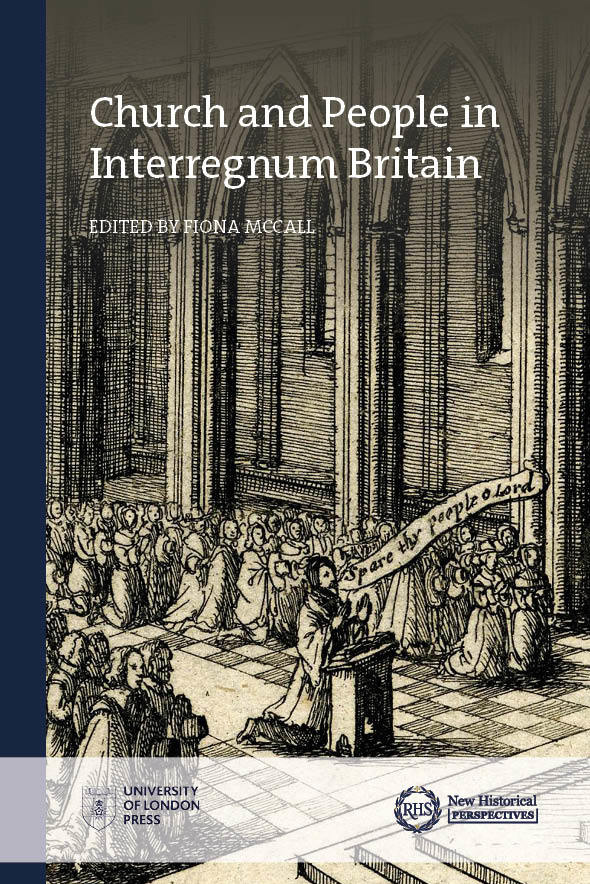
| Title | Church and People in Interregnum Britain |
|---|---|
| Contributor | Fiona McCall (editor) |
| DOI | https://doi.org/10.14296/2106.9781912702664(opens in new tab) |
| Landing page | https://uolpress.co.uk/book/church-and-people-in-interregnum-britain/(opens in new tab) |
| License | https://creativecommons.org/licenses/by-nc-nd/4.0/(opens in new tab) |
| Copyright | Authors |
| Publisher | University of London Press |
| Publication place | London, GB |
| Published on | 2021-06-23 |
| ISBN | 978-1-912702-65-7 (Paperback) |
| 978-1-912702-64-0 (Hardback) | |
| 978-1-912702-66-4 (PDF) | |
| 978-1-913002-18-3 (HTML) | |
| 978-1-912702-68-8 (EPUB) | |
| Short abstract | This volume assesses interregnum religious practice at ground level, based on a sophisticated understanding of the complex and unique pattern of record-keeping and survival from the period. In the process, we see how ever-evolving national initiatives met local spaces, local traditions and individual personal agendas. We see the tensions produced by the emergence of religious plurality in a society still yearning for social conformity under a uniform practice of religion, the forces for inclusion and exclusion, of acceptance of or estrangement from godly religion. |
| Long abstract | In 1645, as the First Civil War approached its end, a second Reformation took place which created profound dislocations in religion and in British society. The Church was disestablished, and godly puritan practices promoted in parish churches and everyday life. Some clergy and parishioners embraced change; others were horrified, experiencing these as times of madness and trouble. Historians continue to debate the extent of the social disruption that resulted, and the impact of godly ideals. With an introduction from Professor Bernard Capp, pre-eminent social historian of the period, this collection of essays assesses interregnum religious practice at ground level, based on a sophisticated understanding of the complex and unique pattern of record-keeping and survival from the period. Each chapter takes an original approach, using a specific local or institutional case study or previously under-examined source from England, Scotland or Wales. In the process, we see how ever-evolving national initiatives met local spaces, local traditions and individual personal agendas. We see the tensions produced by the emergence of religious plurality in a society still yearning for social conformity under a uniform practice of religion, the forces for inclusion and exclusion, of acceptance of or estrangement from godly religion. |
| Print length | 300 pages |
| Language | English (Original) |
| Dimensions | 234 x 156 mm | 9.19" x 6.13" (Paperback) |
| 163 x 245 mm | 6.44" x 9.63" (Hardback) | |
| Media | 27 illustrations |
| THEMA |
|
| BIC |
|
| BISAC |
|
| Keywords |
|
| Funding |