
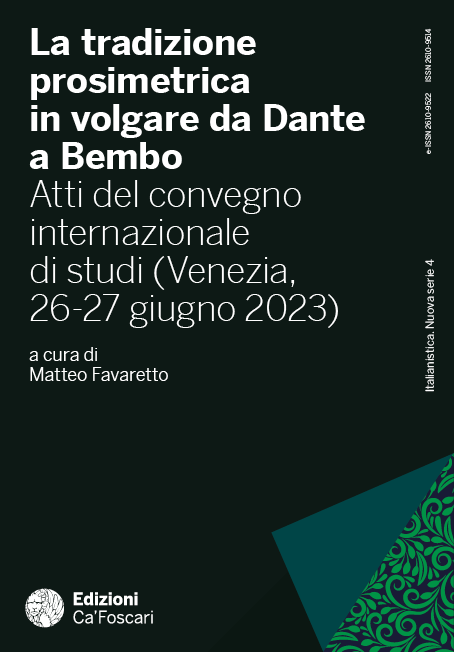
| Title | La tradizione prosimetrica in volgare da Dante a Bembo |
|---|---|
| Subtitle | Atti del convegno internazionale di studi (Venezia, 26-27 giugno 2023) |
| Contributor | Matteo Favaretto (editor) |
| DOI | https://doi.org/10.30687/978-88-6969-821-7(opens in new tab) |
| Landing page | https://edizionicafoscari.it/en/edizioni4/libri/978-88-6969-822-4/(opens in new tab) |
| License | https://creativecommons.org/licenses/by/4.0/(opens in new tab) |
| Copyright | Matteo Favaretto |
| Publisher | Edizioni Ca’ Foscari – Venice University Press |
| Publication place | Venice, Italy |
| Published on | 2024-07-17 |
| Series |
|
| ISBN | 978-88-6969-821-7 (PDF) |
| Short abstract | The present volume brings together papers given at the International Conference on the vernacular tradition of the prosimetrum from Dante to Bembo, which took place last summer at Ca’ Foscari University of Venice at the end of a Marie Sklodowska-Curie postdoctoral fellowship. The conference followed on from a seminar held at the University of Trento over twenty-five years ago; however, the focus was on the mixed texts composed in the early centuries instead of embracing the entire period of Italian literature. The bibliography on these vernacular works considered as a whole is quite limited in comparison to that on the prosimetric production in classical and medieval Latin. Further, it is difficult to establish a satisfactory definition of prosimetrum which goes beyond the etymological meaning described – with few different nuances – in both the early Artes Dictandi and in modern treatises of metrics. Dante’s Vita Nova, the first – and in many respects exceptional – example of this vernacular tradition, does not offer a suitable model for the abundant prosimetra written in the subsequent two centuries, which were characterized by a considerable variety of themes and genres. Therefore, it seemed preferable to reconsider the subject and look closely at all those texts in which the evident alternation of prose sections and poetic compositions conformed to a precise authorial intent on the basis of a relationship of mutual dependence. The papers collected here are intended to offer fresh insights into both famous and lesser-known prosimetra, written between approximately 1250 and 1500, in order to advance our understanding of this hybrid literary phenomenon. Each contributor takes a single prosimetrum focusing either on the interaction between prose and verse or any other relevant aspect, such as textual tradition and critical analysis of the poems, in line with the standard form that was used to examine the works included in the online inventory available at www.unive.it/inprov(opens in new tab). |
| Long abstract | The present volume brings together papers given at the International Conference on the vernacular tradition of the prosimetrum from Dante to Bembo, which took place last summer at Ca’ Foscari University of Venice at the end of a Marie Sklodowska-Curie postdoctoral fellowship. The conference followed on from a seminar held at the University of Trento over twenty-five years ago; however, the focus was on the mixed texts composed in the early centuries instead of embracing the entire period of Italian literature. The bibliography on these vernacular works considered as a whole is quite limited in comparison to that on the prosimetric production in classical and medieval Latin. Further, it is difficult to establish a satisfactory definition of prosimetrum which goes beyond the etymological meaning described – with few different nuances – in both the early Artes Dictandi and in modern treatises of metrics. Dante’s Vita Nova, the first – and in many respects exceptional – example of this vernacular tradition, does not offer a suitable model for the abundant prosimetra written in the subsequent two centuries, which were characterized by a considerable variety of themes and genres. Therefore, it seemed preferable to reconsider the subject and look closely at all those texts in which the evident alternation of prose sections and poetic compositions conformed to a precise authorial intent on the basis of a relationship of mutual dependence. The papers collected here are intended to offer fresh insights into both famous and lesser-known prosimetra, written between approximately 1250 and 1500, in order to advance our understanding of this hybrid literary phenomenon. Each contributor takes a single prosimetrum focusing either on the interaction between prose and verse or any other relevant aspect, such as textual tradition and critical analysis of the poems, in line with the standard form that was used to examine the works included in the online inventory available at www.unive.it/inprov(opens in new tab). |
| Language | Italian (Original) |
| THEMA |
|
| BISAC |
|
| Keywords |
|