
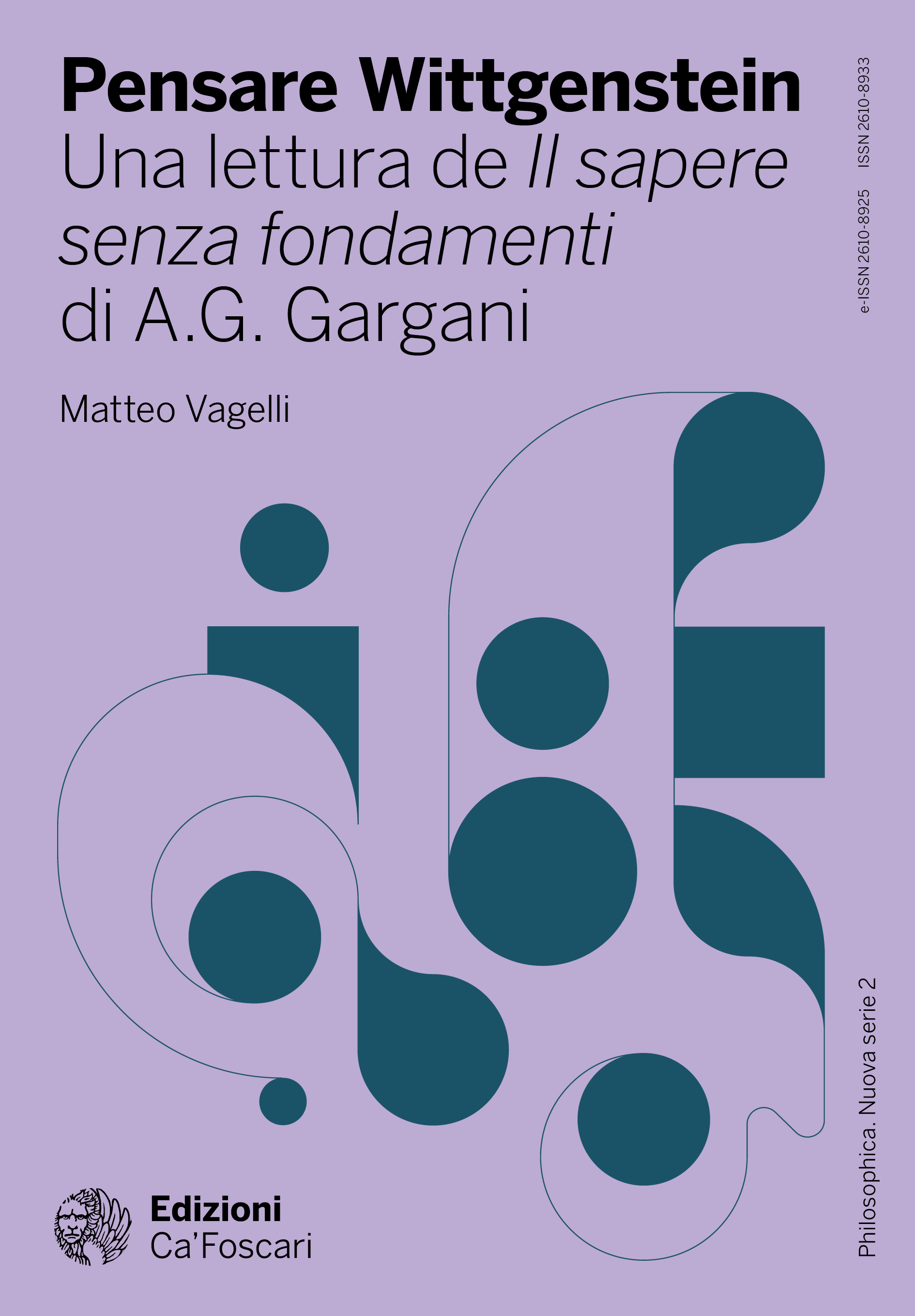
| Title | Pensare Wittgenstein |
|---|---|
| Subtitle | Una lettura de Il sapere senza fondamenti di A.G. Gargani |
| Contributor | Matteo Vagelli (author) |
| DOI | https://doi.org/10.30687/978-88-6969-798-2(opens in new tab) |
| Landing page | https://edizionicafoscari.it/en/edizioni4/libri/978-88-6969-798-2/(opens in new tab) |
| License | https://creativecommons.org/licenses/by/4.0/(opens in new tab) |
| Copyright | Matteo Vagelli |
| Publisher | Edizioni Ca’ Foscari – Venice University Press |
| Publication place | Venice, Italy |
| Published on | 2024-04-23 |
| Series |
|
| ISBN | 978-88-6969-798-2 (PDF) |
| Short abstract | Through a nuanced analysis of the 1970s intellectual landscape in Italy, this book navigates the trajectory from a materialist analysis of science rooted in Marxism towards a linguistic-epistemological approach. This transition, as envisioned through Gargani’s Il sapere senza fondamenti (1975) and Wittgenstein’s philosophy, culminates in a provocative exploration of a politically infused approach to understanding science and knowledge. Under this light, the book explores the notion of ‘political epistemology,’ delineating varied perspectives on how philosophy engages with politics and how Wittgenstein’s philosophy can be politically construed. Chapters 1 and 2 reconstruct the terms of the debate on the nature and limits of science, with a specific focus on some of the positions expressed in the Italian intellectual context of the mid-1970s. By examining various historiographical perspectives and methodological approaches, these chapters define the possibility of a historical-analytical approach to the study of science and knowledge. They do so by emphasising the novelty of Aldo Giorgio Gargani’s intervention in the debate, which aimed at reassessing the ties between science and ordinary forms of knowledge and experience avoiding both purely externalist as well as purely internalist interpretations of science. Chapter 3 retraces Gargani’s reading of science to Ludwig Wittgenstein’s philosophy of language, especially to the reflections developed by the latter in the intermediate phase between the publication of the Tractatus Logico-Philosophicus (1921) and his so-called ‘second philosophy’, as expressed in the Philosophical Investigations (1953). The genesis of an analytical methodology applicable to the historical study of scientific concepts is sought in Wittgenstein’s critical views on the phenomena of fetishism inherent to language that he developed in this intermediate phase of his life and work. In Chapter 4, different and alternative possibilities are illustrated wherein philosophy engages with politics, as well as various ways of politicising Wittgenstein’s philosophy. A resolute reading of Wittgenstein on meaning and nonsense justifies maintaining the avenue for linguistic-social critique and, consequently, political change. Thus, ‘political’ epistemology enables us to return to science and its foundational discussions with an entirely different approach and methodology. |
| Long abstract | Through a nuanced analysis of the 1970s intellectual landscape in Italy, this book navigates the trajectory from a materialist analysis of science rooted in Marxism towards a linguistic-epistemological approach. This transition, as envisioned through Gargani’s Il sapere senza fondamenti (1975) and Wittgenstein’s philosophy, culminates in a provocative exploration of a politically infused approach to understanding science and knowledge. Under this light, the book explores the notion of ‘political epistemology,’ delineating varied perspectives on how philosophy engages with politics and how Wittgenstein’s philosophy can be politically construed. Chapters 1 and 2 reconstruct the terms of the debate on the nature and limits of science, with a specific focus on some of the positions expressed in the Italian intellectual context of the mid-1970s. By examining various historiographical perspectives and methodological approaches, these chapters define the possibility of a historical-analytical approach to the study of science and knowledge. They do so by emphasising the novelty of Aldo Giorgio Gargani’s intervention in the debate, which aimed at reassessing the ties between science and ordinary forms of knowledge and experience avoiding both purely externalist as well as purely internalist interpretations of science. Chapter 3 retraces Gargani’s reading of science to Ludwig Wittgenstein’s philosophy of language, especially to the reflections developed by the latter in the intermediate phase between the publication of the Tractatus Logico-Philosophicus (1921) and his so-called ‘second philosophy’, as expressed in the Philosophical Investigations (1953). The genesis of an analytical methodology applicable to the historical study of scientific concepts is sought in Wittgenstein’s critical views on the phenomena of fetishism inherent to language that he developed in this intermediate phase of his life and work. In Chapter 4, different and alternative possibilities are illustrated wherein philosophy engages with politics, as well as various ways of politicising Wittgenstein’s philosophy. A resolute reading of Wittgenstein on meaning and nonsense justifies maintaining the avenue for linguistic-social critique and, consequently, political change. Thus, ‘political’ epistemology enables us to return to science and its foundational discussions with an entirely different approach and methodology. |
| Print length | 166 pages |
| Language | Italian (Original) |
| THEMA |
|
| BISAC |
|
| Keywords |
|