
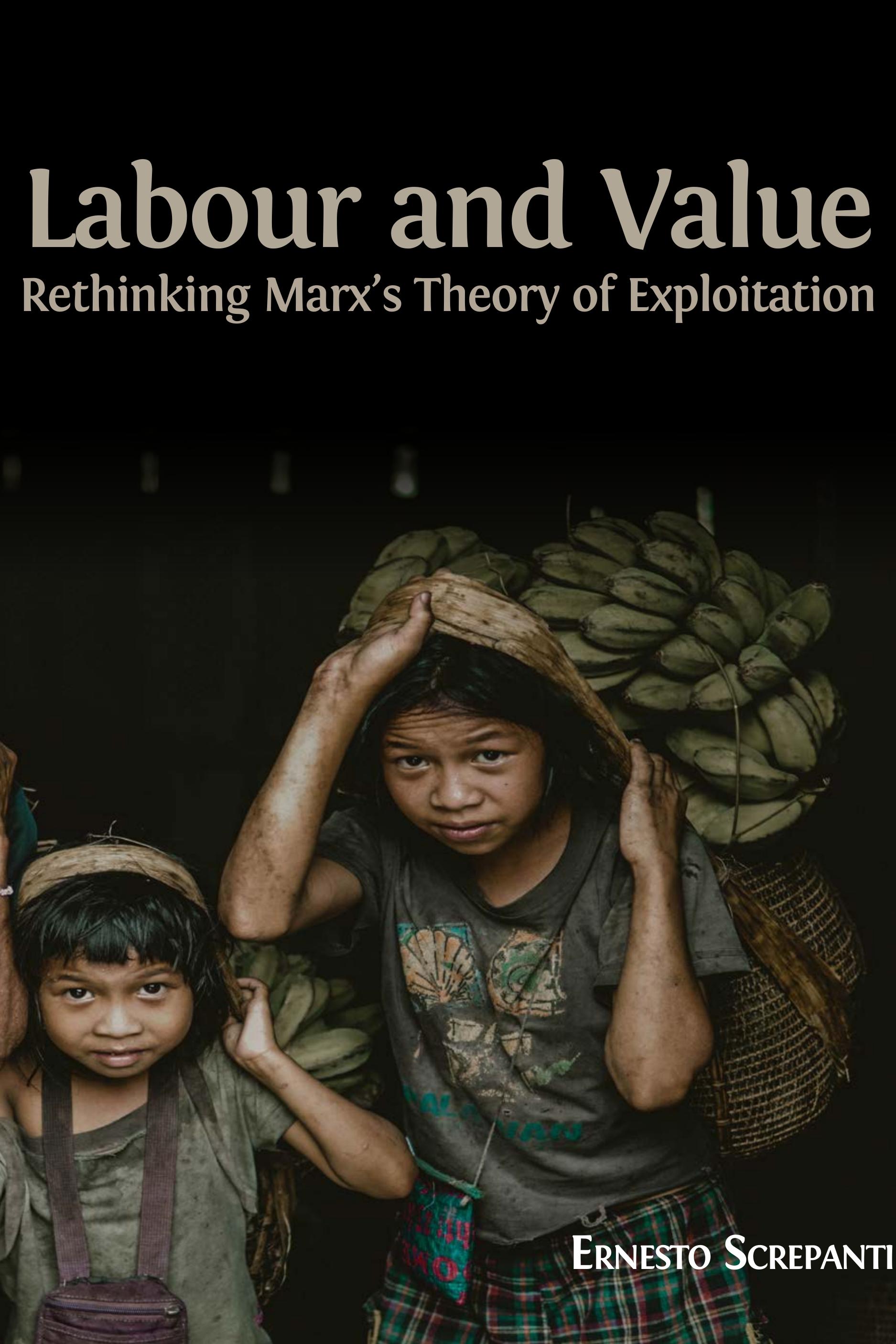
| Title | Labour and Value |
|---|---|
| Subtitle | Rethinking Marx’s Theory of Exploitation |
| Contributor | Ernesto Screpanti (author) |
| DOI | https://doi.org/10.11647/OBP.0182(opens in new tab) |
| Landing page | https://www.openbookpublishers.com/books/10.11647/obp.0182(opens in new tab) |
| License | http://creativecommons.org/licenses/by/4.0/(opens in new tab) |
| Copyright | Ernesto Screpanti |
| Publisher | Open Book Publishers |
| Publication place | Cambridge, UK |
| Published on | 2019-10-02 |
| ISBN | 978-1-78374-779-5 (Paperback) |
| 978-1-78374-780-1 (Hardback) | |
| 978-1-78374-781-8 (PDF) | |
| 978-1-80064-595-0 (HTML) | |
| 978-1-78374-784-9 (XML) | |
| 978-1-78374-782-5 (EPUB) | |
| 978-1-78374-783-2 (MOBI) | |
| Short abstract | In this book Ernesto Screpanti provides a rigorous examination of Marx’s theory of exploitation, one of the cornerstones of Marxist thought. With precision and clarity, he identifies the holes in traditional readings of Marx’s theory before advancing his own original interpretation, drawing on contemporary philosophy and economic theory to provide a refreshingly interdisciplinary exegesis. |
| Long abstract | In this book Ernesto Screpanti provides a rigorous examination of Marx’s theory of exploitation, one of the cornerstones of Marxist thought. With precision and clarity, he identifies the holes in traditional readings of Marx’s theory before advancing his own original interpretation, drawing on contemporary philosophy and economic theory to provide a refreshingly interdisciplinary exegesis. Screpanti’s arguments are delivered with perspicuity and verve: this is a book that aims to spark a debate. He exposes ambiguities present in Marx’s exposition of his own theory, especially when dealing with the employment contract and the notions of ‘abstract labor’ and ‘labor value’, and he argues that these ambiguities have given rise to misunderstandings in previous analyses of Marx’s theory of exploitation. Screpanti’s own interpretation is a meticulously argued counterpoint to these traditional interpretations. Labour and Value is a significant contribution to the theory of economics, particularly Marxist economics. It will also be of great interest to scholars in other disciplines including sociology, political science, and moral and political philosophy. Screpanti’s clear and engaging writing style will attract the interested general reader as well as the academic theorist. |
| Print length | 142 pages (viii+134) |
| Language | English (Original) |
| Dimensions | 156 x 8 x 234 mm | 6.14" x 0.31" x 9.21" (Paperback) |
| 156 x 10 x 234 mm | 6.14" x 0.38" x 9.21" (Hardback) | |
| Weight | 470g | 16.58oz (Paperback) |
| 843g | 29.74oz (Hardback) | |
| OCLC Number | 1193041473 |
| LCCN | 2019452959 |
| BIC |
|
| BISAC |
|
| LCC |
|
| Keywords |
|
Contents
- Abstract Labour as a Natural Substance
- Ernesto Screpanti
- Abstract Labour as a Historical Reality
- Ernesto Screpanti
- Labour Subsumption and Exploitation
- Ernesto Screpanti
- Values and Prices
- Ernesto Screpanti
- Measures of Exploitation
- Ernesto Screpanti
- Ernesto Screpanti
- Ernesto Screpanti
- Ernesto Screpanti
- Ernesto Screpanti