
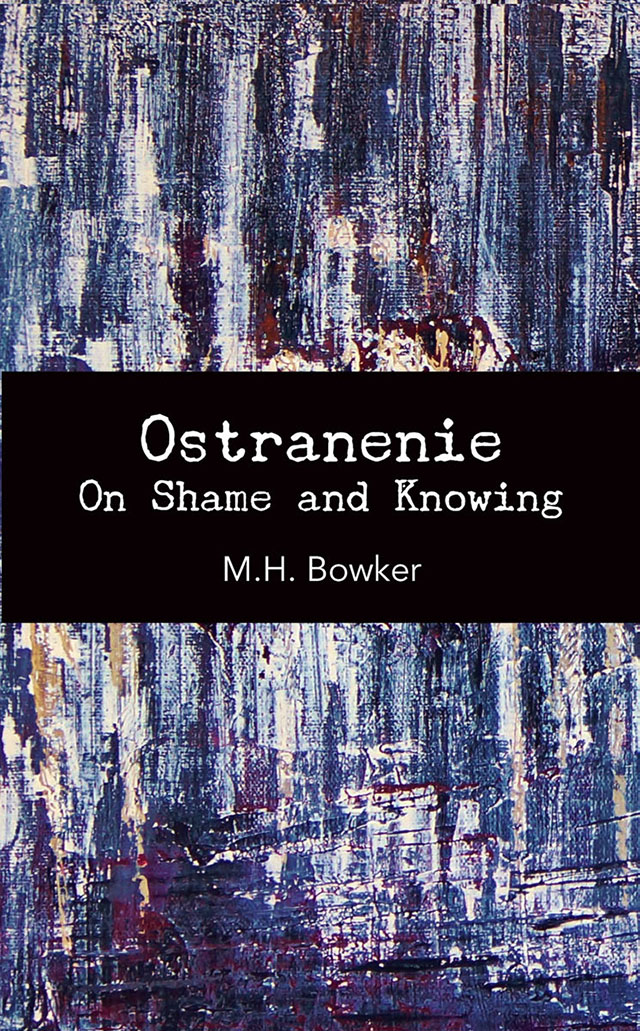
| Title | Ostranenie |
|---|---|
| Subtitle | On Shame and Knowing |
| Contributor | M.H. Bowker(opens in new tab)(author) |
| DOI | https://doi.org/10.21983/P3.0019.1.00(opens in new tab) |
| Landing page | https://punctumbooks.com/titles/ostranenie-on-shame-and-knowing/(opens in new tab) |
| License | https://creativecommons.org/licenses/by-nc-sa/3.0/(opens in new tab) |
| Copyright | Bowker, M.H. (0000-0001-5539-5589) |
| Publisher | punctum books |
| Publication place | Brooklyn, NY |
| Published on | 2012-12-24 |
| ISBN | 978-0-615-74479-7 (Paperback) |
| Long abstract | Ostranenie, the term for defamiliarization introduced by Russian writer and critic Victor Shklovsky, means, among other things, to see in strangeness. To see in strangeness is to participate in an illusion that is more real than real. It may be achieved by (re)presenting the surface as the substance, the play as the thing, or by examining (from exigere: to drive out) what is present before one’s eyes. Ultimately, ostranenie means confessing one’s complicity in making known what is known. M.H. Bowker’s Ostranenie: On Shame and Knowing is a meditation upon the moment of a mother’s death: a moment of defamiliarization in several senses. The body of the work consists of footnotes which elaborate, by exegesis, by parataxis, and sometimes by surprise, the intimate and often hidden relationships between parent and child, illusion and knowledge, shame and loss. These elaborations raise questions about the power of the familiar, the limitations of discursive thought, and the paradoxical nature of the interpersonal, political, and spiritual bargains we make for the sake of security and freedom. Ostranenie treats the personal relationship between the author and his mother in both direct and oblique ways. In a candidly unsettled examination of this relationship and its influence upon the reflections and concerns of the author, the reader is invited to experience a family, a disintegration, a psyche, and its defamiliarization, from the perspectives of both an adult and a child. |
| Print length | 50 pages |
| Language | English (Original) |
| Dimensions | 127 x 203 mm | 5" x 8" (Paperback) |
| THEMA |
|
| BIC |
|
| BISAC |
|
| Keywords |
|
Contributors
M.H. Bowker
(author)M.H. Bowker is the author of ten books — including Escargotesque, or, What is Experience? (opens in new tab) and Misinterest:(opens in new tab) Essays, Pensées, and Dreams (both published with punctum) — and numerous papers in the areas of psychoanalytic theory, social and political philosophy, literary criticism, and critical pedagogy. He is a professor at a small college in upstate New York. Educated at Columbia University and the University of Maryland, College Park, he edits the Psychoanalytic Political Theory book series at Routledge and is the (North American) Editor of the Journal of Psycho-Social Studies. He is a recent Fulbright grant recipient and has taught approximately one hundred courses in a wide array of disciplines, including Political Science, Philosophy, Psychology, English, and more.