
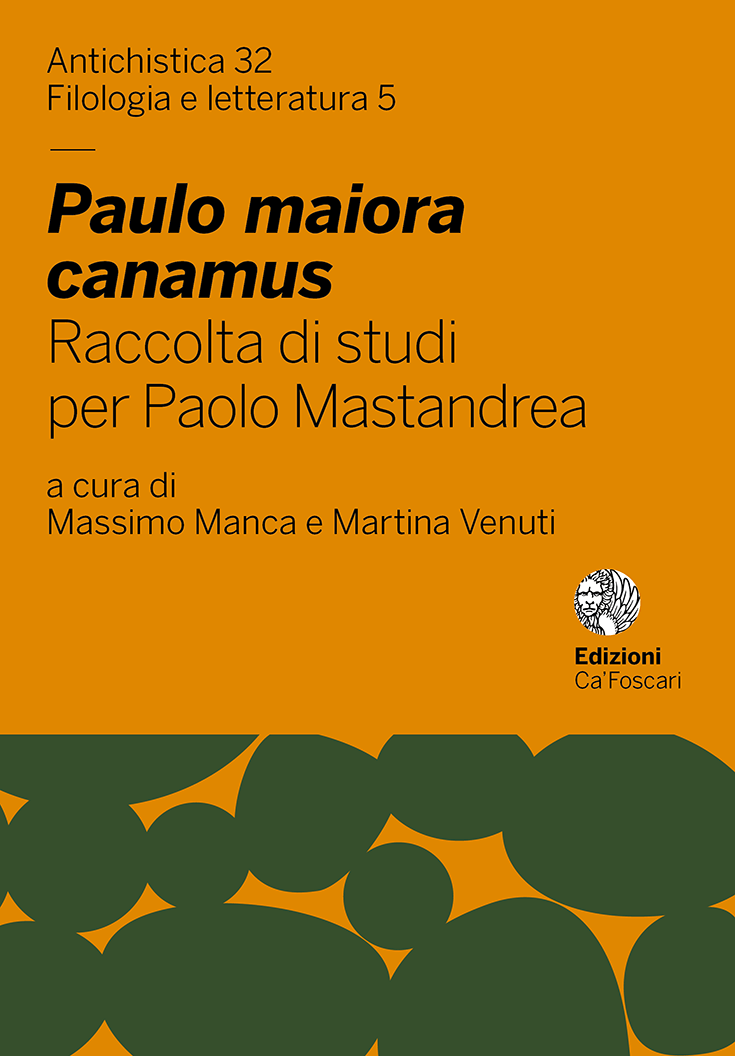
| Title | Paulo maiora canamus |
|---|---|
| Subtitle | Collection of Studies for Paolo Mastandrea |
| Contributor | Massimo Manca (editor) |
| Martina Venuti (editor) | |
| DOI | https://doi.org/10.30687/978-88-6969-557-5(opens in new tab) |
| Landing page | https://edizionicafoscari.it/en/edizioni4/libri/978-88-6969-558-2/(opens in new tab) |
| License | https://creativecommons.org/licenses/by/4.0/(opens in new tab) |
| Copyright | Martina Venuti, Massimo Manca |
| Publisher | Edizioni Ca’ Foscari – Venice University Press |
| Publication place | Venice, Italy |
| Published on | 2021-12-14 |
| Series |
|
| ISBN | 978-88-6969-557-5 (Paperback) |
| 978-88-6969-557-5 (PDF) | |
| Short abstract | This miscellaneous volume in honour of Paolo Mastandrea includes contributions by colleagues and friends dealing with some of the main topics of his scientific interests: intertextuality, late Latin studies, philological problems, the legacy of Classics in Renaissance, digital humanities. The first section, «Literary History and Intertextuality», focuses on special patterns in Latin literature within a very wide chronological range, from Vergil to Optatianus. Specific attention is dedicated to elegy and to mythological characters in elegy and tragedy. The section named «Philological Notes» deals with critical problems within texts by Sallustius, Macrobius and Historia Augusta. The following section, «Late Latin studies», is dedicated to several authors and topics: Simphosius’ Aenigmata, Sidonius, Historia Augusta, Claudianus, Epigrammata Bobiensia, Johannes Lydus and literary topoi used in late Latin texts. The final one, «Classical Reception Studies», examines a few examples of the legacy of Latin authors in the Italian Renaissance. A history of the database Musisque Deoque, along with the future perspectives of this crucial project designed in 2005 by Paolo Mastandrea, are provided in a specific «Appendix». |
| Long abstract | This miscellaneous volume in honour of Paolo Mastandrea includes contributions by colleagues and friends dealing with some of the main topics of his scientific interests: intertextuality, late Latin studies, philological problems, the legacy of Classics in Renaissance, digital humanities. The first section, «Literary History and Intertextuality», focuses on special patterns in Latin literature within a very wide chronological range, from Vergil to Optatianus. Specific attention is dedicated to elegy and to mythological characters in elegy and tragedy. The section named «Philological Notes» deals with critical problems within texts by Sallustius, Macrobius and Historia Augusta. The following section, «Late Latin studies», is dedicated to several authors and topics: Simphosius’ Aenigmata, Sidonius, Historia Augusta, Claudianus, Epigrammata Bobiensia, Johannes Lydus and literary topoi used in late Latin texts. The final one, «Classical Reception Studies», examines a few examples of the legacy of Latin authors in the Italian Renaissance. A history of the database Musisque Deoque, along with the future perspectives of this crucial project designed in 2005 by Paolo Mastandrea, are provided in a specific «Appendix». |
| Print length | 424 pages |
| Language | Italian (Original) |
| THEMA |
|
| BISAC |
|
| Keywords |
|