
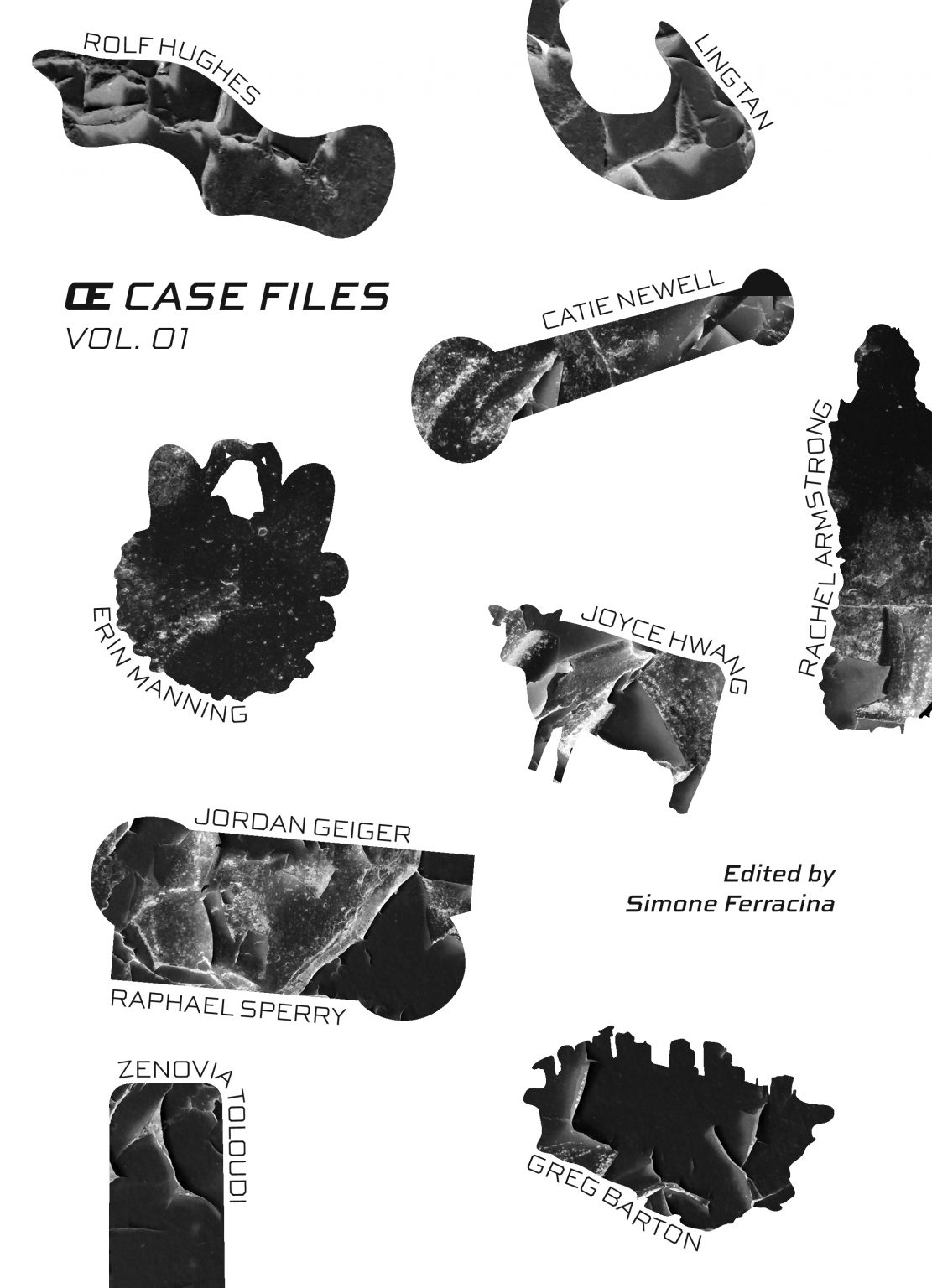
| Title | ΠCase Files, Vol. 01 |
|---|---|
| Contributor | Simone Ferracina(opens in new tab)(editor) |
| DOI | https://doi.org/10.21983/P3.0354.1.00(opens in new tab) |
| Landing page | https://punctumbooks.com/titles/oe-case-files-vol-1/(opens in new tab) |
| License | https://creativecommons.org/licenses/by-nc-sa/4.0/(opens in new tab) |
| Copyright | Ferracina, Simone (0000-0001-7533-6471) |
| Publisher | punctum books |
| Publication place | Earth, Milky Way |
| Published on | 2021-05-13 |
| ISBN | 978-1-953035-22-6 (Paperback) |
| 978-1-953035-23-3 (PDF) | |
| Long abstract | Over the past ten years, the journal Organs Everywhere(opens in new tab) (Œ) has promoted conversations that approach architectural design from the edges of the discipline—testing its boundaries, technologies, methods and (e)valuation systems, and keeping them unstable. It has valued transdisciplinary, speculative, and irreverent explorations over strict publishing formats and academic purity, promoting a profanatory and open-ended ethos. Each issue of Organs Everywhere has strung together disparate organs and limbs, activating precarious couplings and associations, and testing new metabolisms and assemblages. Œ Case Files continues this commitment to the making and unmaking of monsters, both by anthologising past contributions into fresh configurations and designs, and by combining them with entirely new articles and voices. Here, philosophers, designers, experimental architects, artists, science fiction writers, activists, and poets shift, expand, and re-imagine notions of space, time, inhabitation, technology, knowledge, use, value, and experience. A patchwork of essays, stories, design experiments, buildings, art installations, drawings, prose poems, photographs and speculative projects collide in the book, infecting simple disciplinary orthodoxies with doubt and potentials, uncertainty and hope—indecisive photons and softness; metatactility and haunted houses; neurodiversity and protocells; prosthetics, grease and darkness; post-human scenographies, software and GPS anklets; anthropocenic devices, paprika, and synthetic biology. |
| Print length | 302 pages |
| Language | English (Original) |
| Dimensions | 178 x 254 mm | 7" x 10" (Paperback) |
| LCCN | 2020950250 |
| THEMA |
|
| BIC |
|
| BISAC |
|
| Keywords |
|
Contents
- Simone Ferracina
- Simone Ferracina
- smudge studio
- Stuart Munro
- Erin Manning
- Rolf Hughes
- Rachel Armstrong
- Ben Woodard
- Catie Newell
- Zenovia Toloudi
- Thomas Pearce
- Neil Spiller
- Greg Barton
- Bob Sheil
- Thomas Pearce
- Brunella Antomarini
- Lev Manovich
- Jordan Geiger
- Raphael Sperry
- Ling Tan
- Miriam Simun
- Joyce Hwang
Contributors
Simone Ferracina
(editor)Simone Ferracina is a Lecturer in Architectural Design/Detail at the Edinburgh School of Architecture and Landscape Architecture (ESALA), University of Edinburgh, where his research and teaching investigate radical modes of co-authorship, the reactivation of wastes, and metabolic design. Simone received a PhD in Philosophy, Art & Critical Thought from the European Graduate School. He is the founder and editor of the online journal Organs Everywhere (Œ), and he has published, performed, and exhibited work internationally. Simone has also published a monograph on design potentials and radical reuse, Ecologies of Inception: Design Potentials on a Warming Planet (Routledge, 2022). Prior to joining the University of Edinburgh, Simone was a researcher at Newcastle University and, for over a decade, an Associate and Project Manager/Architect at Richard Meier & Partners Architects in New York City, with award-winning projects in Italy, Czech Republic, and Taiwan.
References
- (opens in new tab)
- (opens in new tab)
- (opens in new tab)
- (opens in new tab)
- (opens in new tab)
- (opens in new tab)
- (opens in new tab)
- (opens in new tab)
- (opens in new tab)
- (opens in new tab)
- (opens in new tab)
- (opens in new tab)
- (opens in new tab)
- (opens in new tab)
- (opens in new tab)
- (opens in new tab)
- (opens in new tab)
- (opens in new tab)
- (opens in new tab)
- (opens in new tab)
- (opens in new tab)