
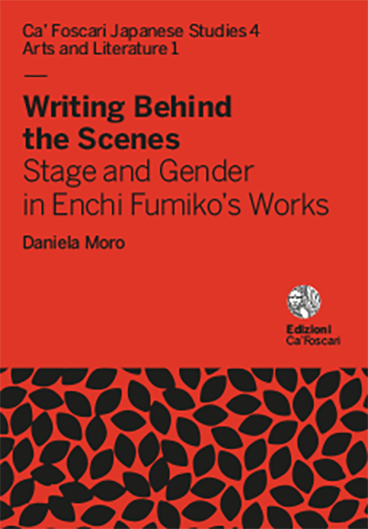
| Title | Writing Behind the Scenes |
|---|---|
| Subtitle | Stage and Gender in Enchi Fumiko’s Works |
| Contributor | Daniela Moro (author) |
| DOI | https://doi.org/10.14277/978-88-6969-056-3(opens in new tab) |
| Landing page | https://edizionicafoscari.it/en/edizioni4/libri/978-88-6969-057-0/(opens in new tab) |
| License | https://creativecommons.org/licenses/by/4.0/(opens in new tab) |
| Copyright | Daniela Moro |
| Publisher | Edizioni Ca’ Foscari – Venice University Press |
| Publication place | Venice, Italy |
| Published on | 2015-12-01 |
| Series |
|
| ISBN | 978-88-6969-056-3 (PDF) |
| Short abstract | The book focuses on the work of the Japanese writer Enchi Fumiko (1905-1986) and in particular on a selection of her late novels and novellas which are set in the world of traditional performing arts. The author analyzes the numerous intertextual references in Enchi’s works, not only to kabuki and noh – in particular through her reinterpretation of central figures such as Ono no Komachi and Kikujidō – but also to the theatrical production of Mishima Yukio. Through a lively dialogue with gender studies, queer studies, theories of performativity and memory, Enchi’s works reveal a strategic and expert use of the expressive potential of the stage. As a place par excellence where the fluidity of gender and more generally of identity are explored, in Enchi’s works theatre becomes an efficacious tool to deconstruct discourses and subvert conventions. |
| Long abstract | The book focuses on the work of the Japanese writer Enchi Fumiko (1905-1986) and in particular on a selection of her late novels and novellas which are set in the world of traditional performing arts. The author analyzes the numerous intertextual references in Enchi’s works, not only to kabuki and noh – in particular through her reinterpretation of central figures such as Ono no Komachi and Kikujidō – but also to the theatrical production of Mishima Yukio. Through a lively dialogue with gender studies, queer studies, theories of performativity and memory, Enchi’s works reveal a strategic and expert use of the expressive potential of the stage. As a place par excellence where the fluidity of gender and more generally of identity are explored, in Enchi’s works theatre becomes an efficacious tool to deconstruct discourses and subvert conventions. |
| Language | Italian (Original) |
| THEMA |
|
| BISAC |
|
| Keywords |
|