
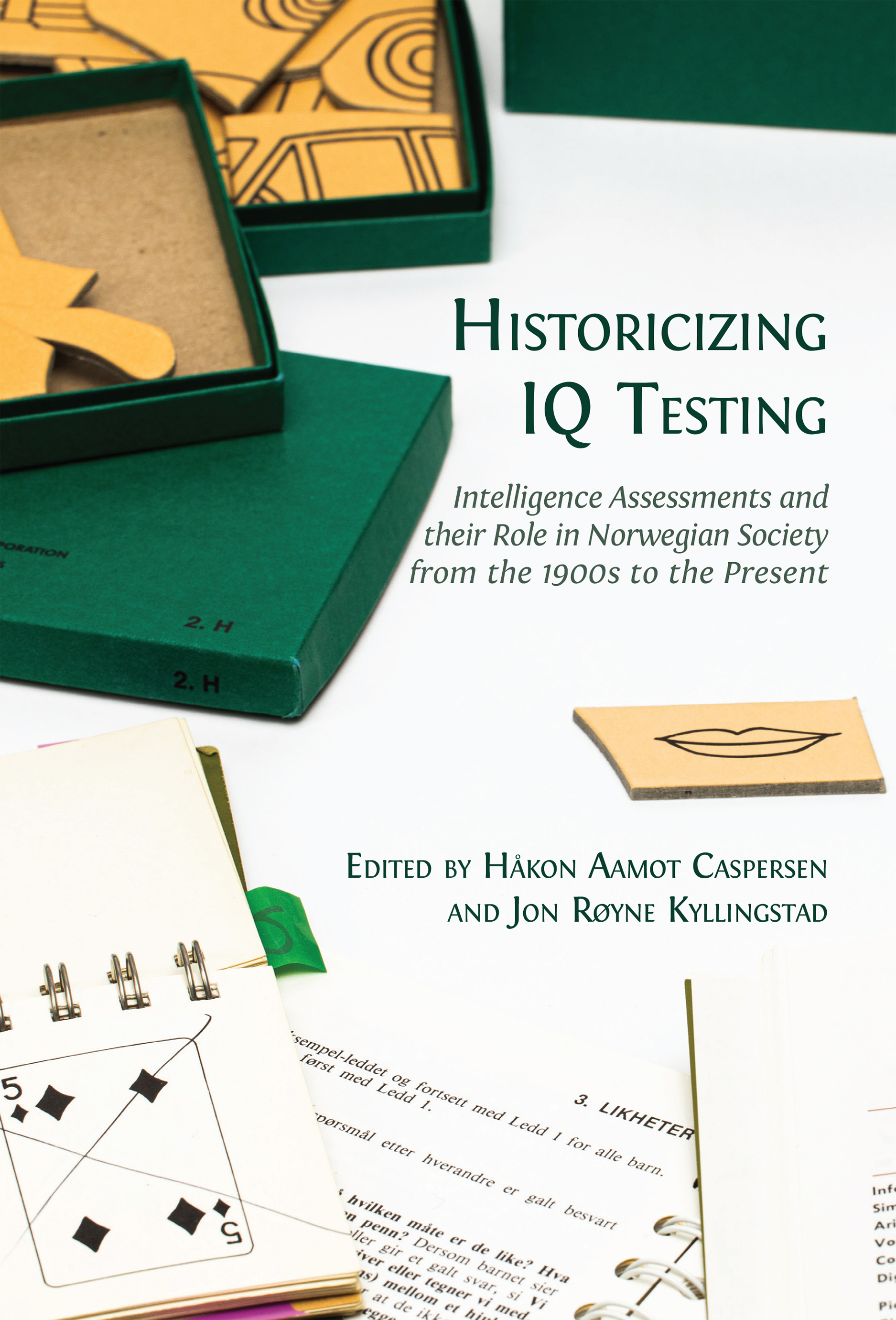
| Title | Historicizing IQ Testing |
|---|---|
| Subtitle | Intelligence Assessments and their Role in Norwegian Society from the 1900s to the Present |
| Contributor | Håkon Aamot Caspersen (editor) |
| Jon Røyne Kyllingstad (editor) | |
| DOI | https://doi.org/10.11647/OBP.0471(opens in new tab) |
| Landing page | https://www.openbookpublishers.com/books/10.11647/OBP.0471(opens in new tab) |
| License | https://creativecommons.org/licenses/by-nc/4.0/(opens in new tab) |
| Copyright | Håkon Aamot Caspersen; Jon Røyne Kyllingstad. Copyright of individual chapters are maintained by the chapter author(s). |
| Publisher | Open Book Publishers |
| Publication place | Cambridge, UK |
| Published on | 2026-03-02 |
| ISBN | 978-1-80511-617-2 (Paperback) |
| 978-1-80511-618-9 (Hardback) | |
| 978-1-80511-619-6 (PDF) | |
| 978-1-80511-621-9 (HTML) | |
| 978-1-80511-620-2 (EPUB) | |
| Short abstract | Intelligence testing has shaped modern society in profound ways, influencing education, psychology, law, and governance. This volume offers the first comprehensive study of the history of IQ testing in a Nordic country, shedding new light on its development, adaptation, and societal impact in Norway. |
| Long abstract | Intelligence testing has shaped modern society in profound ways, influencing education, psychology, law, and governance. This volume offers the first comprehensive study of the history of IQ testing in a Nordic country, shedding new light on its development, adaptation, and societal impact in Norway. By tracing the evolution of intelligence tests—from their role in schools and special education to forensic psychiatry and criminal law—the book uncovers the tensions surrounding their use. Are these tests instruments of empowerment or tools of control? How have they shaped access to education, healthcare, and legal rights? A key focus of this study is the transnational movement of intelligence tests, particularly between Norway, the USA, and other Nordic nations. It explores how tests have been translated, adapted, standardized, and used, raising questions about their claims to measure universal intelligence. This volume challenges assumptions about IQ testing, placing practices of testing and the tests themselves at the center of historical analysis. By examining the Norwegian case, it contributes fresh insights to international scholarship, offering a vital perspective on the global history of intelligence measurement. Essential reading for historians, psychologists, and educators, this book redefines our understanding of intelligence testing in a changing world. |
| Print length | 496 pages (xviii+478) |
| Language | English (Original) |
| Dimensions | 156 x 34 x 234 mm | 6.14" x 1.34" x 9.21" (Paperback) |
| 156 x 38 x 234 mm | 6.14" x 1.50" x 9.21" (Hardback) | |
| Weight | 933g | 32.91oz (Paperback) |
| 1118g | 39.44oz (Hardback) | |
| Media | 29 illustrations |
| OCLC Number | 1575989435 |
| LCCN | 2025432285 |
| THEMA |
|
| BISAC |
|
| LCC |
|
| Keywords |
|
| Funding |
|
Contents
- Håkon Aamot Caspersen
- Jon Røyne Kyllingstad
- Between Change and Stability: The Thorny Adaptation Process of the Stanford–Binet Intelligence Scale in Norway
- Ageliki Lefkaditou
- The Scandinavian Space of IQ Testing: Between Normal and Special Education, 1918–1940
- Christian Ydesen
- Brit Marie Hovland
- Emma Vikström
- A Legal History of Intelligence, Testing, and Criminal Unaccountability
- Linda Gröning
- Svein Atle Skålevåg
- IQ Testing and Sterilization in Norway, 1930 to 1960
- Per Haave
- Jon Røyne Kyllingstad
- Tools of the Trade: Psychotechnics, IQ Testing and the Making of the Psychological Profession in Norway, 1925–1947
- Isak Lønne Emberland
- From Segregation to Integration and the Role of Testing in a Norwegian Educational Psychology Office, 1953–1980
- Kari Ludvigsen
- IQ Testing Today in Norway’s Educational Psychological Services
- Håkon Aamot Caspersen
- ‘Children Got Slightly Smarter with Fish for Lunch’: The WPPSI Test, Randomized Trials, and Optimized Kindergartens
- Susanne Bauer
- A Norwegian Terman–Merrill and the Shelf Life of Intelligence Tests
- Gard Paulsen
- “Culture” and Representability in the Norwegian Standardization of WISC-R
- Jon Røyne Kyllingstad
- ‘A Violation of the Child’s Integrity and of Parental Rights’: The 1959 Controversy on IQ Testing of Norwegian Schoolchildren
- Fredrik W. Thue
- Tests, Metrics, and the Making of the Norwegian School, 1950–2025
- Kim Helsvig
- Drawing Boundaries, Building Barriers: Twentieth-Century US and Norwegian Intelligence Testing from a Comparative Perspective
- Jim W. Porter
- IQ Testing, Education, Reification, and “Race” in Norway’s Social Democratic Welfare State
- Jon Røyne Kyllingstad
- Håkon Aamot Caspersen
- Annette Mülberger
Contributors
Håkon Aamot Caspersen
(editor)Håkon Caspersen is a social anthropologist with a PhD from the University of St Andrews and currently a postdoctoral research fellow in the project Historicizing Intelligence at the Museum of University History/Museum of Cultural History, University of Oslo.
Jon Røyne Kyllingstad
(editor)Jon Røyne Kyllingstad is a historian and associate professor at the University of Oslo, Museum of University History/Museum of Cultural History, where he is the leader of the research project Historicizing Intelligence, which this book is based upon. He is a specialist in the history of science and the history of academic institutions with a focus on Norway. He was previously head conservator at the Norwegian Museum of Technology. His last book Rase: en vitenskapshistorie [Race: a history of a science] sums up two decades of work on changing ideas about race, ethnicity and the nation, within physical anthropology, genetics, and humanities disciplines such as archaeology and history in Norway. Similar topics were also addressed in Measuring the Master Race, published by Open Book Publishers in 2014.