
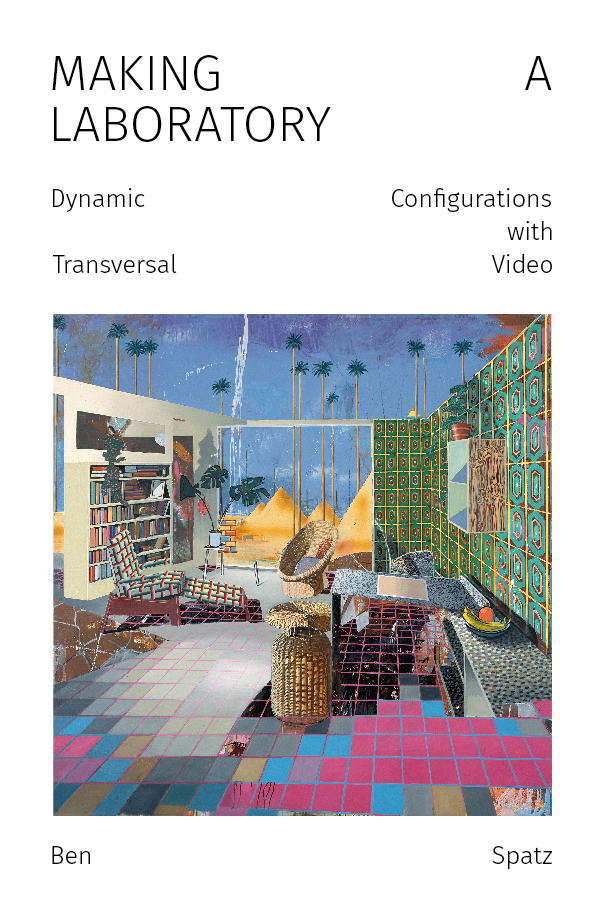
| Title | Making a Laboratory |
|---|---|
| Subtitle | Dynamic Configurations with Transversal Video |
| Contributor | Ben Spatz(opens in new tab)(author) |
| DOI | https://doi.org/10.21983/P3.0295.1.00(opens in new tab) |
| Landing page | https://punctumbooks.com/titles/making-a-laboratory-dynamic-configurations-with-transversal-video/(opens in new tab) |
| License | https://creativecommons.org/licenses/by-nc-sa/4.0/(opens in new tab) |
| Copyright | Spatz, Ben |
| Publisher | punctum books |
| Publication place | Earth, Milky Way |
| Published on | 2020-08-06 |
| ISBN | 978-1-953035-03-5 (Paperback) |
| 978-1-953035-04-2 (PDF) | |
| Long abstract | Making a Laboratory: Dynamic Configurations with Transversal Video defines a new audiovisual embodied research method that short-circuits experimental practice and video recording to generate new kinds of data and documents. Overturning conventional hierarchies of knowledge, “Dynamic Configurations with Transversal Video” (DCTV) grounds both discursive and audiovisual knowledges within the space of embodied practice, synthesizing insights from historical epistemologist Hans-Jörg Rheinberger and philosopher of science Karen Barad to offer the first rigorous definition of laboratoriality outside a techno-scientific paradigm. In this concise book, nonbinary practitioner–researcher Ben Spatz situates the DCTV method in the context of artistic research and alongside emerging audiovisual methods in other fields, while highlighting its unique characteristics. Across six focused chapters, Making a Laboratory introduces DCTV as a queer feminist adaptation of Jerzy Grotowski’s “poor” theater laboratory and defines its core elements, drawing on a range of thinkers including Giorgio Agamben, Rebecca Schneider, and Hito Steyerl, in order to examine power, identity, and documentation in lab practice. Drawing from the ethical consent practices of the BDSM community, it lays the groundwork for a radical reinvention of audiovisuality from the perspective of embodiment — the audiovisual body. |
| Print length | 204 pages |
| Language | English (Original) |
| Dimensions | 102 x 152 mm | 4" x 6" (Paperback) |
| LCCN | 2020942962 |
| THEMA |
|
| BIC |
|
| BISAC |
|
| Keywords |
|
Contributors
Ben Spatz
(author)Ben Spatz(opens in new tab), Senior Lecturer in Drama, Theatre and Performance at the University of Huddersfield, is a nonbinary researcher and theorist of embodied practice. They are the author of What a Body Can Do: Technique as Knowledge, Practice as Research (Routledge, 2015) and Blue Sky Body: Thresholds for Embodied Research (Routledge, 2020), as well as numerous articles. Ben is also the founding editor of the videographic Journal of Embodied Research (Open Library of Humanities) and the Advanced Methods imprint (punctum books), and is also a co-convener of the Embodied Research Working Group within the International Federation for Theatre Research. They have more than two decades of experience as a performer and director of contemporary performance, working mainly in New York City from 2001 to 2013. For more information, see urbanresearchtheater.com(opens in new tab).
References
- (opens in new tab)
- (opens in new tab)
- (opens in new tab)
- (opens in new tab)
- (opens in new tab)
- (opens in new tab)
- (opens in new tab)
- (opens in new tab)
- (opens in new tab)
- (opens in new tab)
- (opens in new tab)
- (opens in new tab)
- (opens in new tab)
- (opens in new tab)
- (opens in new tab)
- (opens in new tab)
- (opens in new tab)
- (opens in new tab)
- (opens in new tab)
- (opens in new tab)
- (opens in new tab)
- (opens in new tab)
- (opens in new tab)
- (opens in new tab)