
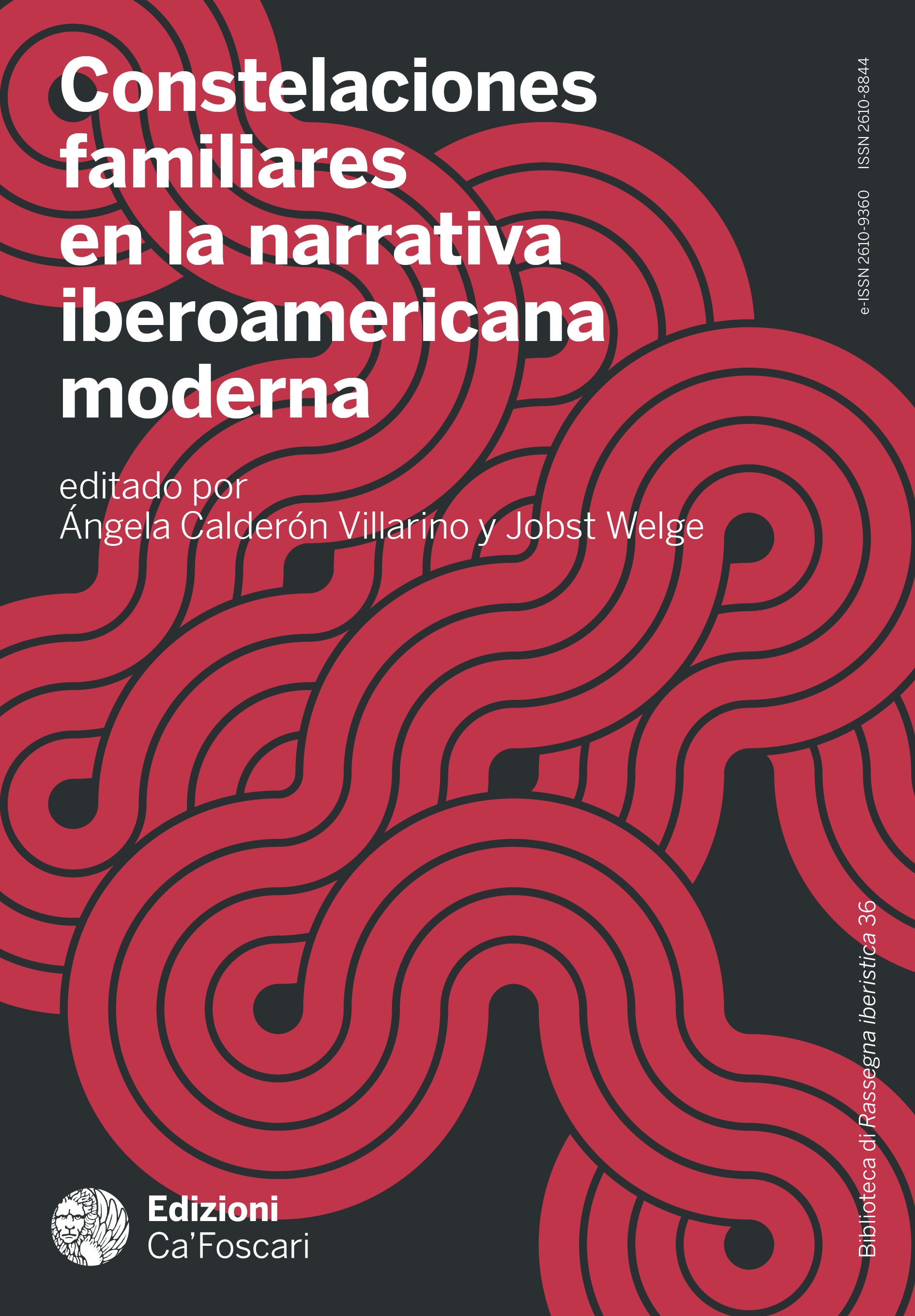
| Title | Constelaciones familiares en la narrativa iberoamericana moderna |
|---|---|
| Contributor | Ángela Calderón Villarino (editor) |
| Jobst Welge (editor) | |
| DOI | https://doi.org/10.30687/978-88-6969-833-0(opens in new tab) |
| Landing page | https://edizionicafoscari.it/en/edizioni4/libri/978-88-6969-834-7/(opens in new tab) |
| License | https://creativecommons.org/licenses/by/4.0/(opens in new tab) |
| Copyright | Ángela Calderón Villarino, Jobst Welge |
| Publisher | Edizioni Ca’ Foscari – Venice University Press |
| Publication place | Venice, Italy |
| Published on | 2024-06-14 |
| Series |
|
| ISBN | 978-88-6969-833-0 (PDF) |
| Short abstract | The present volume collects essays on the subject of ‘family constellations’ in modern and contemporary Iberoamerican fiction, including case studies from Spain, Portugal, Hispanophone Latin America, and Brazil, with analyses of novels ranging from 1973 (Concha Alós, La madama) to 2020 (Juan Gabriel Vásquez, Volver la vista atrás). The volume proposes the idea of ‘family constellations’ as a critical concept to capture the different ways in which these literary works transcend or escape the customary generic rubric of the family novel/saga. In contrast to more organic notions of family or the conventional scheme of genealogical sequence (and decadence), the novelistic works studied here are distinguished by the partial and subjective way in which they imagine affective bonds across or within a generation. Moreover, in contrast to the time-honored allegorical equation of family (history) and nation, the novels of the past decades and of most recent publication tend to foreground transnational and multi-relational or multilateral connections, bonds, and memories, and they frequently also appeal to an international readership. Historical legacies continue to play an important role, but frequently what is focused upon is not the direct experience of ‘historical’ events, but rather the transgenerational and traumatic transmission of historical memories over time and across generations. Finally, many of the novels discussed tend to connect the representation of family relations to meta-fictional and meta-historical devices.Through the eight individual studies presented here, the volume wants to make a case for the continued importance of ‘family’ in contemporary Iberoamerican literature, and to suggest concepts and approaches for further study, that highlight the more flexible and fragmentary modes in which familial relations undergird the content and form of recent fiction. |
| Long abstract | The present volume collects essays on the subject of ‘family constellations’ in modern and contemporary Iberoamerican fiction, including case studies from Spain, Portugal, Hispanophone Latin America, and Brazil, with analyses of novels ranging from 1973 (Concha Alós, La madama) to 2020 (Juan Gabriel Vásquez, Volver la vista atrás). The volume proposes the idea of ‘family constellations’ as a critical concept to capture the different ways in which these literary works transcend or escape the customary generic rubric of the family novel/saga. In contrast to more organic notions of family or the conventional scheme of genealogical sequence (and decadence), the novelistic works studied here are distinguished by the partial and subjective way in which they imagine affective bonds across or within a generation. Moreover, in contrast to the time-honored allegorical equation of family (history) and nation, the novels of the past decades and of most recent publication tend to foreground transnational and multi-relational or multilateral connections, bonds, and memories, and they frequently also appeal to an international readership. Historical legacies continue to play an important role, but frequently what is focused upon is not the direct experience of ‘historical’ events, but rather the transgenerational and traumatic transmission of historical memories over time and across generations. Finally, many of the novels discussed tend to connect the representation of family relations to meta-fictional and meta-historical devices.Through the eight individual studies presented here, the volume wants to make a case for the continued importance of ‘family’ in contemporary Iberoamerican literature, and to suggest concepts and approaches for further study, that highlight the more flexible and fragmentary modes in which familial relations undergird the content and form of recent fiction. |
| Language | Italian (Original) |
| THEMA |
|
| BISAC |
|
| Keywords |
|