
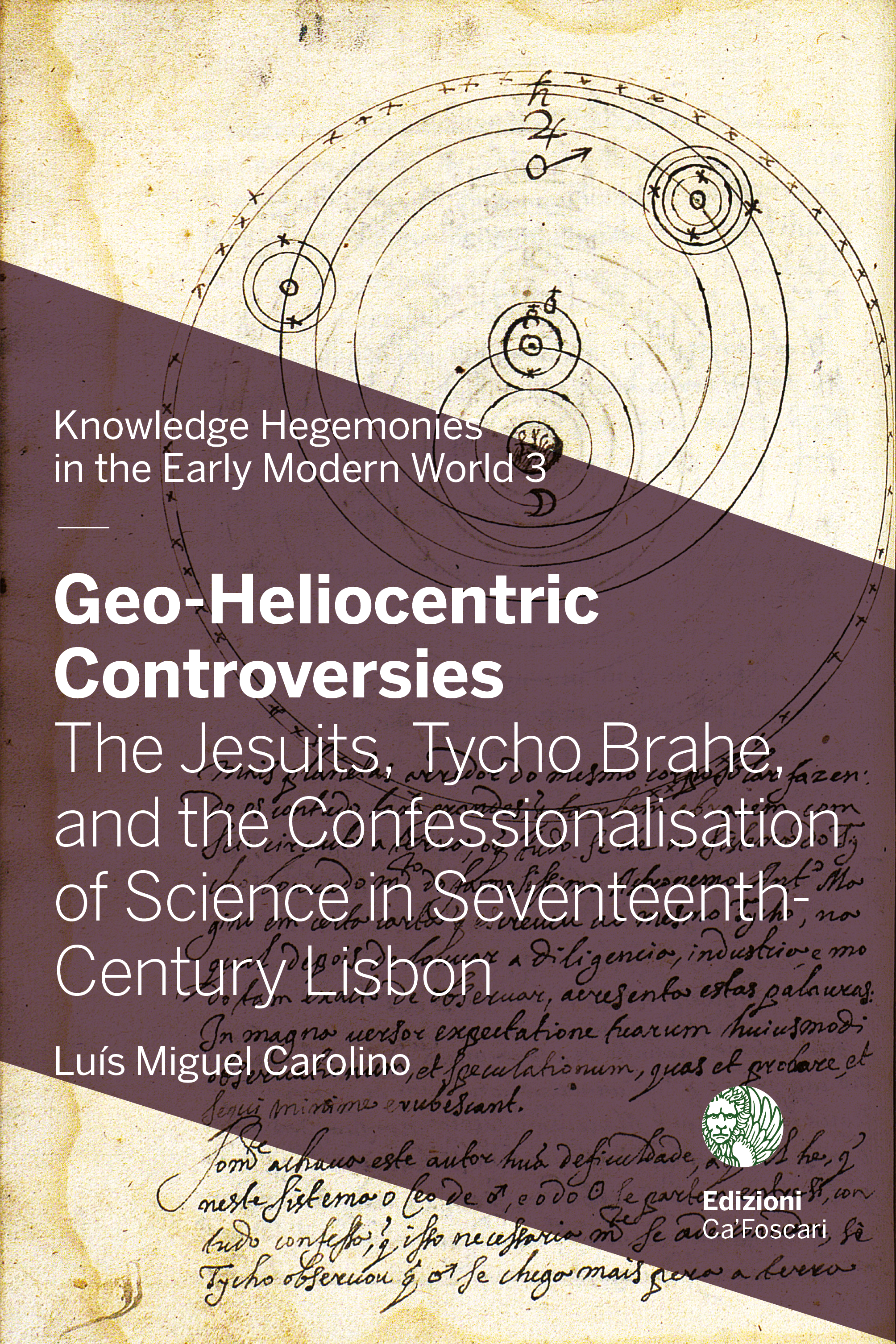
| Title | Geo-Heliocentric Controversies |
|---|---|
| Subtitle | The Jesuits, Tycho Brahe, and the Confessionalisation of Science in Seventeenth-Century Lisbon |
| Contributor | Luís Miguel Carolino (author) |
| DOI | https://doi.org/10.30687/978-886-969-661-9(opens in new tab) |
| Landing page | https://edizionicafoscari.it/en/edizioni4/libri/978-886-969-662-6/(opens in new tab) |
| License | https://creativecommons.org/licenses/by/4.0/(opens in new tab) |
| Copyright | Luís Miguel Carolino |
| Publisher | Edizioni Ca’ Foscari – Venice University Press |
| Publication place | Venice, Italy |
| Published on | 2023-03-22 |
| Series |
|
| ISBN | 978-886-969-661-9 (Paperback) |
| 978-88-6969-661-9 (PDF) | |
| Short abstract | This is a book about the confessionalisation of science in the early modern period. It discusses the cosmological controversies raised by the appropriation of Tycho Brahe’s astronomical theories within the Jesuit milieu, by focusing on the international community of Jesuit mathematicians who taught astronomy at the College of Santo Antão, Lisbon, between 1615 and 1652. The author argues that the cultural politics of the Counter-Reformation Church curbed the reception of Tycho Brahe in this community. Despite supporting the Tychonic geo-heliocentric system and exploring cosmological ideas produced in Tycho’s Protestant milieu, the Jesuits active in Lisbon strove to confine the authority of the Lutheran astronomer to the domain of mathematics. Philosophy was expected to remain the realm of Catholic orthodoxy. |
| Long abstract | This is a book about the confessionalisation of science in the early modern period. It discusses the cosmological controversies raised by the appropriation of Tycho Brahe’s astronomical theories within the Jesuit milieu, by focusing on the international community of Jesuit mathematicians who taught astronomy at the College of Santo Antão, Lisbon, between 1615 and 1652. The author argues that the cultural politics of the Counter-Reformation Church curbed the reception of Tycho Brahe in this community. Despite supporting the Tychonic geo-heliocentric system and exploring cosmological ideas produced in Tycho’s Protestant milieu, the Jesuits active in Lisbon strove to confine the authority of the Lutheran astronomer to the domain of mathematics. Philosophy was expected to remain the realm of Catholic orthodoxy. |
| Print length | 170 pages |
| Language | Italian (Original) |
| THEMA |
|
| BISAC |
|
| Keywords |
|