
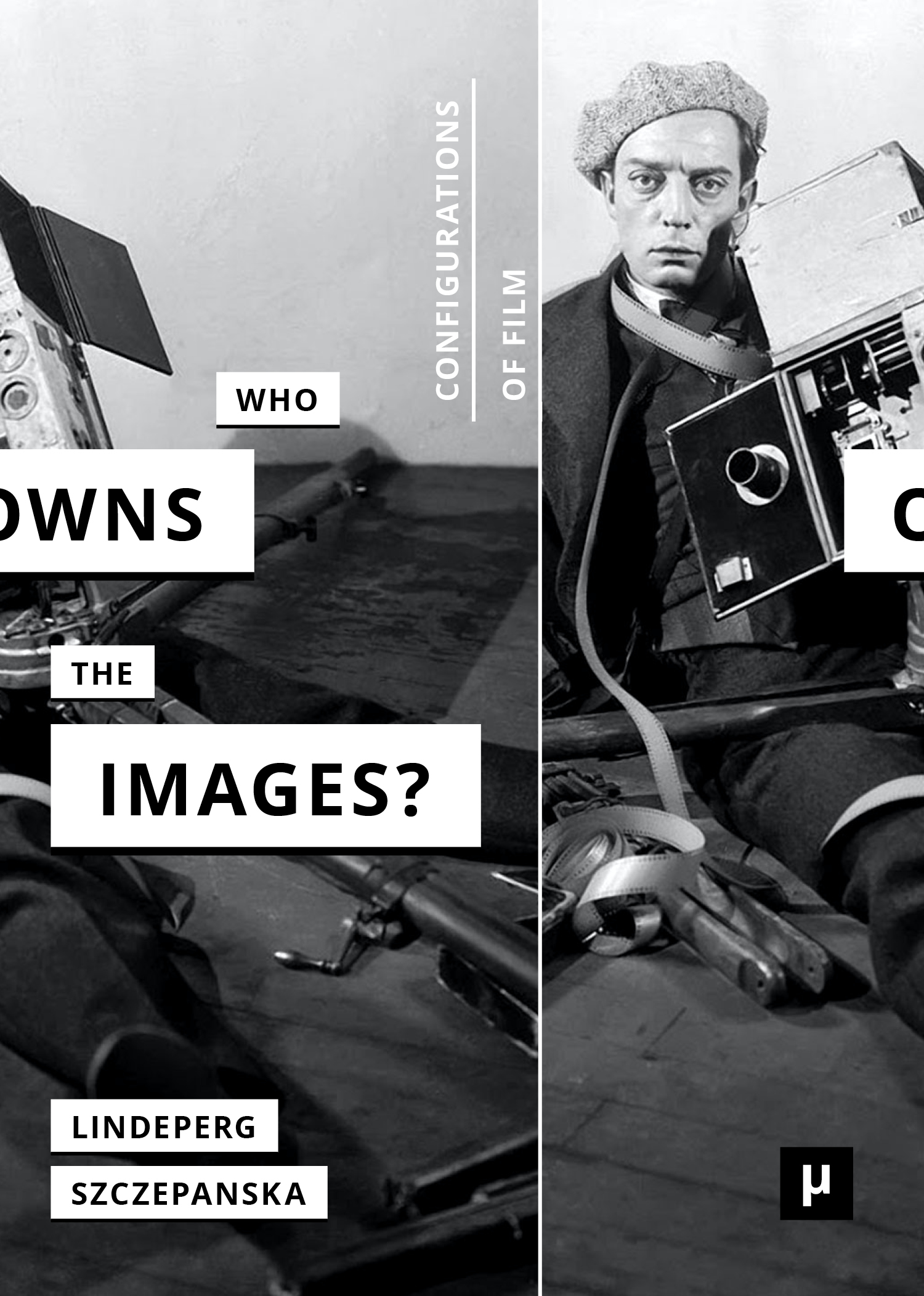
| Title | Who Owns the Images? |
|---|---|
| Subtitle | The Paradox of Archives, between Commercialization, Free Circulation and Respect |
| Contributor | Sylvie Lindeperg (editor) |
| Ania Szczepanska (editor) | |
| DOI | https://doi.org/10.14619/0146(opens in new tab) |
| Landing page | https://meson.press/books/who-owns-the-images/(opens in new tab) |
| License | https://creativecommons.org/licenses/by-sa/4.0/(opens in new tab) |
| Copyright | Sylvie Lindeperg; Ania Szczepanska |
| Publisher | meson press |
| Publication place | Lüneburg |
| Published on | 2021-12-13 |
| Series |
|
| ISBN | 978-3-95796-014-6 (PDF) |
| Short abstract | Digitization carries the utopian promise of archival access unlimited by constraints of space and time, and with it, of new forms of research and historiographies. In reality, digital image archives pose a complex set of technical, legal, ethical and methodological challenges, particularly for film and media studies and adjacent fields. In a series of studies and interviews with practitioners, scholars and theorists, this volume draws a detailed map of these challenges and offers perspectives for further research and creative practice. |
| Long abstract | Digitization carries the utopian promise of archival access unlimited by constraints of space and time, and with it, of new forms of research and historiographies. In reality, digital image archives pose a complex set of technical, legal, ethical and methodological challenges, particularly for film and media studies and adjacent fields. In a series of studies and interviews with practitioners, scholars and theorists, this volume draws a detailed map of these challenges and offers perspectives for further research and creative practice. |
| Print length | 143 pages |
| Language | English (Original) |
| BISAC |
|
| LCC |
|
| Keywords |
|
| Funding |
|
Contents
- Amrita Biswas
- Johanna Laub
- Sylvie Lindeperg
- Ania Szczepanska
- Sylvie Lindeperg
- Sylvie Lindeperg
- Ania Szczepanska
- Nathalie Chassigneux
- Serge Lalou
- Agnès Magnien
- Marie-José Mondzain
- Jean-Gabriel Périot
- Xavier Sené
- Ania Szczepanska
Contributors
Sylvie Lindeperg
(editor)Sylvie Lindeperg is a historian, professor at the University of Paris I Panthéon-Sorbonne and member of the Institut universitaire of France. She is the author and co-editor of fifteen books exploring the connections between film, memory and history amongst which are: Clio de 5 à 7 (Paris: CNRS Éditions, 2000); Nuit et brouillard: un film dans l’Histoire (Odile Jacob, 2007) [Night and Fog: A Film in History. Tr. Tom Mes (Minneapolis: University of Minnesota Press, 2014); La Voie des images (Verdier, 2013), Les Écrans de l’ombre (Paris: Seuil, 2014); Le Moment Eichmann (Albin Michel, 2016), coedited with Annette Wieviorka; her most recent work is: Le procès de Nuremberg: la bataille des images (Payot, 2021).
Ania Szczepanska
(editor)Ania Szczepanska is a graduate of the École normale, film historian and Lecturer et Paris 1 Panthéon-Sorbonne. Her works deal with Eastern European Film and Documentary Film. She made the documentary Nous filmons le peuple! (We Film the People!), produced by Abacaris films (broadcast on Ciné+ and TVP Kultura, released on DVD by Aloest), about the political involvement of filmmakers in Communist Poland. She is the author of: Do granic negocjacji. Historia Zespołu filmowego X Andrzeja Wajdy (1972-1983) (Cracow: Universitas, 2017 [At the border of Negotiation. History of the Andrzej Wajda’s Production Group X (1972-1983)]). In 2019 she made the film Solidarnosc, la chute du mur commence en Pologne (Solidarnosc, how Solidarity changed Europe) produced by Looksfilm for Arte/NDR; her most recent work is Une histoire visuelle de Solidarnosc (MSH, 2021.)