
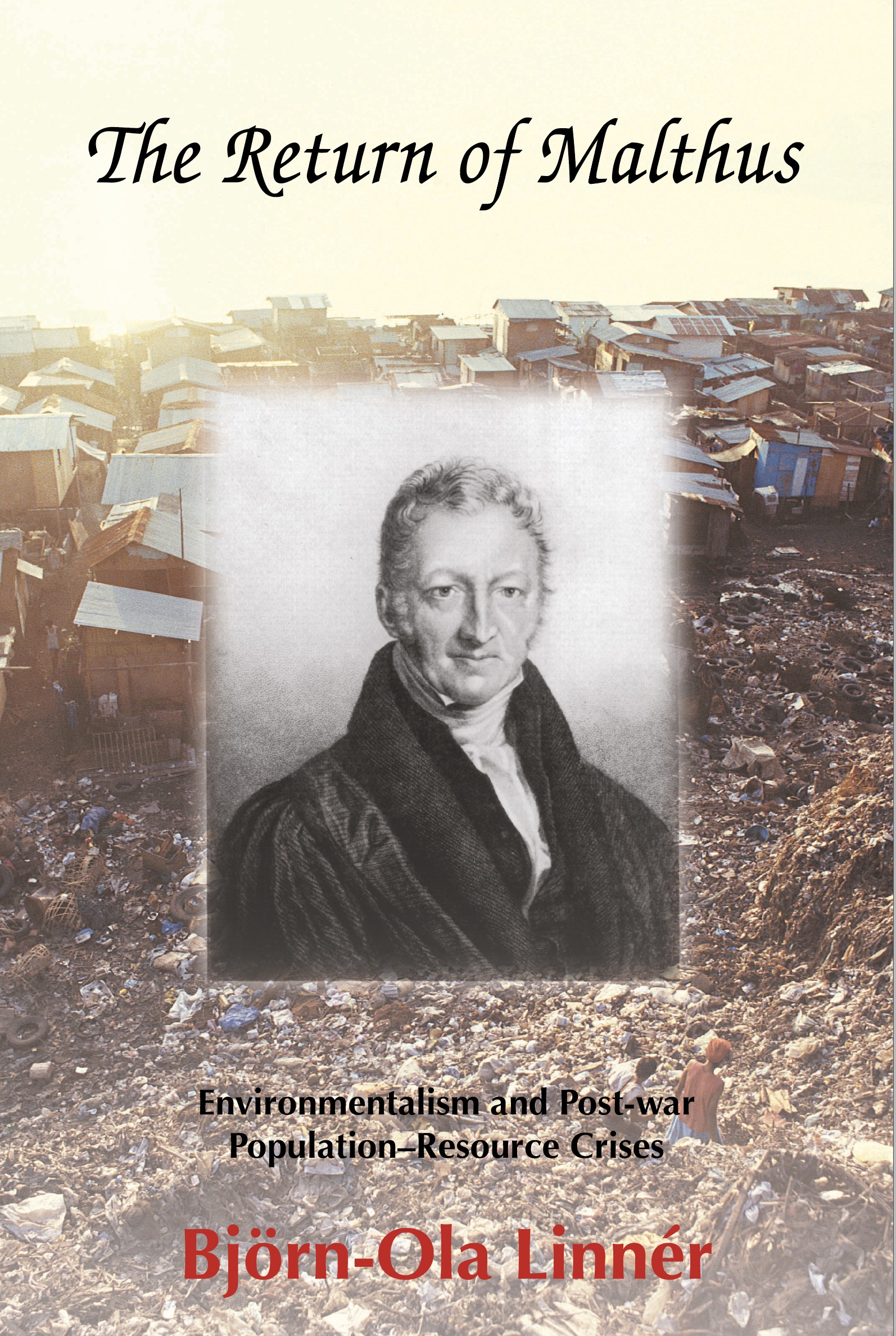
| Title | The Return of Malthus |
|---|---|
| Subtitle | Environmentalism and Post-war Population–Resource Crises |
| Contributor | Björn-Ola Linnér(opens in new tab)(author) |
| DOI | https://doi.org/10.3197/63811987103618.book(opens in new tab) |
| Landing page | https://www.whpress.co.uk/publications/2021/08/16/return-of-malthus/(opens in new tab) |
| License | https://creativecommons.org/licenses/by-nc-nd/4.0/(opens in new tab) |
| Copyright | Björn-Ola Linnér |
| Publisher | The White Horse Press |
| Publication place | Winwick, UK |
| Published on | 2023-04-17 |
| ISBN | 978-1-912186-74-7 (Paperback) |
| 978-1-874267-51-5 (Hardback) | |
| 978-1-912186-73-0 (PDF) | |
| Short abstract | The Return of Malthus is the first comprehensive analysis of the post-war fear of scarcity. Linnér traces the development of an international discourse of crisis through the influence of such thinkers as William Vogt, Fairfield Osborn and Georg Börgström, labelled ‘neo-Malthusians’ for their emphasis on an impending clash between population growth and resource limits, after the manner of the nineteenth-century father of scarcity economics. |
| Long abstract | The Return of Malthus is the first comprehensive analysis of the post-war fear of scarcity. Linnér traces the development of an international discourse of crisis through the influence of such thinkers as William Vogt, Fairfield Osborn and Georg Börgström, labelled ‘neo-Malthusians’ for their emphasis on an impending clash between population growth and resource limits, after the manner of the nineteenth-century father of scarcity economics. The book analyses the role of science and technology in securing food supply, the transmutation of older ideas about preserving nature into a new conservation ideology based on sustainable use, and the preoccupation of the industrialised nations with forestalling communism and controlling power relations. First published by The White Horse Press in 2003. Even more relevant today, this revised edition charts perceptions of and prescriptions for crises of population growth and resource shortage, which have had profound influence on agricultural, population and security policies from the Second World War to the present. |
| Print length | 324 pages |
| Language | English (Original) |
| Dimensions | 152 x 229 mm | 5.98" x 9.02" (Paperback) |
| 154 x 229 mm | 6.06" x 9.02" (Hardback) | |
| Media | 7 illustrations |
| 7 tables | |
| BIC |
|
| BISAC |
|
| Keywords |
|
| Funding |
Contents
- Björn-Ola Linnér
- Björn-Ola Linnér
- Björn-Ola Linnér
- Björn-Ola Linnér
- Björn-Ola Linnér
- Björn-Ola Linnér
- Björn-Ola Linnér
- Björn-Ola Linnér
- Björn-Ola Linnér
Contributors
Björn-Ola Linnér
(author)Björn-Ola Linnér is a Swedish climate policy scholar and professor at Linköping University. He is program director of Mistra Geopolitics, a research programme that critically examines and explores the interplay between the dynamics of geopolitics, human security, and global environmental change.