
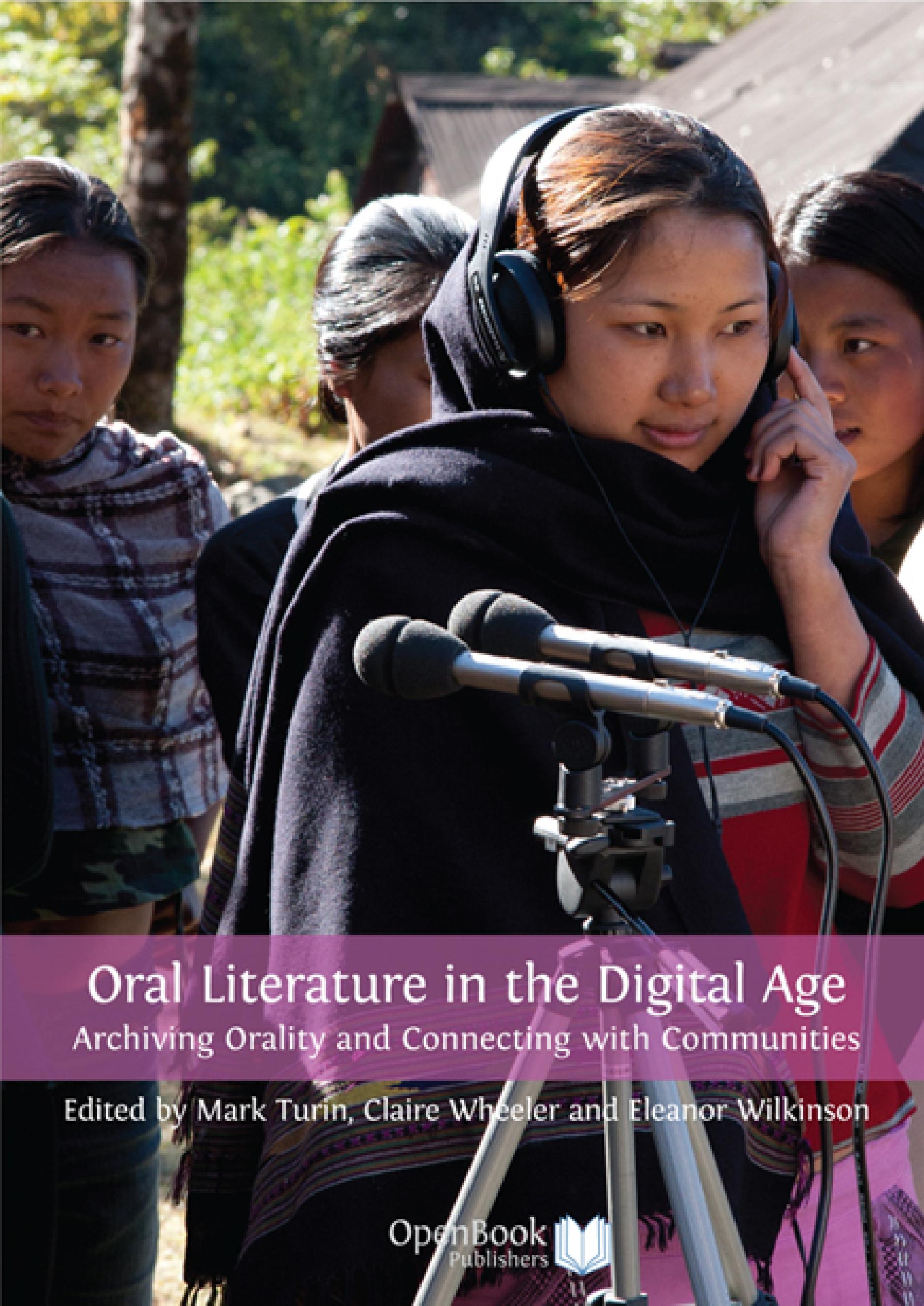
| Title | Oral Literature in the Digital Age |
|---|---|
| Subtitle | Archiving Orality and Connecting with Communities |
| Contributor | Mark Turin(opens in new tab)(editor) |
| Claire Wheeler (editor) | |
| Eleanor Wilkinson (editor) | |
| DOI | https://doi.org/10.11647/OBP.0032(opens in new tab) |
| Landing page | https://www.openbookpublishers.com/books/10.11647/obp.0032(opens in new tab) |
| License | http://creativecommons.org/licenses/by/3.0/(opens in new tab) |
| Copyright | Mark Turin; Claire Wheeler; Eleanor Wilkinson; Contributors retain copyright of their work. |
| Publisher | Open Book Publishers |
| Publication place | Cambridge, UK |
| Published on | 2013-05-10 |
| Series |
|
| ISBN | 978-1-909254-30-5 (Paperback) |
| 978-1-909254-31-2 (Hardback) | |
| 978-1-909254-32-9 (PDF) | |
| 978-1-80064-459-5 (HTML) | |
| 978-1-909254-33-6 (EPUB) | |
| 978-1-909254-34-3 (MOBI) | |
| Short abstract | Thanks to ever-greater digital connectivity, interest in oral traditions has grown beyond that of researcher and research subject to include a widening pool of global users. This book explores the political repercussions of studying marginalised languages; the role of online tools in ensuring responsible access to sensitive cultural materials; and ways of ensuring that when digital documents are created, they are not fossilized as a consequence of being archived. This book is an essential guide and handbook for ethnographers, field linguists, community activists, curators, archivists, librarians, and all who connect with indigenous communities to document and preserve oral traditions. |
| Long abstract | Thanks to ever-greater digital connectivity, interest in oral traditions has grown beyond that of researcher and research subject to include a widening pool of global users. When new publics consume, manipulate and connect with field recordings and digital cultural archives, their involvement raises important practical and ethical questions. This volume explores the political repercussions of studying marginalised languages; the role of online tools in ensuring responsible access to sensitive cultural materials; and ways of ensuring that when digital documents are created, they are not fossilized as a consequence of being archived. Fieldwork reports by linguists and anthropologists in three continents provide concrete examples of overcoming barriers—ethical, practical and conceptual—in digital documentation projects. Oral Literature in the Digital Age is an essential guide and handbook for ethnographers, field linguists, community activists, curators, archivists, librarians, and all who connect with indigenous communities in order to document and preserve oral traditions. |
| Print length | 190 pages (xxiv + 166) |
| Language | English (Original) |
| Dimensions | 156 x 10 x 234 mm | 6.14" x 0.40" x 9.21" (Paperback) |
| 156 x 13 x 234 mm | 6.14" x 0.50" x 9.21" (Hardback) | |
| Weight | 607g | 21.41oz (Paperback) |
| 985g | 34.74oz (Hardback) | |
| Media | 36 illustrations |
| OCLC Number | 1133285149 |
| LCCN | 2019467802 |
| BIC |
|
| BISAC |
|
| LCC |
|
| Keywords |
|
Contents
- Mark Turin
- Claire Wheeler
- Eleanor Wilkinson
- Thomas Widlok
- David Nathan
- Judith Aston
- Paul Matthews
- Daniela Merolla
- Margaret Field
- Jorge Gómez Rendón
- Madan Meena
- C.K. Stuart
Contributors
Mark Turin
(editor)Mark Turin is a linguistic anthropologist specialised in the Himalayas. He directs the World Oral Literature Project and the Digital Himalaya Project, both of which are co-located at Cambridge and Yale universities. He is the author or co-author of four books, the editor of five volumes and has published numerous articles and book chapters. He is the Program Director of Yale's new Himalaya Initiative.
Claire Wheeler
(editor)Claire Wheeler is a Research Assistant at the World Oral Literature Project. She has a background in Modern and Medieval Languages, educational publishing, and teaching English as a foreign language.
Eleanor Wilkinson
(editor)Eleanor Wilkinson is a Research Assistant at the World Oral Literature Project. She has a background in ancient languages and culture, and has previously worked as a freelance collections assistant after completing her MA in Museum Studies.