
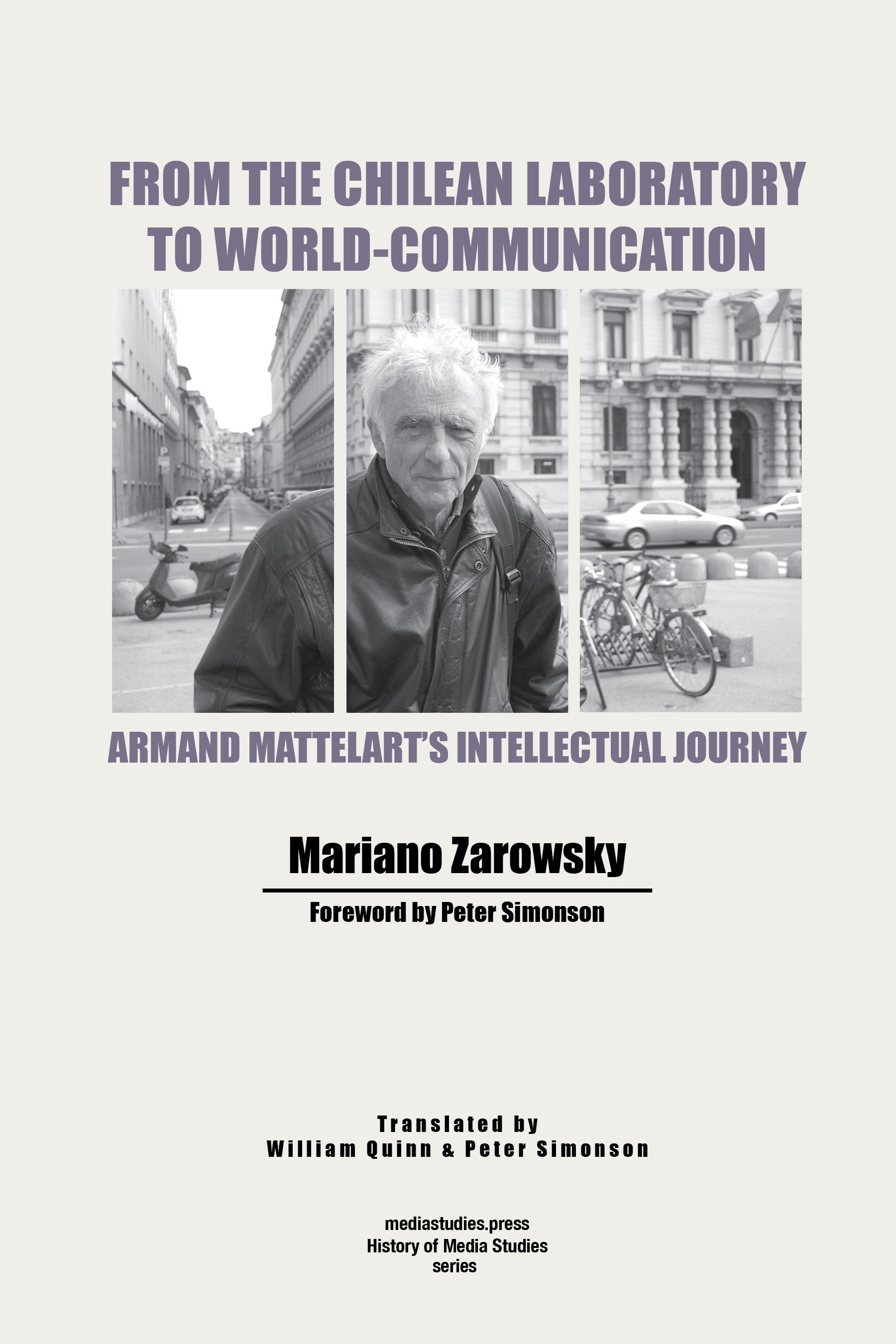
| Title | From the Chilean Laboratory to World-Communication |
|---|---|
| Subtitle | Armand Mattelart’s Intellectual Journey |
| Contributor | Mariano Zarowsky (author) |
| DOI | https://doi.org/10.64629/3f8575cb.08e7ds72(opens in new tab) |
| Landing page | https://www.mediastudies.press/from-the-chilean-laboratory-to-world-communication-armand-mattelarts-intellectual-journey(opens in new tab) |
| License | https://creativecommons.org/licenses/by-nc/4.0/(opens in new tab) |
| Copyright | Zarowsky, Mariano |
| Publisher | mediastudies.press |
| Publication place | Bethlehem, PA |
| Published on | 2025-10-15 |
| Series |
|
| ISBN | 978-1-951399-50-4 (Paperback) |
| 978-1-951399-47-4 (PDF) | |
| 978-1-951399-48-1 (HTML) | |
| 978-1-951399-49-8 (EPUB) | |
| Short abstract | From the Chilean Laboratory to World-Communication follows Armand Mattelart’s intellectual trajectory through Cold War geopolitics and the rise of critical communication studies in Latin America and Europe. |
| Long abstract | From the Chilean Laboratory to World-Communication follows Armand Mattelart’s intellectual trajectory through Cold War geopolitics and the rise of critical communication studies in Latin America and Europe. First published in Spanish, Mariano Zarowsky’s study traces Mattelart’s path from his early work in demography and law, through his political engagement in Salvador Allende’s Chile, to his later role in shaping debates in France and globally on media, cultural politics, and transnational communication. The book offers a rich account of Mattelart’s life and work, and the shifting political, institutional, and epistemological contexts that shaped his thinking and progressive activism. Along the way, it illuminates his distinctive style of research in relation to Anglophone political economy and other strands of critical research. In doing so, Zarowsky positions Mattelart as a theorist whose work emerged from—and continues to speak to—global struggles over culture, knowledge, and power and relations between the Global North and South. As the first English edition of Zarowsky’s landmark study, From the Chilean Laboratory to World-Communication, will appeal to scholars of critical communication studies, Latin American and transnational cultural theory, and those working on the history of the social sciences across global contexts. |
| Print length | 300 pages (xi-xlvi, 1-264) |
| Language | English (Translated into) |
| LCCN | 2025943425 |
| THEMA |
|
| BISAC |
|
| Funding |
|
Contents
- Mariano Zarowsky
- Peter Simonson
- Héctor Schmucler
- Mariano Zarowsky
- Mariano Zarowsky
- Mariano Zarowsky
- Mariano Zarowsky
- Mariano Zarowsky
- Mariano Zarowsky
- Mariano Zarowsky
- Mariano Zarowsky
- Mariano Zarowsky
- Mariano Zarowsky
- Mariano Zarowsky
Contributors
Mariano Zarowsky
(author)Mariano Zarowsky is a researcher at Argentina’s National Scientific and Technical Research Council (CONICET) and teaches at the Faculty of Social Sciences, Universidad de Buenos Aires (UBA). His research intersects the history of intellectuals, communication studies, and political culture in Argentina and Latin America. He is the author of Allende en la Argentina: intelectuales, prensa y edición entre lo local y lo global (1970–1976) (2023), Los estudios en comunicación en la Argentina: ideas, intelectuales, tradiciones político-culturales, 1956–1985 (2017).
William Quinn
(translator)William Quinn is a translator based in Guadalajara, Mexico. He holds a master’s degree in the Communication of Science and Culture from ITESO, where he taught for over 25 years. His translations span topics from data science and Nietzsche to the World Wide Web and childrearing in Mazahua communities.
Peter Simonson
(translator)Peter Simonson is Professor Emeritus of Communication at the University of Colorado Boulder and co-editor of the journal History of Media Studies. He has authored or edited five books, including The International History of Communication Study (2015, with David W. Park) and in recent years has been involved in various international projects on the history of communication studies across the Americas.