
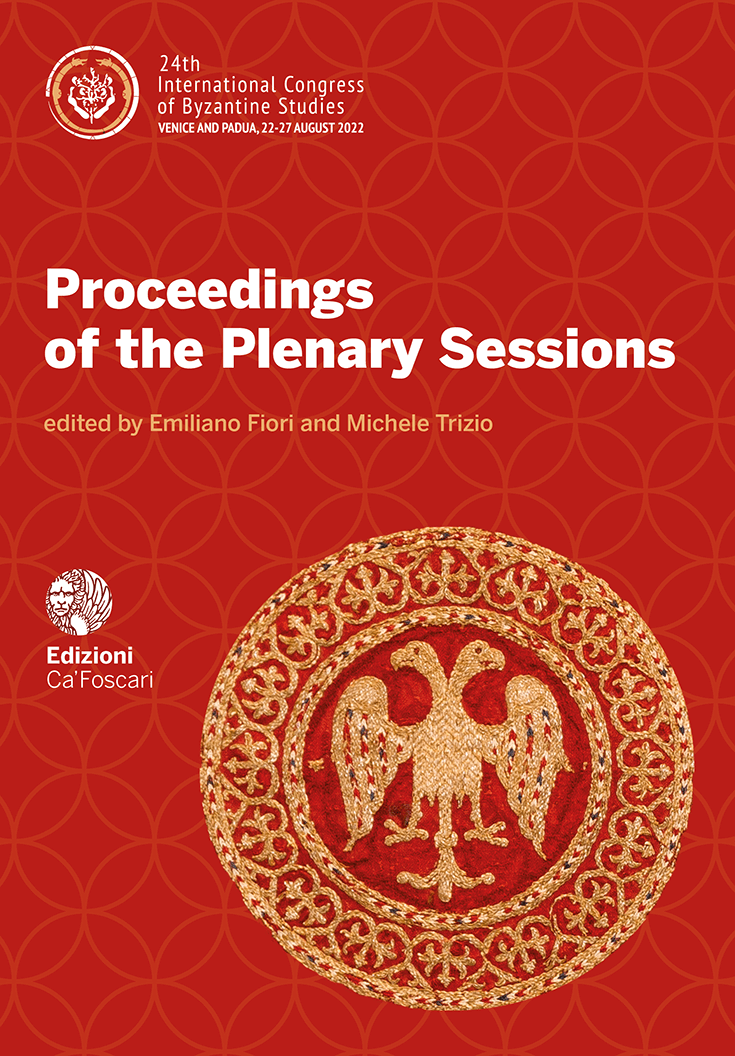
| Title | Proceedings of the Plenary Sessions |
|---|---|
| Subtitle | The 24th International Congress of Byzantine Studies |
| Contributor | Emiliano Fiori (editor) |
| Michele Trizio (editor) | |
| DOI | https://doi.org/10.30687/978-88-6969-590-2(opens in new tab) |
| Landing page | https://edizionicafoscari.it/en/edizioni4/libri/978-88-6969-590-2/(opens in new tab) |
| License | https://creativecommons.org/licenses/by/4.0/(opens in new tab) |
| Copyright | Emiliano Fiori, Michele Trizio |
| Publisher | Edizioni Ca’ Foscari – Venice University Press |
| Publication place | Venice, Italy |
| Published on | 2022-08-22 |
| Series |
|
| ISBN | 978-88-6969-590-2 (PDF) |
| Short abstract | The present volume collects most of the contributions to the plenary sessions held at the 24th International Congress of Byzantine Studies, and incisively reflects the ever increasing broadening of the very concept of ‘Byzantine Studies’. Indeed, a particularly salient characteristic of the papers presented here is their strong focus on interdisciplinarity and their breadth of scope, both in terms of methodology and content. The cross-pollination between different fields of Byzantine Studies is also a major point of the volume. Archaeology and art history have pride of place; it is especially in archaeological papers that one can grasp the vital importance of the interaction with the so-called hard sciences and with new technologies for contemporary research. This relevance of science and technology for archaeology, however, also applies to, and have significant repercussions in, historical studies, where – for example – the study of climate change or the application of specific software to network studies are producing a major renewal of knowledge. In more traditional subject fields, like literary, political, and intellectual history, the contributions to the present volume offer some important reflections on the connection between Byzantium and other cultures and peoples through the intermediary of texts, stories, diplomacy, trade, and war. |
| Long abstract | The present volume collects most of the contributions to the plenary sessions held at the 24th International Congress of Byzantine Studies, and incisively reflects the ever increasing broadening of the very concept of ‘Byzantine Studies’. Indeed, a particularly salient characteristic of the papers presented here is their strong focus on interdisciplinarity and their breadth of scope, both in terms of methodology and content. The cross-pollination between different fields of Byzantine Studies is also a major point of the volume. Archaeology and art history have pride of place; it is especially in archaeological papers that one can grasp the vital importance of the interaction with the so-called hard sciences and with new technologies for contemporary research. This relevance of science and technology for archaeology, however, also applies to, and have significant repercussions in, historical studies, where – for example – the study of climate change or the application of specific software to network studies are producing a major renewal of knowledge. In more traditional subject fields, like literary, political, and intellectual history, the contributions to the present volume offer some important reflections on the connection between Byzantium and other cultures and peoples through the intermediary of texts, stories, diplomacy, trade, and war. |
| Language | Italian (Original) |
| THEMA |
|
| BISAC |
|
| Keywords |
|