
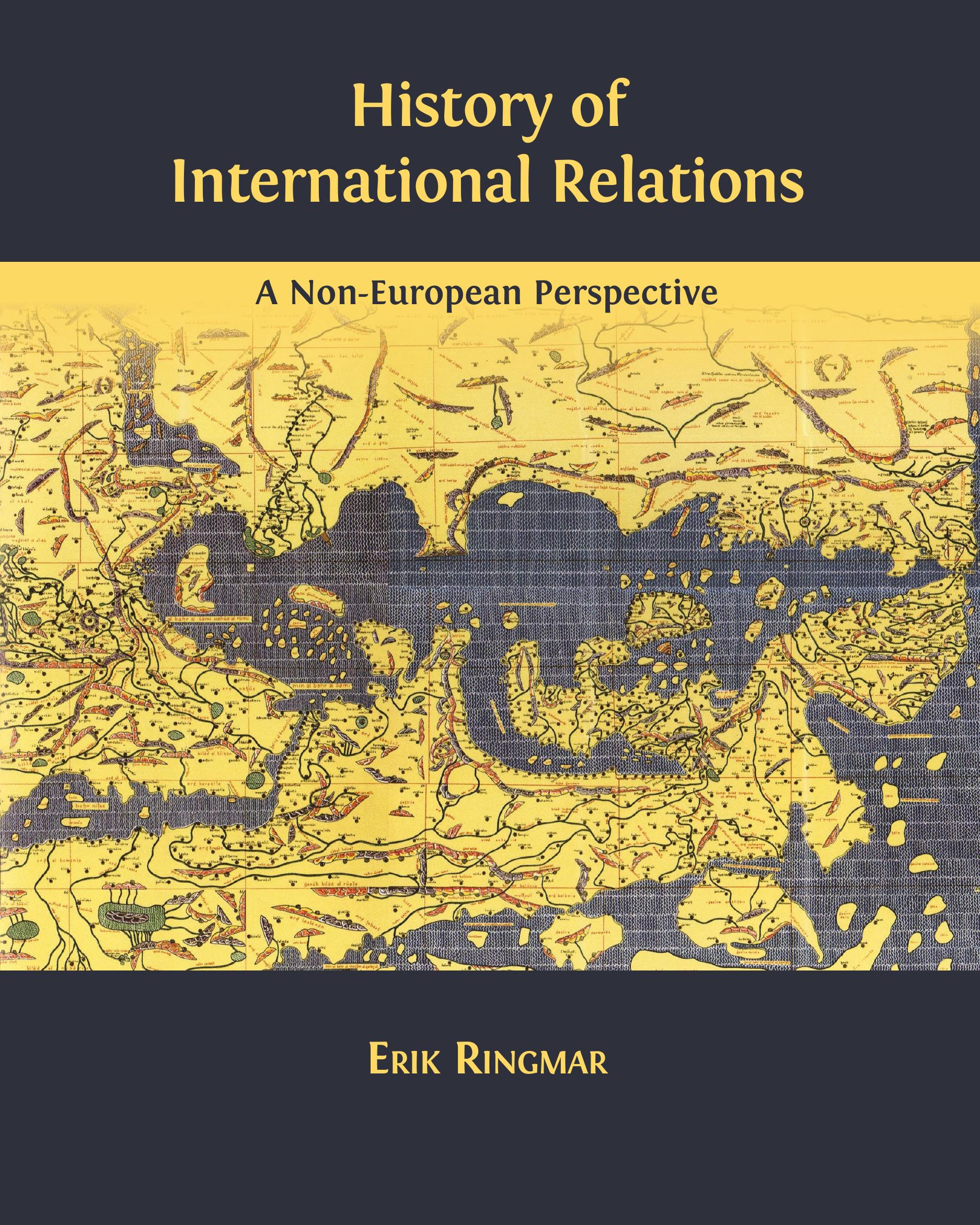
| Title | History of International Relations |
|---|---|
| Subtitle | A Non-European Perspective |
| Contributor | Erik Ringmar(opens in new tab)(author) |
| DOI | https://doi.org/10.11647/OBP.0074(opens in new tab) |
| Landing page | https://www.openbookpublishers.com/books/10.11647/obp.0074(opens in new tab) |
| License | http://creativecommons.org/licenses/by/4.0/(opens in new tab) |
| Copyright | Erik Ringmar |
| Publisher | Open Book Publishers |
| Publication place | Cambridge, UK |
| Published on | 2019-07-31 |
| ISBN | 978-1-78374-022-2 (Paperback) |
| 978-1-78374-023-9 (Hardback) | |
| 978-1-78374-024-6 (PDF) | |
| 978-1-80064-498-4 (HTML) | |
| 978-1-78374-778-8 (XML) | |
| 978-1-78374-025-3 (EPUB) | |
| 978-1-78374-026-0 (MOBI) | |
| Short abstract | Existing textbooks on international relations treat history in a cursory fashion and perpetuate a Euro-centric perspective. This textbook pioneers a new approach by historicizing the material traditionally taught in International Relations courses, and by explicitly focusing on non-European cases, debates and issues. |
| Long abstract | Existing textbooks on international relations treat history in a cursory fashion and perpetuate a Euro-centric perspective. This textbook pioneers a new approach by historicizing the material traditionally taught in International Relations courses, and by explicitly focusing on non-European cases, debates and issues. The volume is divided into three parts. The first part focuses on the international systems that traditionally existed in Europe, East Asia, pre-Columbian Central and South America, Africa and Polynesia. The second part discusses the ways in which these international systems were brought into contact with each other through the agency of Mongols in Central Asia, Arabs in the Mediterranean and the Indian Ocean, Indic and Sinic societies in South East Asia, and the Europeans through their travels and colonial expansion. The concluding section concerns contemporary issues: the processes of decolonization, neo-colonialism and globalization – and their consequences on contemporary society. History of International Relations provides a unique textbook for undergraduate and graduate students of international relations, and anybody interested in international relations theory, history, and contemporary politics. |
| Print length | 216 pages (x+206) |
| Language | English (Original) |
| Dimensions | 203 x 15 x 254 mm | 8" x 0.59" x 10" (Paperback) |
| 203 x 19 x 254 mm | 8" x 0.75" x 10" (Hardback) | |
| Weight | 1305g | 46.03oz (Paperback) |
| 1842g | 64.97oz (Hardback) | |
| Media | 9 illustrations |
| 14 tables | |
| OCLC Number | 1135530383 |
| LCCN | 2019452864 |
| BIC |
|
| BISAC |
|
| LCC |
|
| Keywords |
|
Contents
- Introduction
- Erik Ringmar
- China and East Asia
- Erik Ringmar
- India and Indianization
- Erik Ringmar
- The Muslim Caliphates
- Erik Ringmar
- The Mongol Khanates
- Erik Ringmar
- Africa
- Erik Ringmar
- The Americas
- Erik Ringmar
- European Expansion
- Erik Ringmar
Contributors
Erik Ringmar
(author)Erik Ringmar is professor in the Department of Political Science and International Relations at Ibn Haldun University, Istanbul, Turkey. He graduated from Yale University in 1993 with a PhD in political science and has subsequently worked at the London School of Economics and as professor of international politics at Shanghai Jiaotong Daxue in Shanghai, China.