
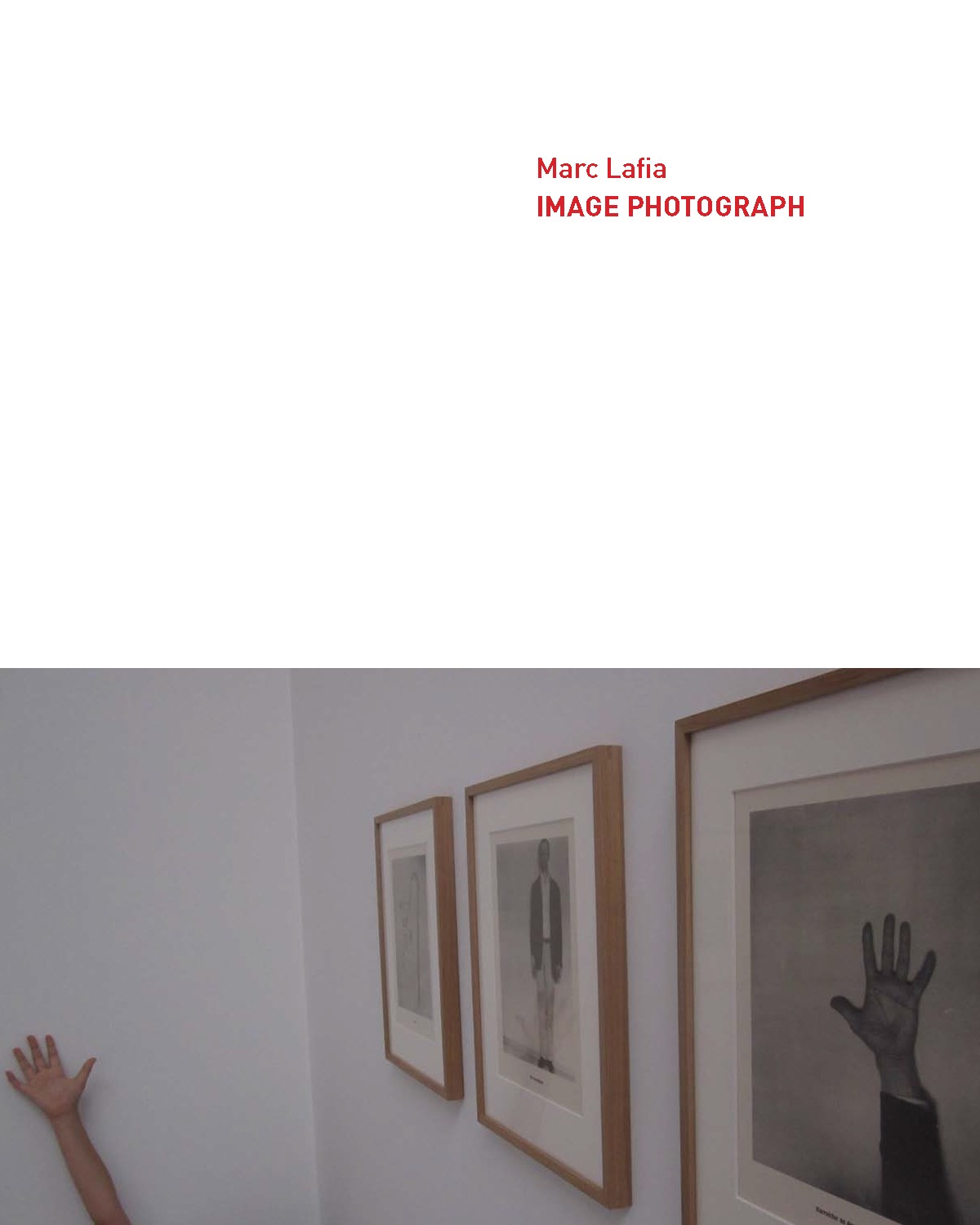
| Title | Image Photograph |
|---|---|
| Contributor | Marc Lafia (author) |
| DOI | https://doi.org/10.21983/P3.0106.1.00(opens in new tab) |
| Landing page | https://punctumbooks.com/titles/image-photograph/(opens in new tab) |
| License | https://creativecommons.org/licenses/by-nc-sa/4.0/(opens in new tab) |
| Copyright | Lafia, Marc |
| Publisher | punctum books |
| Publication place | Brooklyn, NY |
| Published on | 2015-07-01 |
| ISBN | 978-0-9882340-7-9 (Paperback) |
| Long abstract | We no longer live in the society of the spectacle, passively seeing the world. Now we perform our very own spectacle in a society that demands it at every turn. We’ve become advertisements of ourselves, our own PR agents, continually putting on a performance and measuring it hour by hour. This is no longer the society of the spectacle but the society of performance. All events have become a pretense to create the image, to orchestrate an image of images that is us. We believe the image confers on us a kind of immortality: just as the artist believes her works collected by a major museum will do the same, we believe the network will forever host the archive we build everyday. The image that is us lives in the circulation of the network. Though a file, though virtual and malleable, made out of bits and instantly accessible to anyone who wants to find it around the world, this image that lives only lives on screen, as virtual as it might be, is a material fact. In its impression, its reception, its archivability, its remixability, the electronic image is today’s photograph. Image Photograph is a book about, and of, this transformation of the image. In three essays — a foreword by critic and philosopher, Daniel Coffeen; an essay of images and text that explores the varied rhetorics of the image; and a strictly visual essay — the book presents a traversal through photography to arrive at a new understanding of images, what Lafia calls the image-photograph. As Coffeen states, Which is to say, Lafia presents and examines imaging across a breadth of moods, tropes, and contexts in order to see and engage this new technology of image-seeing and image-making — this image-photograph — as it exists today in our age of electronic inscription and networked culture. At once artist book and critical theory, Image Photograph takes its direction from Walter Benjamin’s Arcades, John Berger’s Ways of Seeing and, more recently, Hito Steyerl’s The Wretched of the Screen. Throughout it, Lafia not only writes about the image but constructs images — and, finally, performs this new space of the image-photograph. |
| Print length | 310 pages |
| Language | English (Original) |
| Dimensions | 203 x 254 mm | 8" x 10" (Paperback) |
| THEMA |
|
| BIC |
|
| BISAC |
|
| Keywords |
|
Contributors
Marc Lafia
(author)Marc Lafia(opens in new tab) is an American artist and filmmaker whose work emerges with network culture as it changes the nature of the image and the circulation of cultural objects. An early innovator in the “post-internet,” he turned to it often incisively and humorously in his computational games, prints, films and installations to reexamine art and its history as an ecstatic artifact. He has been exhibited at the Walker Art Center, the Whitney Museum of American Art, the Tate Online, the ZKM, the Centre Pompidou, Anthology Film Archives, International Film Festival Rotterdam, The Minsheng Museum of Art in Shanghai, and most recently at the Shenzhen Sculpture Biennale 2014. He has taught at Stanford University, the San Francisco Art Institute, Art Center College of Design in Pasadena, Pratt Institute and Columbia University.