
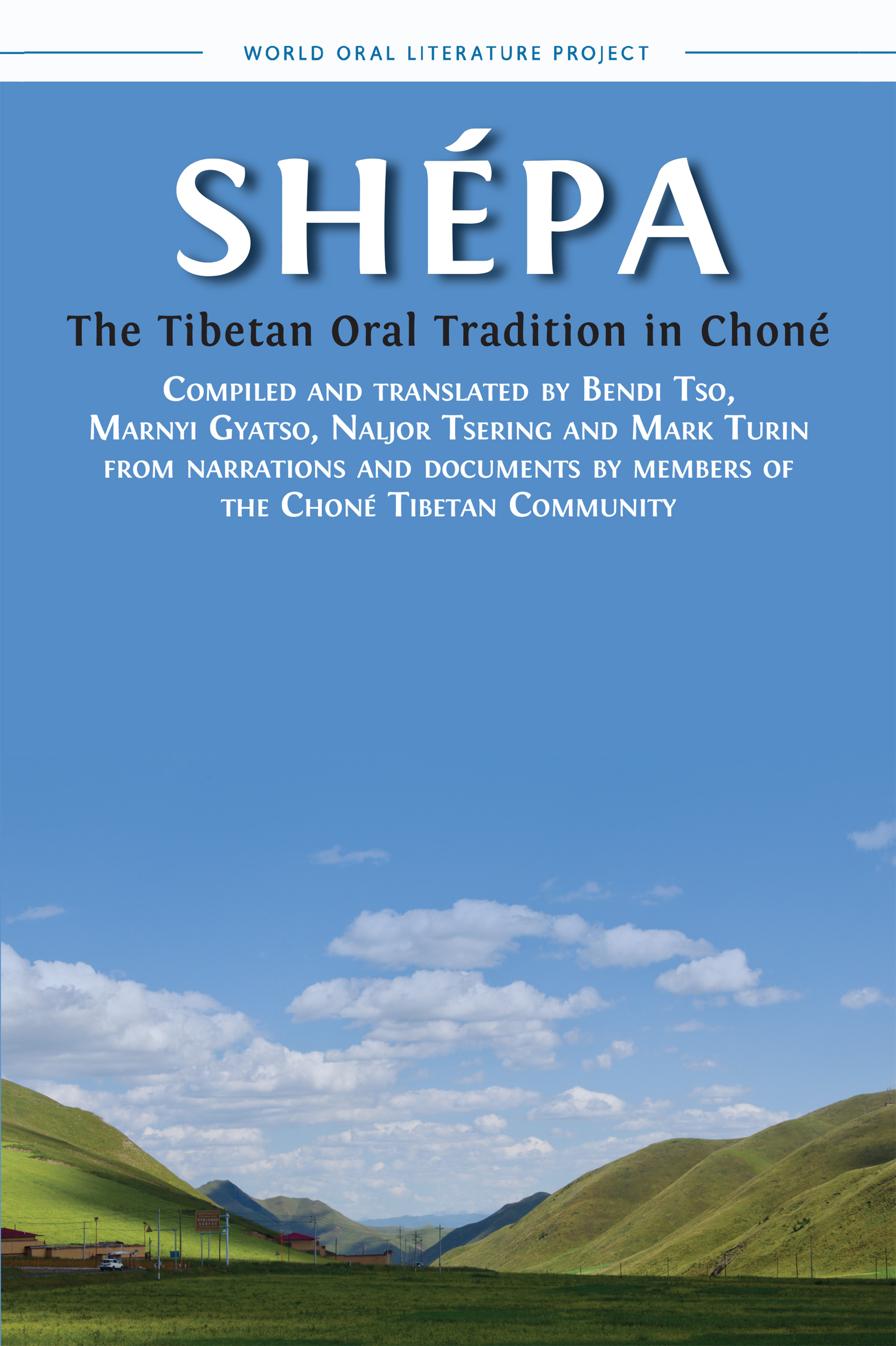
| Title | Shépa |
|---|---|
| Subtitle | The Tibetan Oral Tradition in Choné |
| Contributor | Bendi Tso(opens in new tab)(author) |
| Marnyi Gyatso (author) | |
| Naljor Tsering (author) | |
| Mark Turin(opens in new tab)(author) | |
| Members of the Choné Tibetan Community (author) | |
| DOI | https://doi.org/10.11647/OBP.0312(opens in new tab) |
| Landing page | https://www.openbookpublishers.com/books/10.11647/obp.0312(opens in new tab) |
| License | https://creativecommons.org/licenses/by/4.0/(opens in new tab) |
| Copyright | Bendi Tso, Marnyi Gyatso, Naljor Tsering and Mark Turin acting as Trustees for the Members of the Choné Tibetan Community |
| Publisher | Open Book Publishers |
| Publication place | Cambridge, UK |
| Published on | 2023-10-04 |
| Series |
|
| ISBN | 978-1-80064-800-5 (Paperback) |
| 978-1-80064-801-2 (Hardback) | |
| 978-1-80064-802-9 (PDF) | |
| Short abstract | This book contains a unique collection of Tibetan oral narrations and songs known as Shépa, as these have been performed, recorded and shared between generations of Choné Tibetans from Amdo living in the eastern Tibetan Plateau. Presented in trilingual format — in Tibetan, Chinese and English — the book reflects a sustained collaboration with and between members of the local community, including narrators, monks, and scholars, calling attention to the diversity inherent in all oral traditions, and the mutability of Shépa in particular. |
| Long abstract | Shépa: ‘explanation’ or ‘elucidation’ in Tibetan. A form of oral poetry sung antiphonally in a question-and-answer style. This book contains a unique collection of Tibetan oral narrations and songs known as Shépa, as these have been performed, recorded and shared between generations of Choné Tibetans from Amdo living in the eastern Tibetan Plateau. Presented in trilingual format — in Tibetan, Chinese and English — the book reflects a sustained collaboration with and between members of the local community, including narrators, monks, and scholars, calling attention to the diversity inherent in all oral traditions, and the mutability of Shépa in particular. From creation myths to Bon and Buddhist cosmologies and even wedding songs, Shépa engages with and draws on elements of religious traditions, historical legacies and deep-seated cultural memories within Choné and Tibet, revealing the multi-layered conceptualization of the Tibetan physical world and the resilience of Tibetan communities within it. This vital and unique collection, part of the World Oral Literature Series, situates Shépa in its ethnographic context, offering insights into the preservation and revitalization of intangible cultural heritage in the context of cultural Tibet, Indigenous studies and beyond. Scholars and students in the fields of anthropology, linguistics, ethnic and minority relations, critical Indigenous studies, Tibetan studies, Himalayan studies, Asian studies and the broader study of China will find much to reward them in this book, as will all readers interested in the documentation and preservation of endangered oral traditions, intangible cultural heritage, performance and textuality, and Tibetan literature and religions. |
| Print length | 804 pages (xxii+782) |
| Language | Chinese (Original) |
| English (Original) | |
| Tibetan (Original) | |
| Dimensions | 156 x 41 x 234 mm | 6.14" x 1.61" x 9.21" (Paperback) |
| 156 x 59 x 234 mm | 6.14" x 2.32" x 9.21" (Hardback) | |
| Weight | 1107g | 39.05oz (Paperback) |
| 1303g | 45.96oz (Hardback) | |
| Media | 7 illustrations |
| OCLC Number | 1402804683 |
| LCCN | 2022361354 |
| THEMA |
|
| BIC |
|
| BISAC |
|
| LCC |
|
| Keywords |
|
Contents
- Bendi Tso
- Marnyi Gyatso
- Naljor Tsering
- Mark Turin
- Bendi Tso
- Bendi Tso
- Marnyi Gyatso
- Naljor Tsering
- Mark Turin
- Bendi Tso
- Marnyi Gyatso
- Naljor Tsering
- Mark Turin
- Members of the Choné Tibetan Community
- Bendi Tso
- Marnyi Gyatso
- Naljor Tsering
- Mark Turin
- Members of the Choné Tibetan Community
- Bendi Tso
- Marnyi Gyatso
- Naljor Tsering
- Mark Turin
- Members of the Choné Tibetan Community
- Bendi Tso
- Marnyi Gyatso
- Naljor Tsering
- Mark Turin
- Members of the Choné Tibetan Community
- Bendi Tso
- Marnyi Gyatso
- Naljor Tsering
- Mark Turin
- Members of the Choné Tibetan Community
- Bendi Tso
- Marnyi Gyatso
- Naljor Tsering
- Mark Turin
- Members of the Choné Tibetan Community
- Bendi Tso
- Marnyi Gyatso
- Naljor Tsering
- Mark Turin
- Members of the Choné Tibetan Community
- Bendi Tso
- Marnyi Gyatso
- Naljor Tsering
- Mark Turin
- Members of the Choné Tibetan Community
Contributors
Bendi Tso
(author)Bendi Tso is a sociocultural anthropologist working on borderlands, ethnicity, Indigeneity, and the documentation of oral traditions in China. She is currently working on a book project that examines the negotiation of an essentialized Tibetanness among disparate Tibetan subgroups on the Sino-Tibetan borderland characterized by ambiguity and transition. Bendi Tso received her Ph.D. in Anthropology from the University of British Columbia (2023) and is an incoming postdoctoral fellow in the Center for East Asian Studies at Stanford University (2024).
Marnyi Gyatso
(author)Marnyi Gyatso is a historian of empires and frontiers in East Asia. He is a Postdoctoral Associate at the Council on East Asian Studies of Yale University. His research focuses on the interaction and exchange between China and Inner Asia from the fourteenth to the twentieth century. He is currently working on a book project that examines China’s transition from empire to nation-state in Inner Asia between 1862 and 1962. He is also editing a book that explores how different ethnic groups along the rivers of the eastern Tibetan Plateau have adapted to, negotiated with, transformed, and interpreted their natural surroundings.
Naljor Tsering
(author)Naljor Tsering is a Ph.D. candidate in Ethnology at Southwest Minzu University and in Tibetan History and Philology at École Pratique des Hautes Études, PSL. He is also a member of the Center for Research on East Asian Civilizations. His research interests include Tibetan Indigenous beliefs, ritual practices, early Bon treasure literature, and Tibetan oral tradition. He is currently participating in the project entitled “Protecting the Kingdom with Tibetan Manuscripts: Codicological and Historical Analysis of the Royal Drangsong Collection from Mustang, Nepal.”
Mark Turin
(author)Mark Turin is an anthropologist, linguist and occasional radio presenter, and an Associate Professor of Anthropology at the University of British Columbia. Mark Turin writes and teaches on language reclamation, revitalization, documentation and conservation; language mapping, policies, politics and language rights; orality, archives, digital tools and technology. Indigenous methodologies and decolonial practice inform and shape his teaching and research. He is the author or co-author of four books, three travel guides, the editor of twelve volumes, and he edits the World Oral Literature Series with Open Book Publishers.