
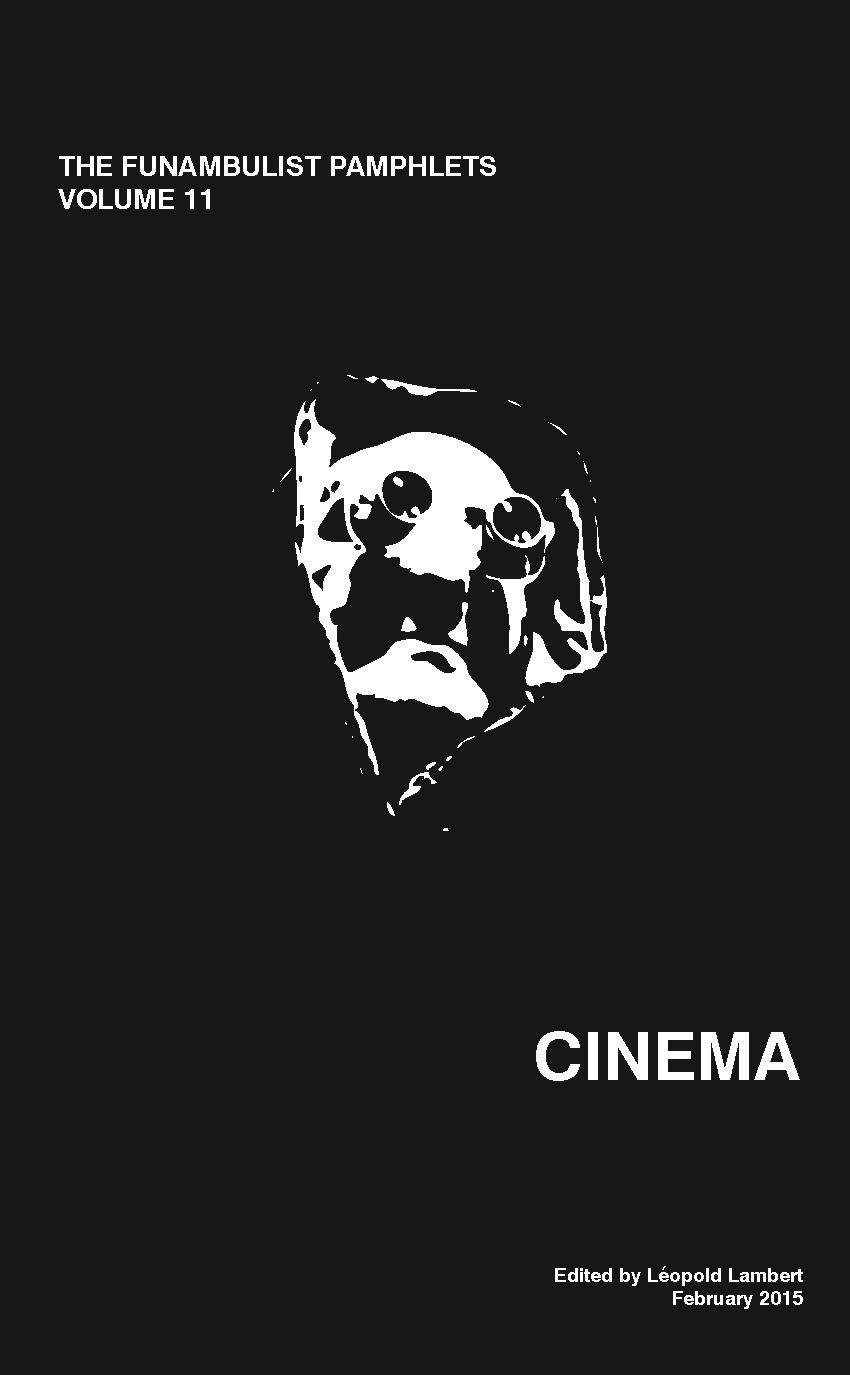
| Title | The Funambulist Pamphlets 11 |
|---|---|
| Subtitle | Cinema |
| Contributor | Léopold Lambert (editor) |
| DOI | https://doi.org/10.21983/P3.0095.1.00(opens in new tab) |
| Landing page | https://punctumbooks.com/titles/the-funambulist-pamphlets-11-cinema/(opens in new tab) |
| License | https://creativecommons.org/licenses/by-nc-sa/3.0/(opens in new tab) |
| Copyright | Lambert, Léopold |
| Publisher | punctum books |
| Publication place | Brooklyn, NY |
| Published on | 2015-02-20 |
| Book set | This book is part of a 11-volume set. Other volumes in the set are:
|
| ISBN | 978-0-692-39026-9 (Paperback) |
| Long abstract | The Funambulist Pamphlets is a series of small books archiving articles published on The Funambulist(opens in new tab), collected according to specific themes. These volumes propose a different articulation of texts than the usual chronological one. The eleven volumes are respectively dedicated to Spinoza, Foucault, Deleuze, Legal Theory, Occupy Wall Street, Palestine, Cruel Designs, Arakawa + Madeline Gins, Science Fiction, Literature, and Cinema. See all published pamphlets HERE(opens in new tab). Volume 11 is devoted to the topic of Cinema: Spike Lee, Béla Tarr, Michelangelo Antonioni and the many other filmmakers named in this volume do not seem to have much in common at first sight; nevertheless, considered through the interpretation of a Spinozist materialist philosophy, their films might have something to say to one another. Take the mud of Red Desert (Antonioni), the volcanic slopes of The Bad Sleep Well (Kurosawa) and the soil of Pina Bausch’s Rite of Spring magnified in Pina (Wenders), for example. What these material manifestations have in common is that they are all in relation with bodies, themselves assemblages of moving matter. Similarly, consider Spike Lee’s dolly shot, Orson Welles’s labyrinth, Béla Tarr’s entropy, and Peter Watkins’s democratic improvisations: they all manifest the power of immanence and its inexorability. These films involve no deus ex machina; everything in them comes ‘from the ground’ in a continuous refusal of a celestial or other form of transcendence. Developing this kind of reading of these films allows us to avoid a traditional chronological reading of history of cinema in favor of another, one more dedicated to the philosophical vision of the world that cinema triggers. |
| Print length | 110 pages |
| Language | English (Original) |
| Dimensions | 108 x 175 mm | 4.25" x 6.88" (Paperback) |
| THEMA |
|
| BIC |
|
| BISAC |
|
| Keywords |
|
Contributors
Léopold Lambert
(editor)Léopold Lambert (born in 1985) is a French architect who has lived in Paris, Hong Kong, and Mumbai and currently resides in New York. His approach to architecture consists in a delicate articulation between theoretical research and a frank enthusiasm for design. Such an articulation has been explicated in his book Weaponized Architecture: The Impossibility of Innocence(opens in new tab) (dpr-barcelona, 2012), which attempts to examine the characteristics that make architecture an inherent political weapon through global research as well as an architectural project specific to the Israeli civil and military occupation of the West Bank. He is also the author of the graphic novel, Lost in the Line(opens in new tab). He finds his architectural inspiration from films, novels, and political philosophy books, rather than in architectural theory texts.