
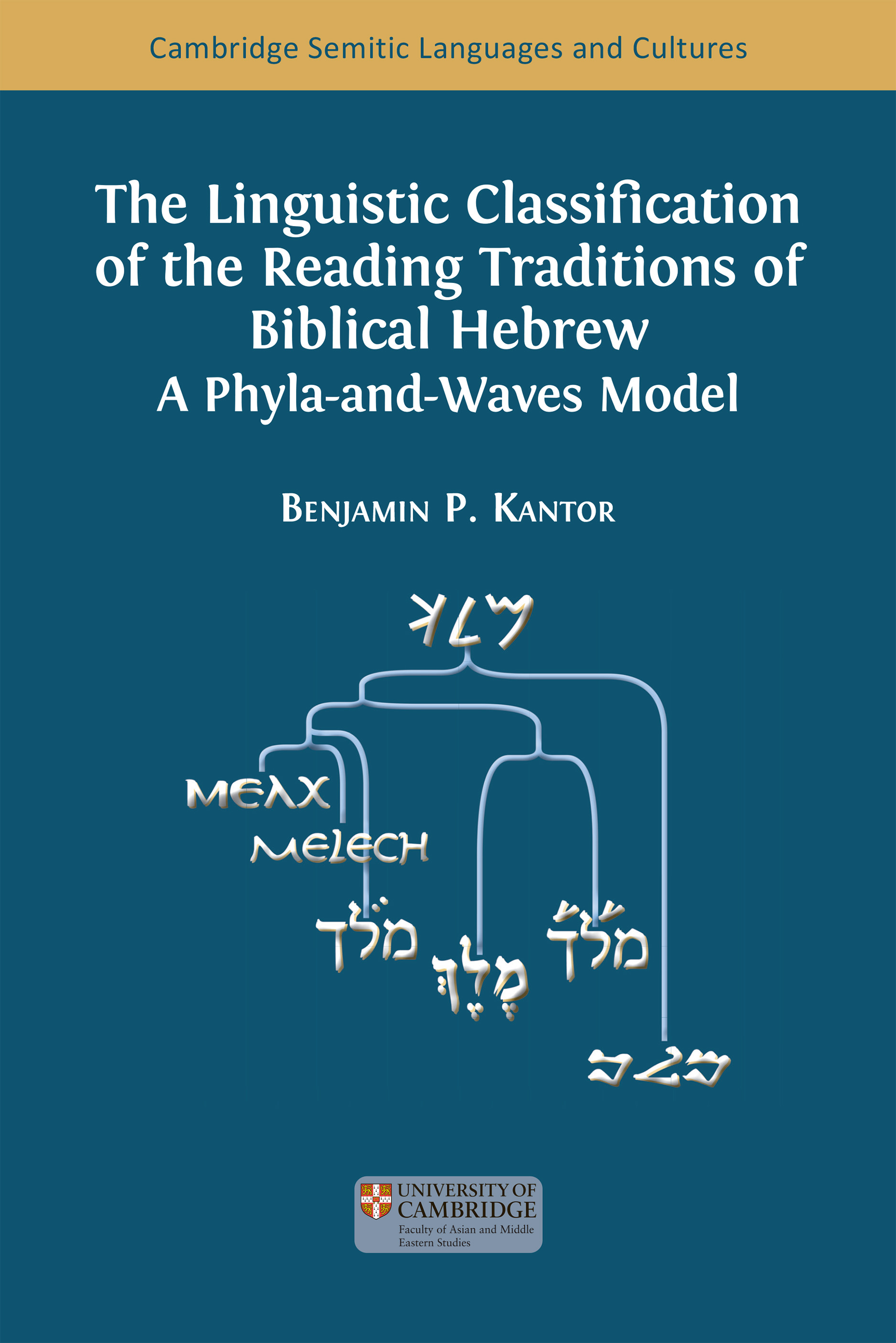
| Title | The Linguistic Classification of the Reading Traditions of Biblical Hebrew |
|---|---|
| Subtitle | A Phyla-and-Waves Model |
| Contributor | Benjamin Paul Kantor (author) |
| DOI | https://doi.org/10.11647/OBP.0210(opens in new tab) |
| Landing page | https://www.openbookpublishers.com/books/10.11647/obp.0210(opens in new tab) |
| License | http://creativecommons.org/licenses/by-nc/4.0/(opens in new tab) |
| Copyright | Benjamin Kantor |
| Publisher | Open Book Publishers |
| Publication place | Cambridge, UK |
| Published on | 2023-08-30 |
| Series |
|
| ISBN | 978-1-78374-953-9 (Paperback) |
| 978-1-78374-954-6 (Hardback) | |
| 978-1-78374-955-3 (PDF) | |
| Short abstract | In recent decades, the field of Biblical Hebrew philology and linguistics has been witness to a growing interest in the diverse traditions of Biblical Hebrew. Indeed, while there is a tendency for many students and scholars to conceive of Biblical Hebrew as equivalent with the Tiberian pointing of the Leningrad Codex as it appears in Biblia Hebraica Stuttgartensia (BHS), there are many other important reading traditions attested throughout history. |
| Long abstract | In recent decades, the field of Biblical Hebrew philology and linguistics has been witness to a growing interest in the diverse traditions of Biblical Hebrew. Indeed, while there is a tendency for many students and scholars to conceive of Biblical Hebrew as equivalent with the Tiberian pointing of the Leningrad Codex as it appears in Biblia Hebraica Stuttgartensia (BHS), there are many other important reading traditions attested throughout history. Origen’s Secunda reflects a late Roman reading tradition of Biblical Hebrew transcribed into Greek letters. Occasional transcriptions of Biblical Hebrew into Latin letters in Jerome’s commentaries similarly reflect a reading tradition from early Byzantine Palestine. In the medieval period, alongside Tiberian Hebrew we also find the Babylonian tradition and the Palestinian tradition. The modern oral reading tradition of the Samaritan community also likely has roots in the Second Temple period. Aside from these primary attestations of the reading traditions, there are a whole host of other modern reading traditions of Biblical Hebrew, from Ashkenazi, to Sephardi, and Yemenite. Despite the rich diversity of traditions of Biblical Hebrew at our fingertips, the linguistic relationship between them has never been mapped out. In this book, then, the phyla-and-waves methodology, which has been used for Semitic language classification, is used to map out the relationship between the main reading traditions of Biblical Hebrew throughout history. |
| Print length | 228 pages (xxii+216) |
| Language | English (Original) |
| Dimensions | 156 x 16 x 234 mm | 6.14" x 0.63" x 9.21" (Paperback) |
| 156 x 19 x 234 mm | 6.14" x 0.75" x 9.21" (Hardback) | |
| Weight | 438g | 15.45oz (Paperback) |
| 612g | 21.59oz (Hardback) | |
| Media | 3 illustrations |
| OCLC Number | 1398181921 |
| LCCN | 2022361430 |
| THEMA |
|
| BIC |
|
| BISAC |
|
| LCC |
|
| Keywords |
|
Contents
- Introduction
- Benjamin Paul Kantor
- Methodology
- Benjamin Paul Kantor
- The Historical Attestations of the Biblical Hebrew Reading Traditions
- Benjamin Paul Kantor
- PHYLA: ‘Shared Innovations’ among the Reading Traditions
- Benjamin Paul Kantor
- WAVES: Influence, Contact, and Convergence
- Benjamin Paul Kantor
- Relationship of the Reading Traditions
- Benjamin Paul Kantor