
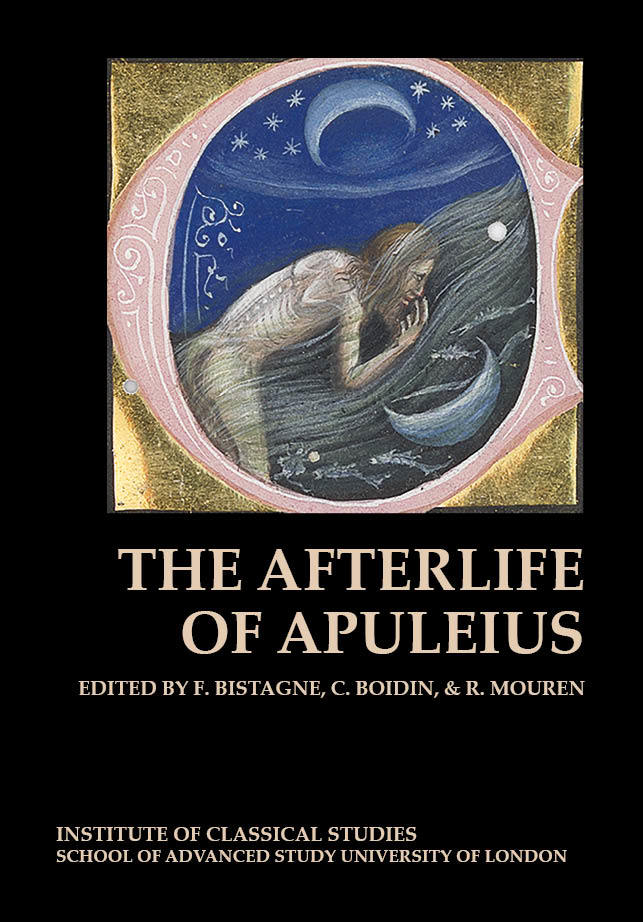
| Title | The Afterlife of Apuleius |
|---|---|
| Contributor | F. Bistagne (editor) |
| C. Boidin (editor) | |
| R. Mouren (editor) | |
| DOI | https://doi.org/10.14296/121.9781905670956(opens in new tab) |
| Landing page | https://uolpress.co.uk/book/the-afterlife-of-apuleius/(opens in new tab) |
| License | https://creativecommons.org/licenses/by-nc/4.0/(opens in new tab) |
| Copyright | Authors |
| Publisher | University of London Press |
| Publication place | London, GB |
| Published on | 2021-01-28 |
| Series |
|
| ISBN | 978-1-905670-88-8 (Paperback) |
| 978-1-905670-95-6 (PDF) | |
| 978-1-914477-46-1 (HTML) | |
| 978-1-905670-96-3 (EPUB) | |
| Short abstract | Apuleius’ literary and philosophical fortune has been considerable since antiquity, mostly through the reception of The Golden Ass. The aim of this collection is to highlight a few major aspects of this afterlife, from the High Middle Ages to early Romanticism, in the fields of literature, linguistics and philology, within a wide geographical scope. |
| Long abstract | Apuleius’ literary and philosophical fortune has been considerable since antiquity, mostly through the reception of The Golden Ass. The aim of this collection of essays is to highlight a few major aspects of this afterlife, from the High Middle Ages to early Romanticism, in the fields of literature, linguistics and philology, within a wide geographical scope. The volume gathers the proceedings of an international conference held in March 2016 at the Warburg Institute in London, in association with the Institute of Classical Studies. It includes both diachronic overviews and specific case-studies. A first series of papers focuses on The Golden Ass and its historical and geographical diffusion, from High Medieval Europe to early modern Mexico. The oriental connections of the book are also taken into account. The second part of the book examines the textual and visual destiny of Psyche’s story from the Apuleian fabula to allegorical retellings, in poetical or philosophical books and on stage. As the third series of essays indicates, the fortunes of the book led many ancient and early modern writers and translators to use it as a canonical model for reflections about the status of fiction. It also became, mostly around the beginning of the fifteenth century, a major linguistic and stylistic reference for lexicographers and neo-Latin writers : the last papers of the book deal with Renaissance polemics about ‘Apuleianism’ and the role of editors and commentators. |
| Print length | 230 pages |
| Language | English (Original) |
| Dimensions | 170 x 16 x 244 mm | 6.69" x 0.63" x 9.63" (Paperback) |
| Weight | 501g | 17.75oz (Paperback) |
| THEMA |
|
| BIC |
|
| BISAC |
|
| Keywords |
|