
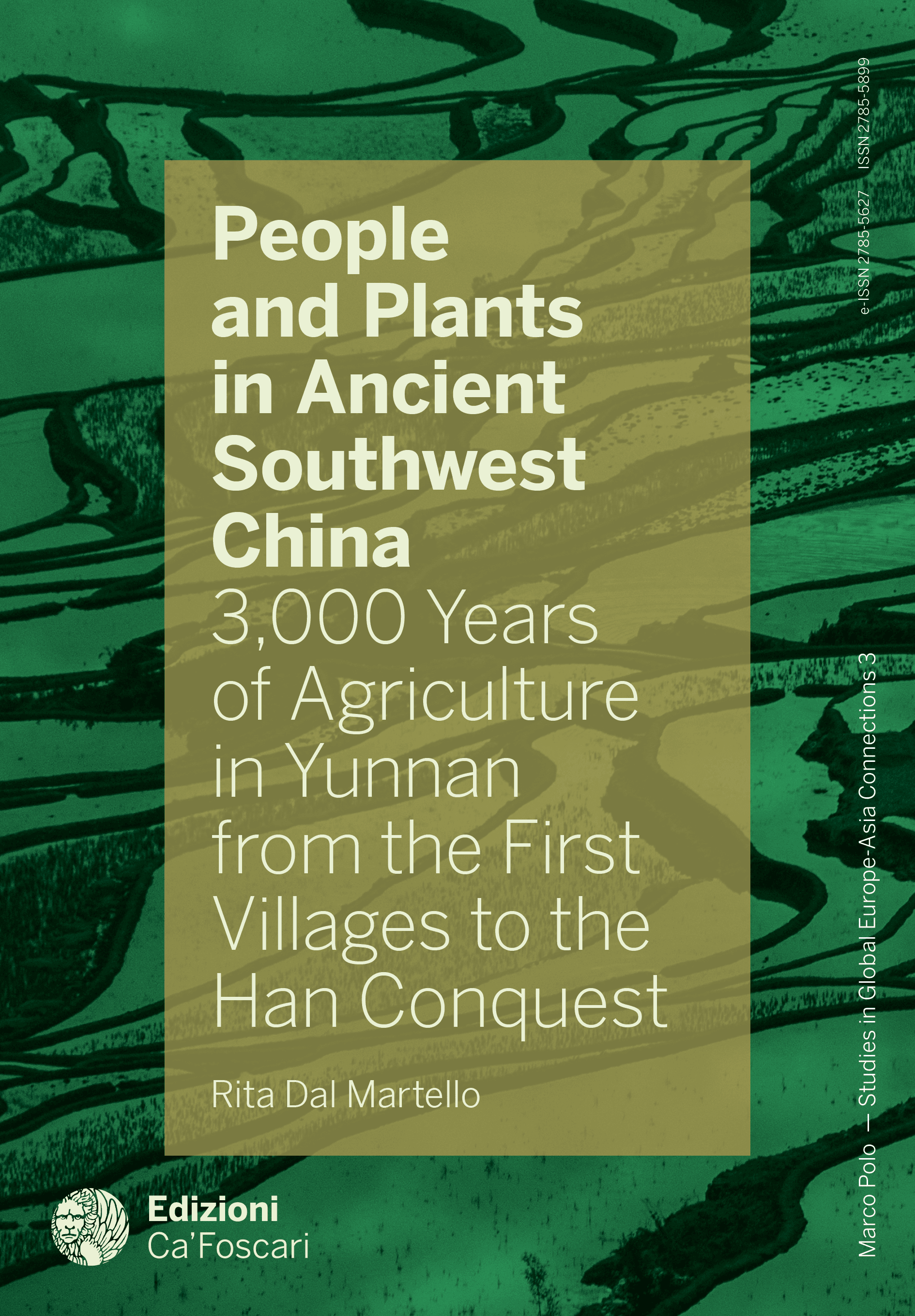
| Title | People and Plants in Ancient Southwest China |
|---|---|
| Subtitle | 3,000 Years of Agriculture in Yunnan from the First Villages to the Han Conquest |
| Contributor | Rita Dal Martello (author) |
| DOI | https://doi.org/10.30687/978-88-6969-935-1(opens in new tab) |
| Landing page | https://edizionicafoscari.it/en/edizioni4/libri/978-88-6969-936-8/(opens in new tab) |
| License | https://creativecommons.org/licenses/by/4.0/(opens in new tab) |
| Copyright | Rita Dal Martello |
| Publisher | Edizioni Ca’ Foscari – Venice University Press |
| Publication place | Venice, Italy |
| Published on | 2025-09-18 |
| Series |
|
| ISBN | 978-88-6969-935-1 (PDF) |
| Short abstract | Today Yunnan is a highly productive agricultural region within Southwest China. Located at the ecological transition between temperate and tropical East Asia, the mild year-round climate supports up to three crop harvests per year in some areas. This has allowed it to become the fourth largest exporter of vegetable products in the country, despite having been considered to have only 6% of land originally suitable for agriculture. How did Yunnan become such an agriculturally productive region? This book examines the accumulated archaeological evidence for ancient plant remains in Yunnan and reconstructs the origin and development of farming practices in the province. Covering the period from the first sedentary villages to the Han conquest of the Dian Kingdom (third millennium BCE to early first millennium CE), the book also explores the local evolution of farming in the broader context of external connections and local adaptations. Special attention is given to the Sanjiang area, where the Yangzi, Mekong, and Salween rivers converge, creating a hub for connections between East, South and Southeast Asia, as well as the Dian Basin, the core region of the Dian Kingdom. By analysing crops cultivation and uses, and comparing findings from Yunnan with those from broader Southwest China and mainland Southeast Asia, this monograph addresses the question of early human migrations in and out of Yunnan, and how these impacted the evolution of the region’s first agricultural societies, ultimately laying the basis for the flourishing agricultural production we see in the province today. |
| Long abstract | Today Yunnan is a highly productive agricultural region within Southwest China. Located at the ecological transition between temperate and tropical East Asia, the mild year-round climate supports up to three crop harvests per year in some areas. This has allowed it to become the fourth largest exporter of vegetable products in the country, despite having been considered to have only 6% of land originally suitable for agriculture. How did Yunnan become such an agriculturally productive region? This book examines the accumulated archaeological evidence for ancient plant remains in Yunnan and reconstructs the origin and development of farming practices in the province. Covering the period from the first sedentary villages to the Han conquest of the Dian Kingdom (third millennium BCE to early first millennium CE), the book also explores the local evolution of farming in the broader context of external connections and local adaptations. Special attention is given to the Sanjiang area, where the Yangzi, Mekong, and Salween rivers converge, creating a hub for connections between East, South and Southeast Asia, as well as the Dian Basin, the core region of the Dian Kingdom. By analysing crops cultivation and uses, and comparing findings from Yunnan with those from broader Southwest China and mainland Southeast Asia, this monograph addresses the question of early human migrations in and out of Yunnan, and how these impacted the evolution of the region’s first agricultural societies, ultimately laying the basis for the flourishing agricultural production we see in the province today. |
| Language | Italian (Original) |
| THEMA |
|
| BISAC |
|
| Keywords |
|