
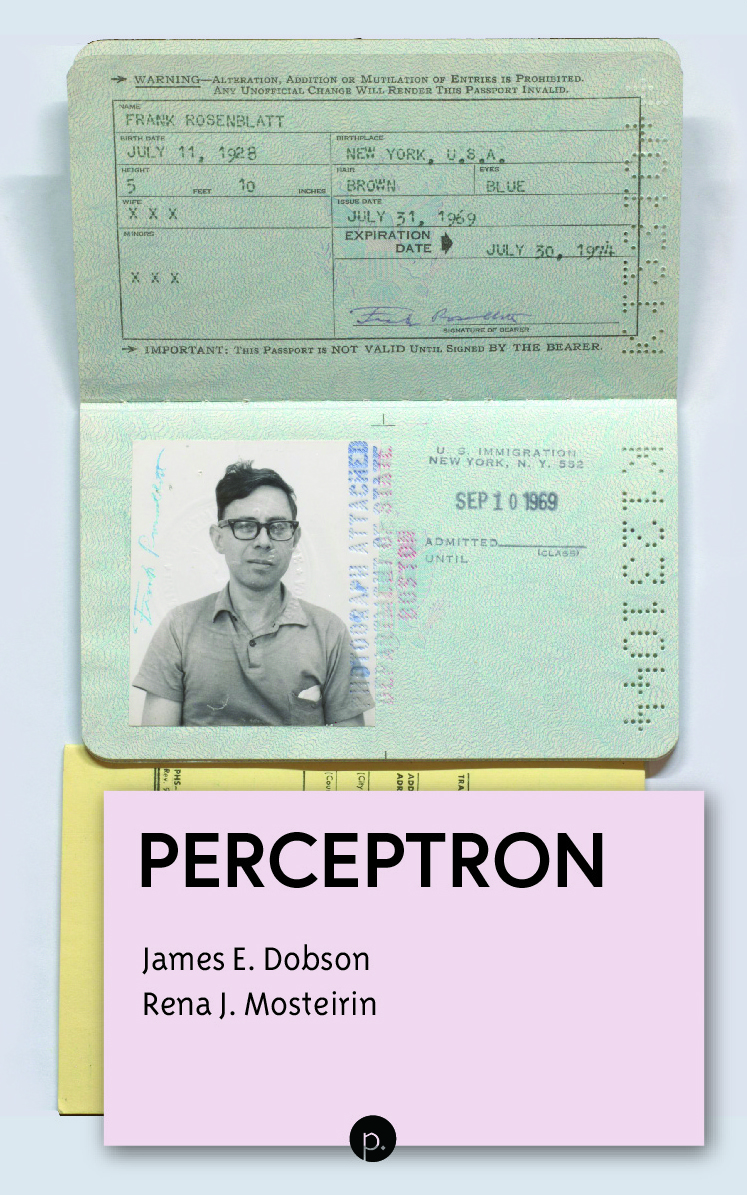
| Title | Perceptron |
|---|---|
| Contributor | James E. Dobson(opens in new tab)(author) |
| Rena J. Mosteirin (author) | |
| DOI | https://doi.org/10.53288/0408.1.00(opens in new tab) |
| Landing page | https://punctumbooks.com/titles/perceptron/(opens in new tab) |
| License | https://creativecommons.org/licenses/by-nc-sa/4.0/(opens in new tab) |
| Copyright | James E. Dobson and Rena J. Mosteirin |
| Publisher | punctum books |
| Publication place | Earth, Milky Way |
| Published on | 2025-11-21 |
| ISBN | 978-1-68571-216-7 (Paperback) |
| 978-1-68571-217-4 (PDF) | |
| 978-1-68571-298-3 (EPUB) | |
| Long abstract | Perceptron is a work of experimental poetry and a critical biographical reading of Frank Rosenblatt (1928–1971) and his 1957 invention, the Perceptron. The Perceptron was the first widely publicized and used machine learning device and the origin of much contemporary neural network technology. Rosenblatt was a psychologist, a computer engineer, a musician, an amateur astronomer, a sailor, and a poet. The Perceptron was born from an interdisciplinary mix of ideas and was so far ahead of its time that it was widely misunderstood by other scientists and the public. This mechanical invention, imagined as an alternative to general purpose digital computers, and its algorithmic implementation as a simulation of the device was deeply rooted in mid-twentieth-century neuroscience and psychological theories of behavior. Introduced to the world by one newspaper under the headline “Shades of Frankenstein!” in 1958, following a public demonstration in Maryland sponsored by the US Navy, the Perceptron was a radical new approach to designing computer systems. What made it different was its design as a simplified model of animal vision systems. The Perceptron could perform pattern recognition and matching from a collection of simple visual objects. It was innovative and impressive, but it was also constantly oversold by its financial supporters, the press, and by its inventor. Perceptron traces, contextualizes, and celebrates the ideas that would become embedded in this early thinking machine and that animated the excitement and promise that would eventually turn to frustration and failure during Rosenblatt’s tragically short lifetime. |
| Print length | 182 pages |
| Language | English (Original) |
| Dimensions | 127 x 10 x 203 mm | 5" x 0.41" x 8" (Paperback) |
| Weight | 258g | 9.10oz (Paperback) |
| LCCN | 2025948625 |
| THEMA |
|
| BISAC |
|
| Keywords |
|
| Funding |
Contributors
James E. Dobson
(author)James E. Dobson is Associate Professor of English and creative writing at Dartmouth College. He is the author of Critical Digital Humanities: The Search for a Methodology (Illinois, 2019), and The Birth of Computer Vision (Minnesota, 2023) and co-author of Moonbit (punctum, 2019).
Rena J. Mosteirin
(author)Rena J. Mosteirin is the author of Nick Trail’s Thumb (Kore Press, 2008) chosen by Lydia Davis for the Kore Press Short Fiction Award, half-fabulous whales (Little Dipper, 2019), a book of Moby-Dick erasure poetry, and Experiment 116 (Counterpath, 2021). She is also the co-author of Moonbit (punctum, 2019). Mosteirin is a lecturer at Dartmouth College, editor at Bloodroot Literary Magazine, and owner of Left Bank Books in Hanover, New Hampshire.
References
- (opens in new tab)
- (opens in new tab)
- (opens in new tab)
- (opens in new tab)
- (opens in new tab)
- (opens in new tab)
- (opens in new tab)
- (opens in new tab)
- (opens in new tab)
- (opens in new tab)
- (opens in new tab)
- (opens in new tab)
- (opens in new tab)
- (opens in new tab)
- (opens in new tab)
- (opens in new tab)
- (opens in new tab)
- (opens in new tab)
- (opens in new tab)
- (opens in new tab)
- (opens in new tab)
- (opens in new tab)
- (opens in new tab)
- (opens in new tab)
- (opens in new tab)
- (opens in new tab)