
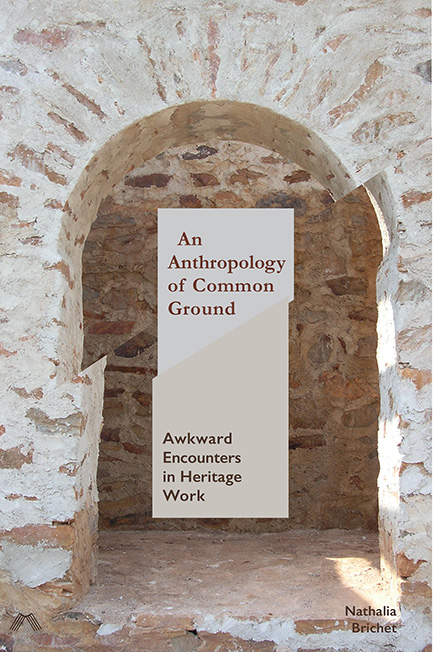
| Title | An Anthropology of Common Ground |
|---|---|
| Subtitle | Awkward Encounters in Heritage Work |
| Contributor | Nathalia Brichet(opens in new tab)(author) |
| DOI | https://doi.org/10.28938/9780995527799(opens in new tab) |
| Landing page | https://www.matteringpress.org/books/an-anthropology-of-common-ground(opens in new tab) |
| License | https://creativecommons.org/licenses/by-nc-sa/4.0/(opens in new tab) |
| Copyright | Nathalia Brichet |
| Publisher | Mattering Press |
| Publication place | Manchester |
| Published on | 2018-07-23 |
| ISBN | 978-0-9955277-9-9 (Paperback) |
| 978-1-912729-00-5 (PDF) | |
| Short abstract | Paying attention to details and ‘small stories’ as that which make worlds (heritage projects as well as ethnography), the book proposes a kind of postcolonial scholarship. Rather than uncovering or building up one story about the Danish-Ghanaian past, the work insists on providing ‘inconclusive’ analyses, collaboratively generated in the course of the project work and in the process of writing ethnographically about it. The ambition is to nurture fieldwork as an opportunity for creating a common ground, on which to think about what heritage and ethnography could be. Common ground, then, is not only an ideal of the joint heritage project, but an expression of an anthropological ambition. In consequence, the book is an account of a particular ethnographic research project – the ‘methods story’ being about how post-colonial relations might be noticed and supported and about how empirical research is done as relations between what is going on in the field and the way that the ethnographer chooses to tell the story of the field in the text. |
| Long abstract | Paying attention to details and ‘small stories’ as that which make worlds (heritage projects as well as ethnography), the book proposes a kind of postcolonial scholarship. Rather than uncovering or building up one story about the Danish-Ghanaian past, the work insists on providing ‘inconclusive’ analyses, collaboratively generated in the course of the project work and in the process of writing ethnographically about it. The ambition is to nurture fieldwork as an opportunity for creating a common ground, on which to think about what heritage and ethnography could be. Common ground, then, is not only an ideal of the joint heritage project, but an expression of an anthropological ambition. In consequence, the book is an account of a particular ethnographic research project – the ‘methods story’ being about how post-colonial relations might be noticed and supported and about how empirical research is done as relations between what is going on in the field and the way that the ethnographer chooses to tell the story of the field in the text. The book is structured around four different approaches, following a ‘crafting the field’ chapter (in lieu of a ‘context’ chapter). Each provides a qualification of heritage and ethnography – as components of positively and collaboratively generating what these phenomena even are. |
| Print length | 288 pages |
| Language | English (Original) |
| Dimensions | 152 x 17 x 229 mm | 5.98" x 0.67" x 9.02" (Paperback) |
| Weight | 427g | 15.06oz (Paperback) |
| Media | 25 illustrations |
| BISAC |
|
Contents
- Nathalia Brichet
- Nathalia Brichet
- Nathalia Brichet
- Nathalia Brichet
- Nathalia Brichet