
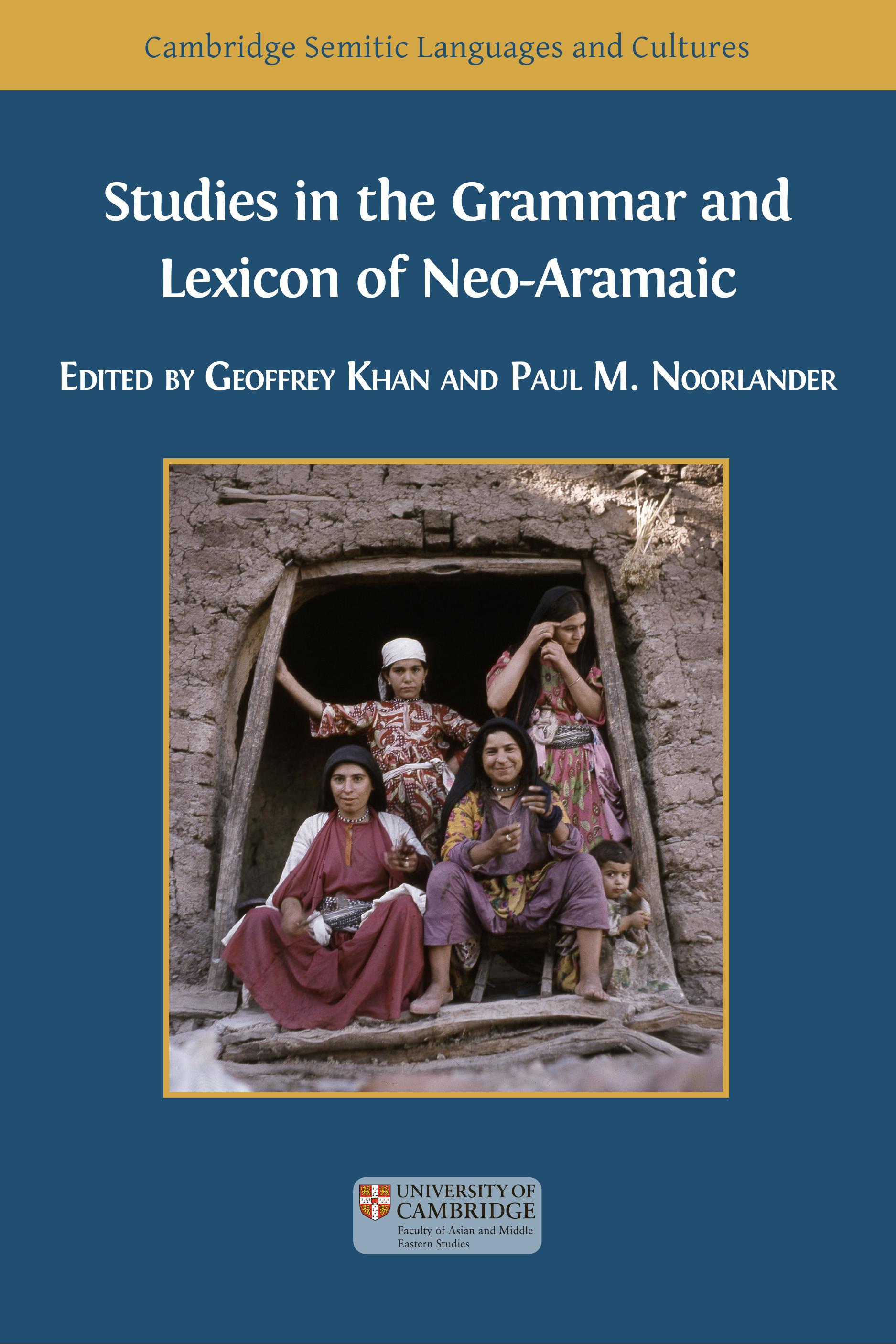
| Title | Studies in the Grammar and Lexicon of Neo-Aramaic |
|---|---|
| Contributor | Geoffrey Khan(opens in new tab)(editor) |
| Paul M. Noorlander(opens in new tab)(editor) | |
| DOI | https://doi.org/10.11647/OBP.0209(opens in new tab) |
| Landing page | https://www.openbookpublishers.com/books/10.11647/obp.0209(opens in new tab) |
| License | http://creativecommons.org/licenses/by/4.0/(opens in new tab) |
| Copyright | Geoffrey Khan; Paul M. Noorlander; |
| Publisher | Open Book Publishers |
| Publication place | Cambridge, UK |
| Published on | 2021-01-15 |
| Series |
|
| ISBN | 978-1-78374-947-8 (Paperback) |
| 978-1-78374-948-5 (Hardback) | |
| 978-1-78374-949-2 (PDF) | |
| 978-1-80064-617-9 (HTML) | |
| 978-1-78374-952-2 (XML) | |
| 978-1-78374-950-8 (EPUB) | |
| 978-1-78374-951-5 (MOBI) | |
| Short abstract | The papers in this volume represent the full range of research that is currently being carried out on Neo-Aramaic dialects. They advance the field in numerous ways. In order to allow linguists who are not specialists in Neo-Aramaic to benefit from the papers, the examples are fully glossed. |
| Long abstract | The Neo-Aramaic dialects are modern vernacular forms of Aramaic, which has a documented history in the Middle East of over 3,000 years. Due to upheavals in the Middle East over the last one hundred years, thousands of speakers of Neo-Aramaic dialects have been forced to migrate from their homes or have perished in massacres. As a result, the dialects are now highly endangered. The dialects exhibit a remarkable diversity of structures. Moreover, the considerable depth of attestation of Aramaic from earlier periods provides evidence for pathways of change. For these reasons the research of Neo-Aramaic is of importance for more general fields of linguistics, in particular language typology and historical linguistics. The papers in this volume represent the full range of research that is currently being carried out on Neo-Aramaic dialects. They advance the field in numerous ways. In order to allow linguists who are not specialists in Neo-Aramaic to benefit from the papers, the examples are fully glossed. |
| Print length | 540 pages (xxvi+514) |
| Language | English (Original) |
| Dimensions | 156 x 28 x 234 mm | 6.14" x 1.09" x 9.21" (Paperback) |
| 156 x 30 x 234 mm | 6.14" x 1.19" x 9.21" (Hardback) | |
| Weight | 1658g | 58.48oz (Paperback) |
| 2055g | 72.49oz (Hardback) | |
| Media | 1 illustration |
| OCLC Number | 1233023312 |
| LCCN | 2020447270 |
| BIC |
|
| BISAC |
|
| LCC |
|
| Keywords |
|
Contents
- Geoffrey Khan
- Eugene Barsky
- Sergey Loesov
- Paul M. Noorlander
- Dorota Molin
- Geoffrey Khan
- Eran Cohen
- Michael Waltisberg
- Ivri Bunis
- Steven E. Fassberg
- Ariel Gutman
- Lidia Napiorkowska
- Aziz Tezel
- Eugene Barsky
- Yulia Furman
- Hezy Mutzafi
- Alexey Lyavdansky
- Aziz Emmanuel Eliya Al-Zebari
- Salam Neamah Hirmiz Hakeem
- Sina Tezel
Contributors
Geoffrey Khan
(editor)Geoffrey Khan (PhD, School of Oriental and African Studies, London, 1984) is Regius Professor of Hebrew at the University of Cambridge. His research publications focus on three main fields: Biblical Hebrew language (especially medieval traditions), Neo-Aramaic dialectology and medieval Arabic documents. He is the general editor of The Encyclopedia of Hebrew Language and Linguistics and is the senior editor of Journal of Semitic Studies. His most recent book is The Tiberian Pronunciation Tradition of Biblical Hebrew, 2 vols, Cambridge Semitic Languages and Cultures 1 (University of Cambridge & Open Book Publishers, 2020).
Paul M. Noorlander
(editor)Paul M. Noorlander (PhD, Leiden University, 2018) is a Rubicon Fellow at Leiden University seconded to the University of Cambridge. His current work focuses on the documentation of endangered Neo-Aramaic dialects originally spoken in Turkey and coordinating the development of the online NENA database and NENA digital corpus. His PhD thesis was on the typology of alignment in Neo-Aramaic. He has worked on Semitic languages from a comparative-historical perspective and on diachronic developments in Aramaic in particular, including detailed syntactic studies of Late Antique Aramaic varieties. His research interests and published work also involve tense-aspect-mood, word order and contact between Neo-Aramaic and neighbouring languages such as Iranian and Armenian.