
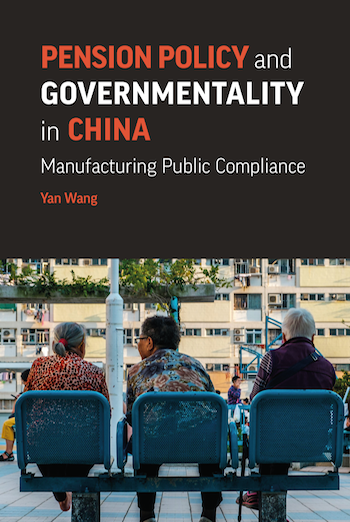
| Title | Pension Policy and Governmentality in China |
|---|---|
| Subtitle | Manufacturing Public Compliance |
| Contributor | Yan Wang(opens in new tab)(author) |
| DOI | https://doi.org/10.31389/lsepress.ppc(opens in new tab) |
| Landing page | https://press.lse.ac.uk/books/m/10.31389/lsepress.ppc(opens in new tab) |
| License | https://creativecommons.org/licenses/by/4.0/(opens in new tab) |
| Copyright | Author(s) |
| Publisher | LSE Press |
| Publication place | London |
| Published on | 2022-10-27 |
| ISBN | 978-1-909890-88-6 (Paperback) |
| 978-1-909890-88-6 (PDF) | |
| 978-1-909890-90-9 (EPUB) | |
| 978-1-909890-91-6 (MOBI) | |
| Short abstract | Economic growth is often a disruptive social process - so how has the Chinese state been able to maintain compliance from its people while at the same time pushing ahead an exceptionally rapid social and economic transformation? This book explores the question via detailed analysis of the trajectories, policy rationale, and effects of China’s pension reforms, demonstrating how statecraft shapes the ways that citizens ascribe credit and responsibility for pensions protection across themselves, the state and other actors. The book shows that China’s governmentality for manufacturing compliance is hybrid, organic, and dynamic. The targeted allocation of benefits, policy experimentation, propaganda and knowledge construction, and many other approaches are used to shape public expectations and to justify state rule. An original contribution to the study of legitimation in modern states, the analysis particularly highlights that when active counter-conduct (such as resistance) is confined, individuals may choose cognitive rebellion and falsify their public compliance. |
| Long abstract | Rapid economic growth is often a disruptive social process threatening the social relations and ideologies of incumbent regimes. Yet far from acting defensively, the Chinese Communist Party has lead a major social and economic transformation over forty years, without yet encountering fundamental challenges subverting its rule. A key question for political sociology is thus - how have the logics of China’s governmentality been able to help maintain compliance from the governed while acting so radically to advance the state’s growth priorities? This book explores the issue by analysing the detailed trajectories, rationale, and effects of China’s pension reforms. It uses strong methods, including institutional analysis of resource allocation in the multiple pension schemes and programmes, and quantitative text analysis of the knowledge construction in official discourse along with the reforms. Causal identification estimates the effects of key policy instruments on public opinion about pension responsibility and political trust. Moving beyond the pension issues, the analysis discusses with qualitative evidence why falsified compliance might exist in China’s society and the mechanisms that may lie behind it. Where active counter-conduct (such as resistance) is confined, individuals may choose cognitive rebellion and falsify their public compliance. The Chinese state’s strategy to generate public compliance is hybrid, organic, and dynamic. The state rules society by its customised governance design and constant adjustments. Public compliance is not only acquired through ‘buying off’ the public with governmental performance and transfer benefits, but is also manufactured through achieving cultural changes and new ideological foundations for general legitimation. |
| Print length | 282 pages |
| Language | English (Original) |
| Dimensions | 152 x 229 mm | 5.98" x 9.02" (Paperback) |
| THEMA |
|
| BIC |
|
| BISAC |
|
| LCC |
|
| Keywords |
|
Contents
- Yan Wang
- Yan Wang
- Yan Wang
- Yan Wang
- Yan Wang
- Yan Wang
- Yan Wang
Contributors
Yan Wang
(author)Yan is a Research Fellow at the School of Public Policy, having previously been an LSE Fellow in the Department of Methodology. Yan’s work mainly investigates the issue of state governance, redistribution of public goods, and public participation, she is especially interested in how actors’ agency shapes authoritarian governmentality.