
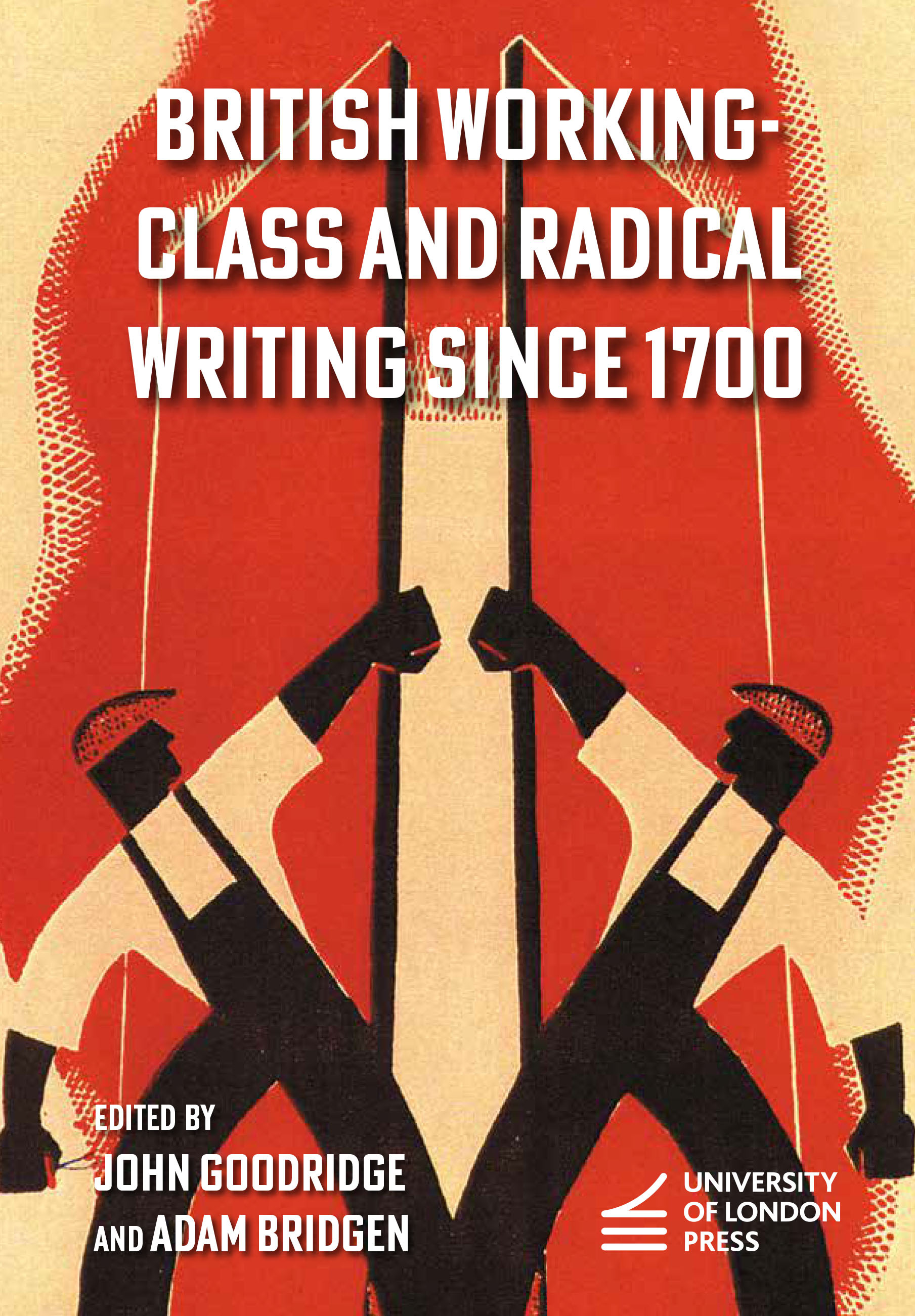
| Title | British Working-Class and Radical Writing Since 1700 |
|---|---|
| Contributor | John Goodridge(opens in new tab)(editor) |
| Adam Bridgen(opens in new tab)(editor) | |
| DOI | https://doi.org/10.63674/jimx5453(opens in new tab) |
| Landing page | https://uolpress.co.uk/book/british-working-class-and-radical-writing-since-1700/(opens in new tab) |
| License | https://creativecommons.org/licenses/by-nc-nd/4.0/(opens in new tab) |
| Copyright | Authors |
| Publisher | University of London Press |
| Publication place | London, GB |
| Published on | 2025-09-25 |
| ISBN | 978-1-913739-07-2 (Paperback) |
| 978-1-913739-06-5 (Hardback) | |
| 978-1-913739-08-9 (PDF) | |
| 978-1-913739-09-6 (EPUB) | |
| Short abstract | At a time when working-class writing is gaining long-overdue recognition and radical ideas are more important than ever, this collection examines the intersection of British working-class and radical writing from the eighteenth century to the present. Topics include the obstacles facing writers, women writers, socialism, feminism, anti-imperialism, and diasporic identities. The volume recovers the work of several lesser-known authors and reappraises figures such as John Clare and Ethel Carnie Holdsworth. |
| Long abstract | An essential history of how literature became a battleground for class struggle and political dissent in Britain. At a time when working-class writing is gaining long-overdue recognition and radical ideas may be more important than ever, this timely collection of eighteen essays examines the powerful intersection of British working-class and radical writing from the eighteenth century to the present day. Taking the pioneering work of H. Gustav Klaus on British labouring-class, socialist and anarchist writing traditions as its foundation, the volume embraces variety to reflect the richness of working-class and radical cultures across the last three centuries. Cross-cutting topics include the ways in which working-class writers got into print, the obstacles they faced in doing so and in expressing their views, the rise of women writers and their involvement in radical culture, representations of animals and more-than-human perspectives, socialism and environmentalism, feminism, anti-imperialism, and the intersection of working-class and diasporic identities. Questions of genre and form are also addressed, from dialect poetry to the novel, pastoral to melodrama, and life writing to theatre. Showcasing a wide range of innovative approaches, the volume contributes significantly to recovering the literary work and radicalism of several little-studied and forgotten working-class authors, as well as reappraising better-known figures such as John Clare and Ethel Carnie Holdsworth. |
| Language | English (Original) |
| Dimensions | 156 x 234 mm | 6.14" x 9.21" (Paperback) |
| 160 x 240 mm | 6.31" x 9.44" (Hardback) | |
| Media | 2 illustrations |
| THEMA |
|
| BIC |
|
| BISAC |
|
| Keywords |
|
Contributors
John Goodridge
(editor)John Goodridge is Emeritus Professor of English at Nottingham Trent University, President of the John Clare Society, and a Fellow of the English Association. He is the general editor of English Labouring Class Poets (2003 and 2006, six volumes), co-edited with Bridget Keegan, A Cambridge History of Working-Class Writing (2018), and edits and principally writes the online ‘Catalogue of Labouring-class Poetry’.
Adam Bridgen
(editor)Adam Bridgen is a Leverhulme Trust Early Career Fellow at Durham University. He has published widely on labouring-class poetry, the social dimensions of writing about slavery, resource extraction, and human-animal relationships during the long eighteenth century. His first monograph, on British labouring-class antislavery writing, is forthcoming with Oxford University Press.