
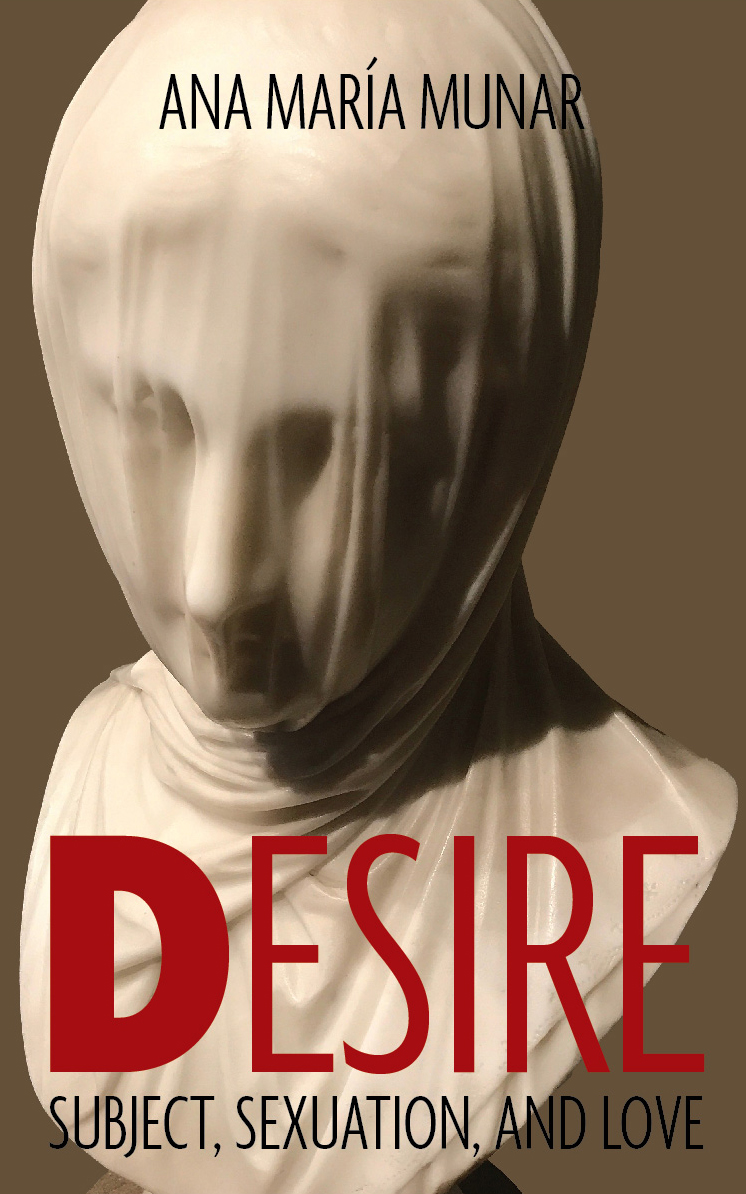
| Title | Desire |
|---|---|
| Subtitle | Subject, Sexuation, and Love |
| Contributor | Ana María Munar(opens in new tab)(author) |
| DOI | https://doi.org/10.53288/0516.1.00(opens in new tab) |
| Landing page | https://punctumbooks.com/titles/desire-subject-sexuation-and-love/(opens in new tab) |
| License | https://creativecommons.org/licenses/by-nc-sa/4.0/(opens in new tab) |
| Copyright | Ana María Munar |
| Publisher | punctum books |
| Publication place | Earth, Milky Way |
| Published on | 2026-02-27 |
| ISBN | 978-1-68571-186-3 (Paperback) |
| 978-1-68571-187-0 (PDF) | |
| 978-1-68571-310-2 (EPUB) | |
| Long abstract | Have you ever wondered what makes you wake up in the morning? Why not just lay down, stay, and eventually disappear? What is the wanting, the energy, and the grace of liveliness? Desire is at the core of liveliness, and this book explains why it is so. Desire is much more than a mere appendix to love, sex, or our craving to have the latest fashion item. It is what allows the most personal and unique expression of each of us. Desire: Subject, Sexuation, and Love is a work of gratitude to the Lacanian tradition and feminist philosophy. It creatively uses the story of “The Little Mermaid” by H.C. Andersen, as well as art and popular culture to explain the complex landscape of desire and its relation to love and sexuation. Much of the criticism of psychoanalysis from gender studies and poststructuralism is based on a superficial reading of Jacques Lacan, and Munar corrects this, providing in the first half of the book a rigorous and clear analysis of Lacanian subjectification and sexuation, elucidating their relationship to the nature of desire and love, in order to modify overly simplistic and erroneous interpretations of his thinking on desire. Desire is essayistic and poetic philosophy, drawing upon and playing with psychoanalysis, philosophy, literature, biography, poetry, and art. As the reader enters the second part of the book, the focus on Lacanian theory recedes, opening a space that is more paradoxical and multiple where Munar engages in creative form as an expression of critique, transforming our understandings of desire and love, which always elude us while also always being present. |
| Print length | 260 pages |
| Language | English (Original) |
| Dimensions | 127 x 15 x 203 mm | 5" x 0.59" x 8" (Paperback) |
| Weight | 349g | 12.30oz (Paperback) |
| LCCN | 2026933813 |
| THEMA |
|
| BIC |
|
| BISAC |
|
| Keywords |
|
Contributors
Ana María Munar
(author)Ana María Munar is Associate Professor in the Department of Business Humanities and Law, Copenhagen Business School. Her scholarship is postdisciplinary and characterized by the application of experimental writing, critical theory, and philosophical thought to gender studies, higher education, and tourism studies. In recent years, Ana’s research has focused on the philosophy of desire and emotion, feminist epistemology, poststructuralism, and postdisciplinarity. Her passion lies in philosophizing and developing creative academic communities, where love and joy are possible. One of these is the Critical Tourism Studies network that she has co-chaired together with Professor Kellee Caton. She is the author and editor of several book anthologies and special journal issues, and has written over forty academic articles and book chapters. Her latest collective work is an open source multimedia platform and book on* Sexism in Danish Higher Education and Research(opens in new tab).*