
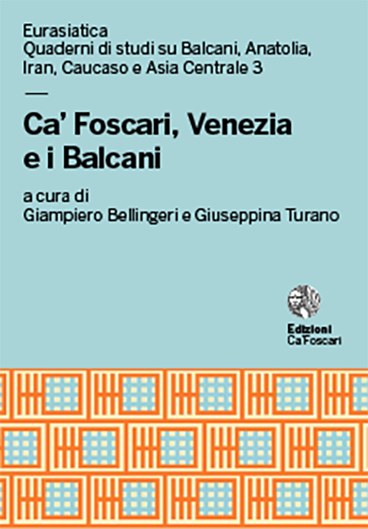
| Title | Ca’ Foscari, Venice and the Balkans |
|---|---|
| Contributor | Giampiero Bellingeri(opens in new tab)(editor) |
| Giuseppina Turano(opens in new tab)(editor) | |
| DOI | https://doi.org/10.14277/978-88-6969-048-8(opens in new tab) |
| Landing page | https://edizionicafoscari.it/en/edizioni4/libri/978-88-6969-050-1/(opens in new tab) |
| License | https://creativecommons.org/licenses/by/4.0/(opens in new tab) |
| Copyright | Giuseppina Turano, Giampiero Bellingeri |
| Publisher | Edizioni Ca’ Foscari – Venice University Press |
| Publication place | Venice, Italy |
| Published on | 2015-11-02 |
| Series |
|
| ISBN | 978-88-6969-048-8 (PDF) |
| Short abstract | This volume of the "Eurasiatica" series collects eleven papers presented at the 2nd Ca' Foscari Conference of Balkan Studies, Venice and the Balkans held in Venice in 2013. They range from historiography to archaeology, from monument restoration to art, from economics to literature, from nationalist ideological practices to cultural identity practices, on the common denominator of the Balkans. A multiplicity of themes studied through manuscript documents, observing archaeological finds, analysing rare examples of religious mosaics, interpreting inscriptions from the Ottoman era, in a journey that once again highlights how intense inter-Adriatic relations are between Venice and the Balkans. |
| Long abstract | This volume of the "Eurasiatica" series collects eleven papers presented at the 2nd Ca' Foscari Conference of Balkan Studies, Venice and the Balkans held in Venice in 2013. They range from historiography to archaeology, from monument restoration to art, from economics to literature, from nationalist ideological practices to cultural identity practices, on the common denominator of the Balkans. A multiplicity of themes studied through manuscript documents, observing archaeological finds, analysing rare examples of religious mosaics, interpreting inscriptions from the Ottoman era, in a journey that once again highlights how intense inter-Adriatic relations are between Venice and the Balkans. |
| Language | Italian (Original) |
| THEMA |
|
| BISAC |
|
| Keywords |
|