
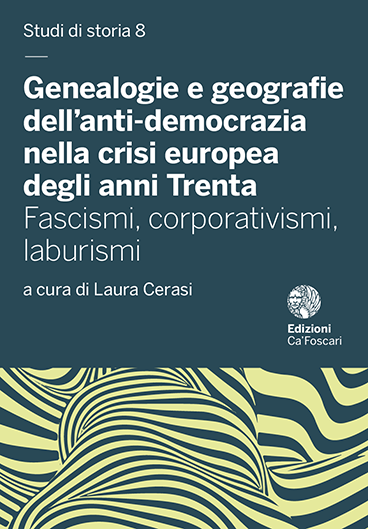
| Title | Genealogies and Geographies of Anti-Democracy in the European Crisis of the 1930s |
|---|---|
| Subtitle | Fascisms, Corporativisms, Laburisms |
| Contributor | Laura Cerasi(opens in new tab)(editor) |
| DOI | https://doi.org/10.30687/978-88-6969-317-5(opens in new tab) |
| Landing page | https://edizionicafoscari.it/en/edizioni4/libri/978-88-6969-318-2/(opens in new tab) |
| License | https://creativecommons.org/licenses/by/4.0/(opens in new tab) |
| Copyright | Laura Cerasi |
| Publisher | Edizioni Ca’ Foscari – Venice University Press |
| Publication place | Venice, Italy |
| Published on | 2019-05-31 |
| Series |
|
| ISBN | 978-88-6969-317-5 (Paperback) |
| 978-88-6969-317-5 (PDF) | |
| Short abstract | The European responses to the inter-war years crisis were marked by the emergence of fascist and corporatist movements and regimes, combined with the creation of cultural and political networks of the radical right. Their ability to express ultra-nationalist, organicistic, palingenetic communitarian trends, radically hostile to socialist egalitarianism and liberal individualism, aiming at a national, hierarchical, collective new order, posed the ultimate authoritarian threat to European democracy. This book investigates cultural genealogies as well a as national and transnational geographies of such regimes, movements and cultures: for their transversal political nature, they provide a privileged ground for new perspectives in the inter-war crisis of Western culture, and for questioning their legacies to postwar world. |
| Long abstract | The European responses to the inter-war years crisis were marked by the emergence of fascist and corporatist movements and regimes, combined with the creation of cultural and political networks of the radical right. Their ability to express ultra-nationalist, organicistic, palingenetic communitarian trends, radically hostile to socialist egalitarianism and liberal individualism, aiming at a national, hierarchical, collective new order, posed the ultimate authoritarian threat to European democracy. This book investigates cultural genealogies as well a as national and transnational geographies of such regimes, movements and cultures: for their transversal political nature, they provide a privileged ground for new perspectives in the inter-war crisis of Western culture, and for questioning their legacies to postwar world. |
| Print length | 294 pages |
| Language | Italian (Original) |
| THEMA |
|
| BISAC |
|
| Keywords |
|