
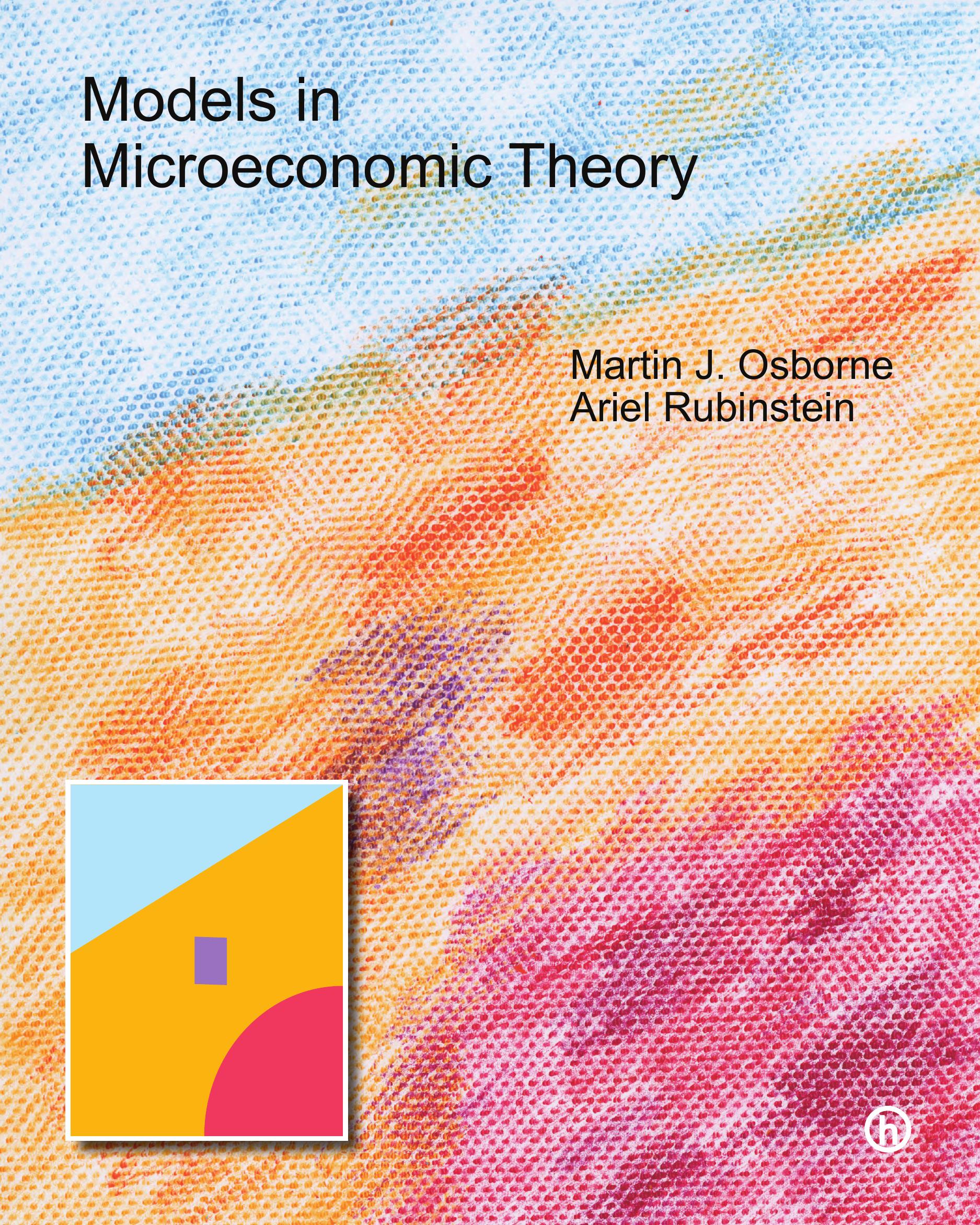
| Title | Models in Microeconomic Theory ('He' Edition) |
|---|---|
| Contributor | Martin J. Osborne(opens in new tab)(author) |
| Ariel Rubinstein(opens in new tab)(author) | |
| DOI | https://doi.org/10.11647/OBP.0204(opens in new tab) |
| Landing page | https://www.openbookpublishers.com/books/10.11647/obp.0204(opens in new tab) |
| License | https://creativecommons.org/licenses/by-nc-nd/4.0/(opens in new tab) |
| Copyright | Martin J. Osborne; Ariel Rubinstein |
| Publisher | Open Book Publishers |
| Publication place | Cambridge, UK |
| Published on | 2020-03-27 |
| ISBN | 978-1-78374-920-1 (Paperback) |
| 978-1-78374-921-8 (Hardback) | |
| 978-1-78374-922-5 (PDF) | |
| Short abstract | Models in Microeconomic Theory covers basic models in current microeconomic theory. The book focuses on the concepts of model and equilibrium. It states models and results precisely, and provides proofs for all results. It uses only elementary mathematics (with almost no calculus), although many of the proofs involve sustained logical arguments. It includes about 150 exercises. |
| Long abstract | Models in Microeconomic Theory covers basic models in current microeconomic theory. Part I (Chapters 1-7) presents models of an economic agent, discussing abstract models of preferences, choice, and decision making under uncertainty, before turning to models of the consumer, the producer, and monopoly. Part II (Chapters 8-14) introduces the concept of equilibrium, beginning, unconventionally, with the models of the jungle and an economy with indivisible goods, and continuing with models of an exchange economy, equilibrium with rational expectations, and an economy with asymmetric information. Part III (Chapters 15-16) provides an introduction to game theory, covering strategic and extensive games and the concepts of Nash equilibrium and subgame perfect equilibrium. Part IV (Chapters 17-20) gives a taste of the topics of mechanism design, matching, the axiomatic analysis of economic systems, and social choice. The book focuses on the concepts of model and equilibrium. It states models and results precisely, and provides proofs for all results. It uses only elementary mathematics (with almost no calculus), although many of the proofs involve sustained logical arguments. It includes about 150 exercises. With its formal but accessible style, this textbook is designed for undergraduate students of microeconomics at intermediate and advanced levels. |
| Print length | 362 pages (xviii+344) |
| Language | English (Original) |
| Dimensions | 203 x 25 x 254 mm | 8" x 0.99" x 10" (Paperback) |
| 203 x 29 x 254 mm | 8" x 1.13" x 10" (Hardback) | |
| Weight | 2141g | 75.52oz (Paperback) |
| 2690g | 94.89oz (Hardback) | |
| OCLC Number | 1148094465 |
| LCCN | 2019452876 |
| BIC |
|
| BISAC |
|
| LCC |
|
| Keywords |
|
Contents
- Martin Osborne
- Ariel Rubinstein
- Martin Osborne
- Ariel Rubinstein
- Martin Osborne
- Ariel Rubinstein
- Martin Osborne
- Ariel Rubinstein
- Martin Osborne
- Ariel Rubinstein
- Martin Osborne
- Ariel Rubinstein
- Martin Osborne
- Ariel Rubinstein
- Martin Osborne
- Ariel Rubinstein
- Martin Osborne
- Ariel Rubinstein
- Martin Osborne
- Ariel Rubinstein
- Martin Osborne
- Ariel Rubinstein
- Martin Osborne
- Ariel Rubinstein
- Martin Osborne
- Ariel Rubinstein
- Martin Osborne
- Ariel Rubinstein
- Martin Osborne
- Ariel Rubinstein
- Martin Osborne
- Ariel Rubinstein
- Martin Osborne
- Ariel Rubinstein
- Martin Osborne
- Ariel Rubinstein
- Martin Osborne
- Ariel Rubinstein
- Martin Osborne
- Ariel Rubinstein