
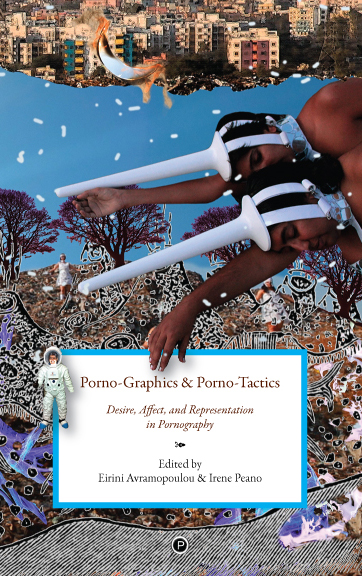
| Title | Porno-Graphics and Porno-Tactics |
|---|---|
| Subtitle | Desire, Affect, and Representation in Pornography |
| Contributor | Eirini Avramopoulou (editor) |
| Irene Peano (editor) | |
| DOI | https://doi.org/10.21983/P3.0141.1.00(opens in new tab) |
| Landing page | https://punctumbooks.com/titles/porno-graphics-and-porno-tactics/(opens in new tab) |
| License | https://creativecommons.org/licenses/by-nc-sa/4.0/(opens in new tab) |
| Copyright | Avramopoulou, Eirini; Peano, Irene |
| Publisher | punctum books |
| Publication place | Earth, Milky Way |
| Published on | 2016-05-26 |
| ISBN | 978-0-692-72054-7 (Paperback) |
| Long abstract | Porno-Graphics and Porno-Tactics asks whether, and how, it is possible to re-appropriate pornography and think through it critically and creatively for a project of liberation. In the different contributions which make up this deliberately heterogeneous collection of short, non-canonical essays, such a quest proceeds by re-articulating the aporias of desire, intimacy, touch and seduction. It also relates them to claims of visibility, visions of emancipation and its failures, as well as to the politics of violence that we get exposed to through circulating images and affects. This is an attempt to exceed the limits set by and for ourselves in relation to how we connect to our own bodies, to the bodies of our lovers and to the bodies of the theories we live with, sleep with and dream about – in short, to all that we get attached to. The editors and contributors of this collection do not claim the euphoric potentiality of pornography as necessarily subversive and emancipatory, but are nevertheless open to the possibilities of re-shaping it (in textual, contextual, intertextual, but also affective and embodied forms) through different graphic and tactical/tactile inscriptions. On the one hand, authors reflect on definitions and practices of pornography as a genre adopting specific codes and canons, whether it is concerned with sex acts and the industry of porn or with other predominant forms of representation and the structures of power underlying them. On the other hand, chapters relate to the more affective, libidinal, synaesthetic and inter/subjective dimensions of pornography, and on the capacity of different reappropriations to subvert its limits. |
| Print length | 102 pages |
| Language | English (Original) |
| Dimensions | 127 x 203 mm | 5" x 8" (Paperback) |
| THEMA |
|
| BIC |
|
| BISAC |
|
| Keywords |
|
Contents
- Eirini Avramopoulou
- Irene Peano
- Eirini Avramopoulou
- Irene Peano
- Eirini Avramopoulou
- Irene Peano
- Adele Tulli
- Kathryn Fischer
- Sinan Goknur
- Namita Aavriti
- Eliza Steinbock
- Eli Charidi
- Mantas Kvedaravicius
- Eirini Avramopoulou
- Irene Peano
Contributors
Eirini Avramopoulou
(editor)Eirini Avramopoulou is currently a A.G. Leventis Fellow at the British School at Athens, working on a research project titled “Changing Spaces of Refuge: Histories and Geographies of Displacement amidst Politics of Crisis in Greece.” She received a PhD in Social Anthropology in 2012 from the University of Cambridge (thesis: “The Affective Language of Activism: An Ethnography of Human Rights, Gender Politics and Activist Coalitions in Istanbul, Turkey”). Her work has been published in several edited volumes and journals, including The Greek Review of Social Research, Cultural Anthropology/Hot Spots, Critical Interdisciplinarity (Kritiki Diepistimonikotita), and Thesis. Her research interests include anthropology of human rights, social movements, and activism; gender and sexuality; secularism and Islam; queer theory; feminist and psychoanalytic approaches to subjectivity, biopolitics, and affect; economic crisis, memory and trauma. In 2013-2014 she was a fellow at the Institute for Cultural Inquiry (ICI), Berlin and in 2014-2015 she worked as a research fellow at the Sociology Department of the University of Cambridge. At the moment she is completing her first monograph on affect, performativity, and gender-queer activism in Istanbul, Turkey.
Irene Peano
(editor)Irene Peano is a precarious militant researcher. She recently completed a two-year Marie Curie Postdoctoral Fellowship at the University of Bologna, where she currently holds another postdoctoral position. Her research project deals with forms of resistance to the regime of mobility control and the exploitation of migrant labour, with a special focus on the agro-industrial context and on its reproductive articulations. She received her PhD from the Department of Social Anthropology at the University of Cambridge, for a project on the bonded sexual labour of Nigerian migrants. Her work focuses on subjectivity, and on the analysis of different forms of power, resistance and escape, with a special focus on gender, sexuality, and affective and reproductive labor.