
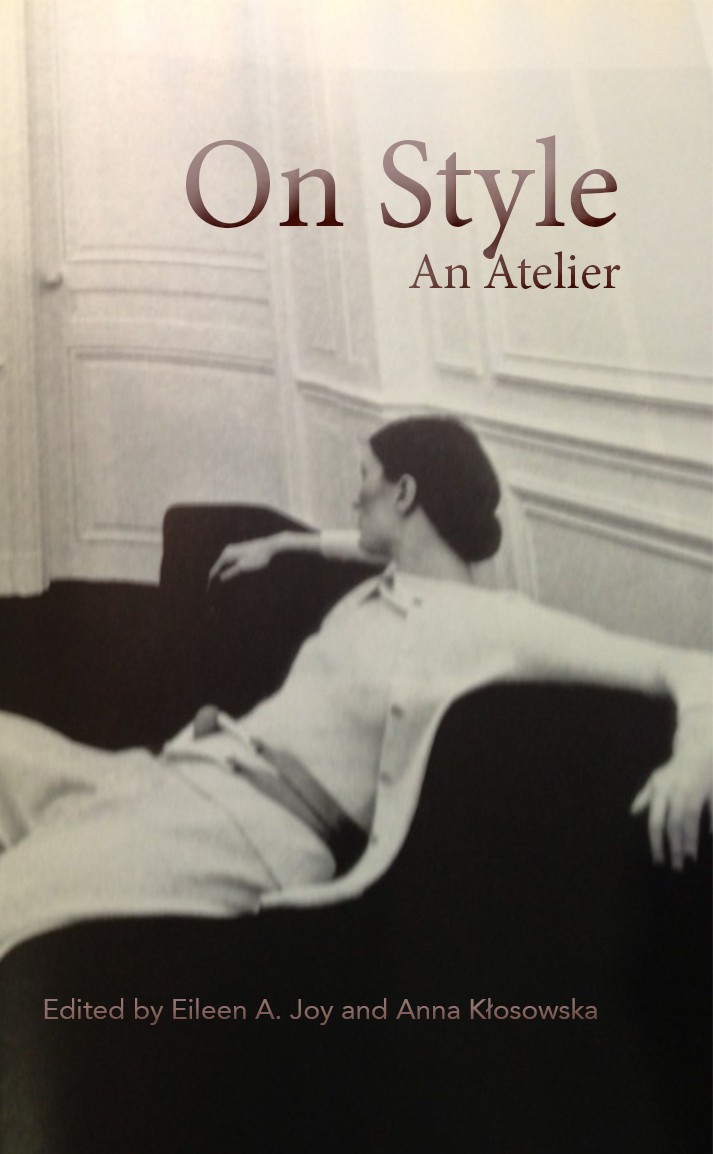
| Title | On Style |
|---|---|
| Subtitle | An Atelier |
| Contributor | Eileen A. Joy(opens in new tab)(editor) |
| Anna Kłosowska (editor) | |
| DOI | https://doi.org/10.21983/P3.0055.0.00(opens in new tab) |
| Landing page | https://punctumbooks.com/titles/on-style-an-atelier/(opens in new tab) |
| License | https://creativecommons.org/licenses/by-nc-sa/3.0/(opens in new tab) |
| Copyright | Joy, Eileen A.; Kłosowska, Anna |
| Publisher | punctum books |
| Publication place | Brooklyn, NY |
| Published on | 2013-12-06 |
| ISBN | 978-0-615-93402-0 (Paperback) |
| Long abstract | Scholarship in medieval studies of the past 20 or so years has offered some provocative experiments in, and elegant exempla of, style. Scholars such as Anne Clark Bartlett, Kathleen Biddick, Catherine Brown, Brantley Bryant, Michael Camille, Jeffrey Jerome Cohen, Carolyn Dinshaw, James Earl, L.O. Aranye Fradenburg, Roberta Frank, Amy Hollywood, Cary Howie, C. Stephen Jaeger, Eileen Joy, Anna Klosowska, Nicola Masciandaro, Peggy McCracken, Paul Strohm, David Wallace, and Paul Zumthor, among others, have blended the conventions of academic writing with those of fiction, drama, memoir, comedy, polemic, and lyricism, and/or have developed what some would describe as elegant, and arresting (and in some cases, deliciously difficult) prose styles. As these registers merge, they can produce what has been called a queer historiographical encounter (or in queer theorist Elizabeth Freeman’s terms, “an erotohistoriography”), a “poetics of intensification,” and even a “new aestheticism.” The work of these scholars has also opened up debates (some rancorous) that often install what the editors of this volume feel are false binaries between form and content, feeling and thinking, affect and rigor, poetry and history, attachment and critical distance, enjoyment and discipline, style and substance. As Anna Klosowska writes in her contribution to this volume, "The question of style, as it applies to medieval studies, is precisely the overcoming of that dichotomy between Nature and Man: a third element. And when the critique proceeds through the denunciation of the inimitability of someone’s style, as if it were the third sex, ungenerative, queer, sterile, sodomitic, lesbian, etc., the critic unconsciously puts his finger on exactly what style is; but that critic is mistaken about the style’s supposedly non-generative powers. In fact, style, neither fact nor theory but facilitating the transition between the two, is […] the generative principle itself." What can be said about the “style” of academic discourse at the present time, especially in relation to historical method, theory, and reading literary and historical texts? Is style merely supplemental to scholarly substance? As scholars, are we “subjects” of style? And what is the relationship between style and theory? Is style an object, a method, or something else? These were the questions that guided two conference sessions organized by the BABEL Working Group(opens in new tab) in 2010 (in Kalamazoo, Michigan and Austin, Texas), out of which this volume was developed. On Style: An Atelier gathers together medievalists and early modernists, as well as a poet and a novelist, in order to offer ruminations upon style in scholarship and theoretical writing (Roland Barthes, Carolyn Dinshaw, Lee Edelman, Bracha Ettinger, Charles Fourier, L.O. Aranye Fradenburg, Heidegger, Lacan, Ignatius of Loyola, and the Marquis de Sade, among others), as well as upon various trajectories of fashionable representation and self-representation in literature, sculpture, psychoanalysis, philosophy, religious history, rhetoric, and global politics. |
| Print length | 154 pages |
| Language | English (Original) |
| Dimensions | 114 x 184 mm | 4.50" x 7.25" (Paperback) |
| THEMA |
|
| BIC |
|
| BISAC |
|
| Keywords |
|
Contents
- Eileen A. Joy
- Anna Kłosowska
- Anna Kłosowska
- Valerie Allen
- Ruth Evans
- Anna Kłosowska
- Kathleen Biddick
- Michael D. Snediker
- Gila Aloni
- Jessica Roberts Frazier
- Christine Neufeld
- Valerie Vogrin
- Eileen A. Joy
- Anna Kłosowska
Contributors
Eileen A. Joy
(editor)Eileen A. Joy is the Director of punctum books and has published widely on medieval literature, cultural studies, intellectual and literary history, ethics, the post/human, and speculative realism. She is the co-editor of postmedieval: a journal of medieval cultural studies(opens in new tab), and is also the Lead Ingenitor of the BABEL Working Group(opens in new tab). She is also the co-editor of The Postmodern Beowulf (West Virginia University Press, 2007), Cultural Studies of the Modern Middle Ages (Palgrave, 2007), Dark Chaucer: An Assortment(opens in new tab) (punctum, 2012) and Speculative Medievalisms: Discography(opens in new tab) (punctum, 2013).