
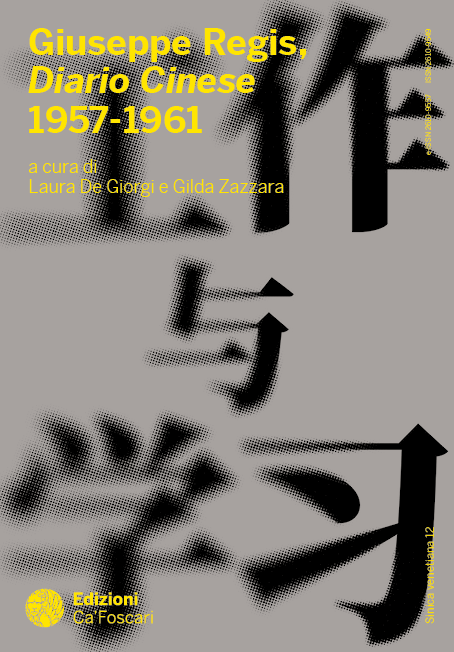
| Title | Giuseppe Regis, Diario cinese 1957-1961 |
|---|---|
| Contributor | Laura De Giorgi(opens in new tab)(editor) |
| Gilda Zazzara(opens in new tab)(editor) | |
| DOI | https://doi.org/10.30687/978-88-6969-958-0(opens in new tab) |
| Landing page | https://edizionicafoscari.it/en/edizioni4/libri/978-88-6969-959-7/(opens in new tab) |
| License | https://creativecommons.org/licenses/by/4.0/(opens in new tab) |
| Copyright | Gilda Zazzara, Laura De Giorgi |
| Publisher | Edizioni Ca’ Foscari – Venice University Press |
| Publication place | Venice, Italy |
| Published on | 2025-11-17 |
| Series |
|
| ISBN | 978-88-6969-958-0 (PDF) |
| Short abstract | In 1957, Giuseppe Regis moved to Beijing with his wife, Maria Arena, and their son, Vittorio, where they lived until 1961. During this period, he played a pivotal role in fostering commercial relations with the People’s Republic of China on behalf of the Italian Communist Party. This position brought him into direct contact with major Chinese economic and trade institutions, allowing him to witness both Mao’s China during the Great Leap Forward and one of the most complex stages of the Cold War: the years of the Sino-Soviet split. Upon returning to Italy, Regis and Arena established Edizioni Oriente, the leading Italian publishing house dedicated to introducing and discussing Maoism. Regis’s journal from his four years in China is accompanied by an introductory essay by Laura De Giorgi and a biographical profile by Gilda Zazzara. A selection of original photographs of the family’s life in China and a bibliographical appendix of Regis’s works further enrich the volume. |
| Long abstract | In 1957, Giuseppe Regis moved to Beijing with his wife, Maria Arena, and their son, Vittorio, where they lived until 1961. During this period, he played a pivotal role in fostering commercial relations with the People’s Republic of China on behalf of the Italian Communist Party. This position brought him into direct contact with major Chinese economic and trade institutions, allowing him to witness both Mao’s China during the Great Leap Forward and one of the most complex stages of the Cold War: the years of the Sino-Soviet split. Upon returning to Italy, Regis and Arena established Edizioni Oriente, the leading Italian publishing house dedicated to introducing and discussing Maoism. Regis’s journal from his four years in China is accompanied by an introductory essay by Laura De Giorgi and a biographical profile by Gilda Zazzara. A selection of original photographs of the family’s life in China and a bibliographical appendix of Regis’s works further enrich the volume. |
| Language | Italian (Original) |
| THEMA |
|
| BISAC |
|
| Keywords |
|