
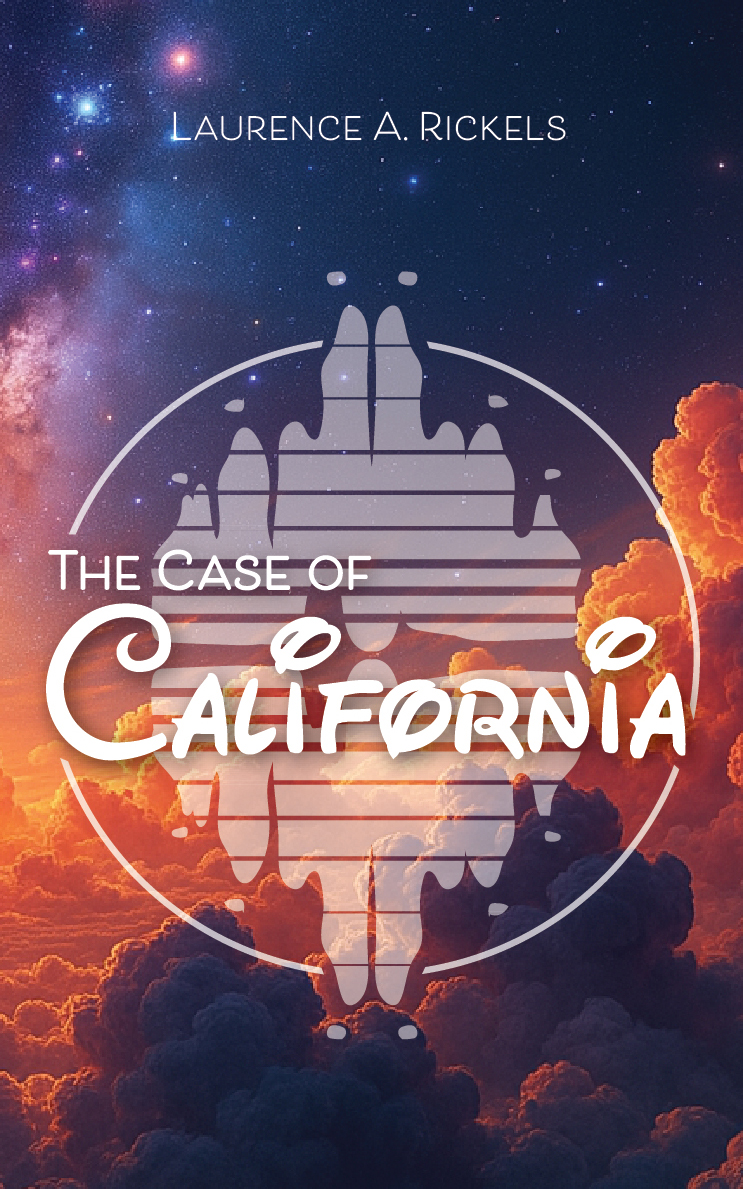
| Title | The Case of California |
|---|---|
| Edition | 2nd Edition |
| Contributor | Laurence A. Rickels (author) |
| DOI | https://doi.org/10.53288/0577.1.00(opens in new tab) |
| Landing page | https://punctumbooks.com/titles/the-case-of-california-new-edition/(opens in new tab) |
| License | https://creativecommons.org/licenses/by-nc-sa/4.0/(opens in new tab) |
| Copyright | Laurence A. Rickels |
| Publisher | punctum books |
| Publication place | Earth, Milky Way |
| Published on | 2026-01-20 |
| ISBN | 978-1-68571-292-1 (Paperback) |
| 978-1-68571-293-8 (PDF) | |
| 978-1-68571-294-5 (EPUB) | |
| Long abstract | Focusing on the changing image of the West Coast through such varied social and cultural artifacts as bodybuilding, group therapy, suicide cults, Marilyn Monroe, milk-carton images of missing children, orgies, Mickey Mouse, zombies, teenage slang, shock therapy, and surf music, The Case of California offers a dizzying psycho-history of the twentieth century as crystallized in the symbolic configuration and “case” of California, which case is articulated in relation to German modernism, National Socialism, and Freudian psychoanalysis. As Laurence Rickels writes, “on the personalizable level or label, California is a death cult; on the social, outward, happy-face level, it distributes pleasure via sadomasochism, the adolescent group, or friendship.” Ultimately, The Case of California excavates the places “California” occupies as concept or placeholder within Freudian psychoanalysis and such systems as the Frankfurt School, East Coast psychoanalysis, and deconstruction. To excavate the full range of “California,” one must apply pressure to a series of adjacent (and often equally marginal or missing) concepts, including group and adolescent psychology, female sexuality, the haunting of music and of mass media at large, the charge of child abuse, and a certain convergence of religious and hysterical conversion. This publication was originally published by University of Minnesota Press in 1991, and is now being released as a new print and open-access edition as part of punctum’s Special Collections(opens in new tab) initiative. |
| Print length | 416 pages |
| Language | English (Original) |
| Dimensions | 127 x 24 x 203 mm | 5" x 0.95" x 8" (Paperback) |
| Weight | 414g | 14.60oz (Paperback) |
| LCCN | 2025948281 |
| THEMA |
|
| BISAC |
|
| Keywords |
|
| Funding |
|
Contributors
Laurence A. Rickels
(author)After thirty years teaching at the University of California, Santa Barbara, Laurence A. Rickels accepted a professorship in art and theory at the Staatliche Akademie der Bildenden Künste, Karlsruhe and taught there until 2017. During 2018 Rickels was Eberhard Berent Visiting Professor and Distinguished Writer at New York University, and he continues to offer seminars in media and philosophy at the European Graduate School where he holds the Sigmund Freud Chair. Rickels is the author of Aberrations of Mourning (Minnesota, 1988), The Vampire Lectures (Minnesota, 1999), Nazi Psychoanalysis (3 vols., Minnesota, 2002), The Devil Notebooks (Minnesota, 2008), Ulrike Ottinger: The Autobiography of Art Cinema (Minnesota, 2008), I Think I Am: Philip K. Dick (Minnesota, 2010), SPECTRE (Anti-Oedipus, 2013), Germany: A Science Fiction (Anti-Oedipus, 2014), The Psycho Records (Columbia, 2016), and The Critique of Fantasy(opens in new tab) (3 vols., punctum books, 2020–2021).
References
- (opens in new tab)
- (opens in new tab)
- (opens in new tab)
- (opens in new tab)
- (opens in new tab)
- (opens in new tab)
- (opens in new tab)
- (opens in new tab)
- (opens in new tab)
- (opens in new tab)
- (opens in new tab)
- (opens in new tab)
- (opens in new tab)
- (opens in new tab)
- (opens in new tab)
- (opens in new tab)
- (opens in new tab)
- (opens in new tab)
- (opens in new tab)
- (opens in new tab)
- (opens in new tab)
- (opens in new tab)
- (opens in new tab)
- (opens in new tab)
- (opens in new tab)
- (opens in new tab)
- (opens in new tab)
- (opens in new tab)
- (opens in new tab)
- (opens in new tab)
- (opens in new tab)
- (opens in new tab)
- (opens in new tab)
- (opens in new tab)
- (opens in new tab)
- (opens in new tab)
- (opens in new tab)
- (opens in new tab)
- (opens in new tab)
- (opens in new tab)
- (opens in new tab)
- (opens in new tab)
- (opens in new tab)
- (opens in new tab)
- (opens in new tab)
- (opens in new tab)
- (opens in new tab)
- (opens in new tab)
- (opens in new tab)
- (opens in new tab)
- (opens in new tab)
- (opens in new tab)
- (opens in new tab)
- (opens in new tab)
- (opens in new tab)