
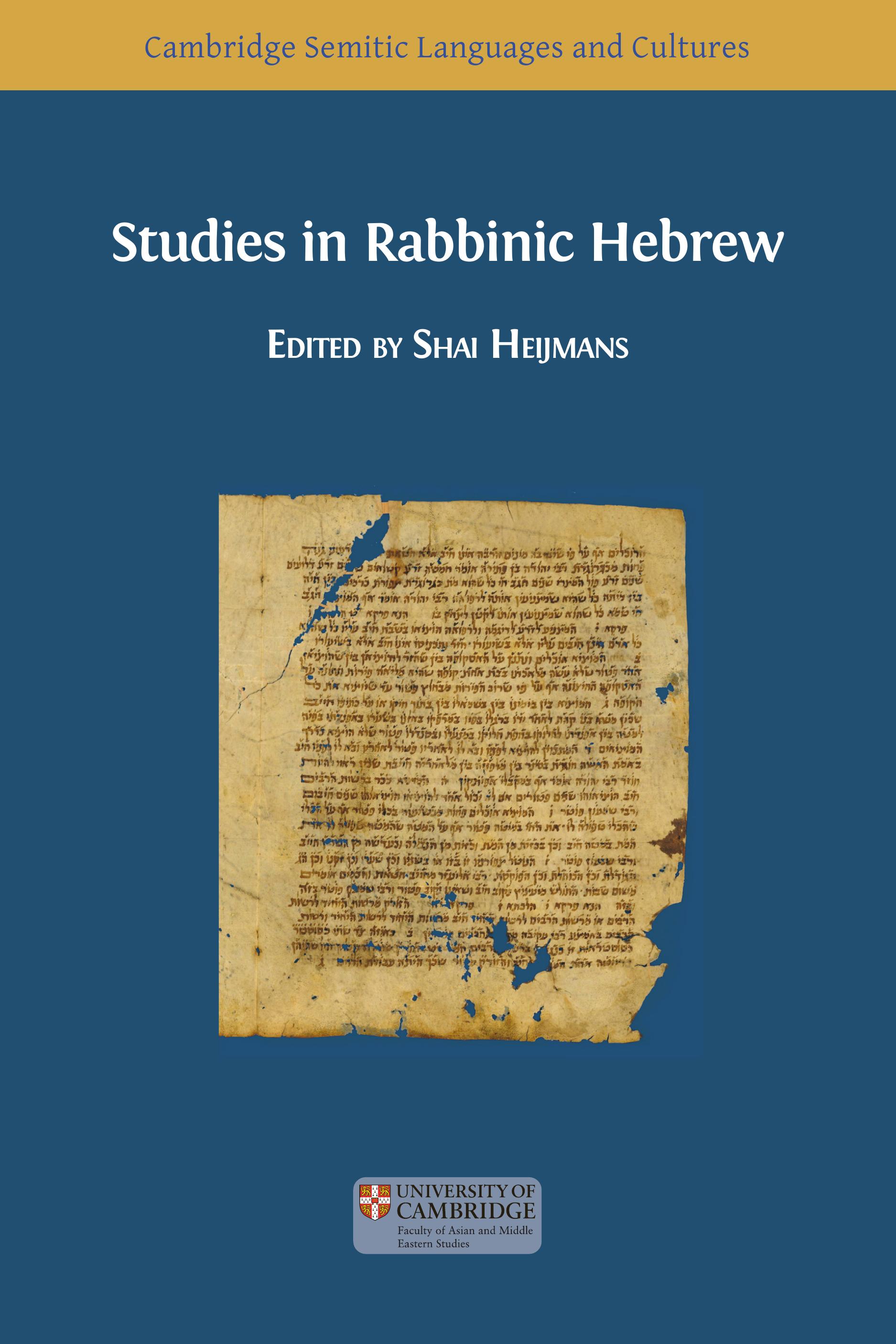
| Title | Studies in Rabbinic Hebrew |
|---|---|
| Contributor | Shai Heijmans (editor) |
| DOI | https://doi.org/10.11647/OBP.0164(opens in new tab) |
| Landing page | https://www.openbookpublishers.com/books/10.11647/obp.0164(opens in new tab) |
| License | http://creativecommons.org/licenses/by/4.0/(opens in new tab) |
| Copyright | Shai Heijmans. Copyright of individual chapters is maintained by the chapters’ authors. |
| Publisher | Open Book Publishers |
| Publication place | Cambridge, UK |
| Published on | 2020-05-19 |
| Series |
|
| ISBN | 978-1-78374-680-4 (Paperback) |
| 978-1-78374-681-1 (Hardback) | |
| 978-1-78374-682-8 (PDF) | |
| 978-1-80064-581-3 (HTML) | |
| 978-1-78374-768-9 (XML) | |
| 978-1-78374-683-5 (EPUB) | |
| 978-1-78374-684-2 (MOBI) | |
| Short abstract | This volume presents a collection of articles centring on the language of the Mishnah and the Talmud – the most important Jewish texts (after the Bible), which were compiled in Palestine and Babylonia in the latter centuries of Late Antiquity. Despite the fact that Rabbinic Hebrew has been the subject of growing academic interest across the past century, very little scholarship has been written on it in English. |
| Long abstract | This volume presents a collection of articles centring on the language of the Mishnah and the Talmud – the most important Jewish texts (after the Bible), which were compiled in Palestine and Babylonia in the latter centuries of Late Antiquity. Despite the fact that Rabbinic Hebrew has been the subject of growing academic interest across the past century, very little scholarship has been written on it in English. Studies in Rabbinic Hebrew addresses this lacuna, with eight lucid but technically rigorous articles written in English by a range of experienced scholars, focusing on various aspects of Rabbinic Hebrew: its phonology, morphology, syntax, pragmatics and lexicon. This volume is essential reading for students and scholars of Rabbinic studies alike, and constitutes the first in a new series, Studies in Semitic Languages and Cultures, in collaboration with the Faculty of Asian and Middle Eastern Studies at the University of Cambridge. |
| Print length | 238 pages (viii+230) |
| Language | English (Original) |
| Dimensions | 156 x 13 x 234 mm | 6.14" x 0.51" x 9.21" (Paperback) |
| 156 x 21 x 234 mm | 6.14" x 0.81" x 9.21" (Hardback) | |
| Weight | 757g | 26.70oz (Paperback) |
| 1399g | 49.35oz (Hardback) | |
| OCLC Number | 1155481578 |
| LCCN | 2020376760 |
| BIC |
|
| BISAC |
|
| LCC |
|
| Keywords |
|
Contents
- Shai Heijmans
- Rabba and Rava, ʾAbba and ʾAva: Spelling, Pronunciation and Meaning
- Yochanan Breuer
- The Vocalisation of MS Cambridge of the Mishnah: An Encounter Between Traditions
- Yehudit Henshke
- Adjacency Pairs and Argumentative Steps in The Halakhic Give-and-Take Conversations in The Mishnah
- Rivka Shemesh-Raiskin
- Tannaitic Aramaic: Methodological Remarks and a Test Case
- Christian Stadel
- Rabbinic Entries in R. Judah Ibn-Tibbon's Translation of Duties of the Hearts
- Barak Avirbach
- The Distinction Between Branches of Rabbinic Hebrew in Light of the Hebrew of the Late Midrash
- Yehonatan Wormser
- Two Textual Versions of Psiqata of the Ten Commandments
- Shlomi Efrati
- Vowel Reduction in Greek Loanwords in the Mishnah: The Phenomenon and Its Significance
- Shai Heijmans
Contributors
Shai Heijmans
(editor)Shai Heijmans is a post-doctoral researcher at the Faculty of Asian and Middle Eastern Studies in the University of Cambridge. He has completed his MA thesis on the morphology of Palestinian Aramaic, and his PhD on Greek and Latin loanwords in Rabbinic Hebrew, both at Tel Aviv University. His research interests are Rabbinic Hebrew, Palestinian Aramaic, and pronunciation traditions of Biblical Hebrew. He is now working on a new edition of the Mishnah according to Codex Kaufmann.