
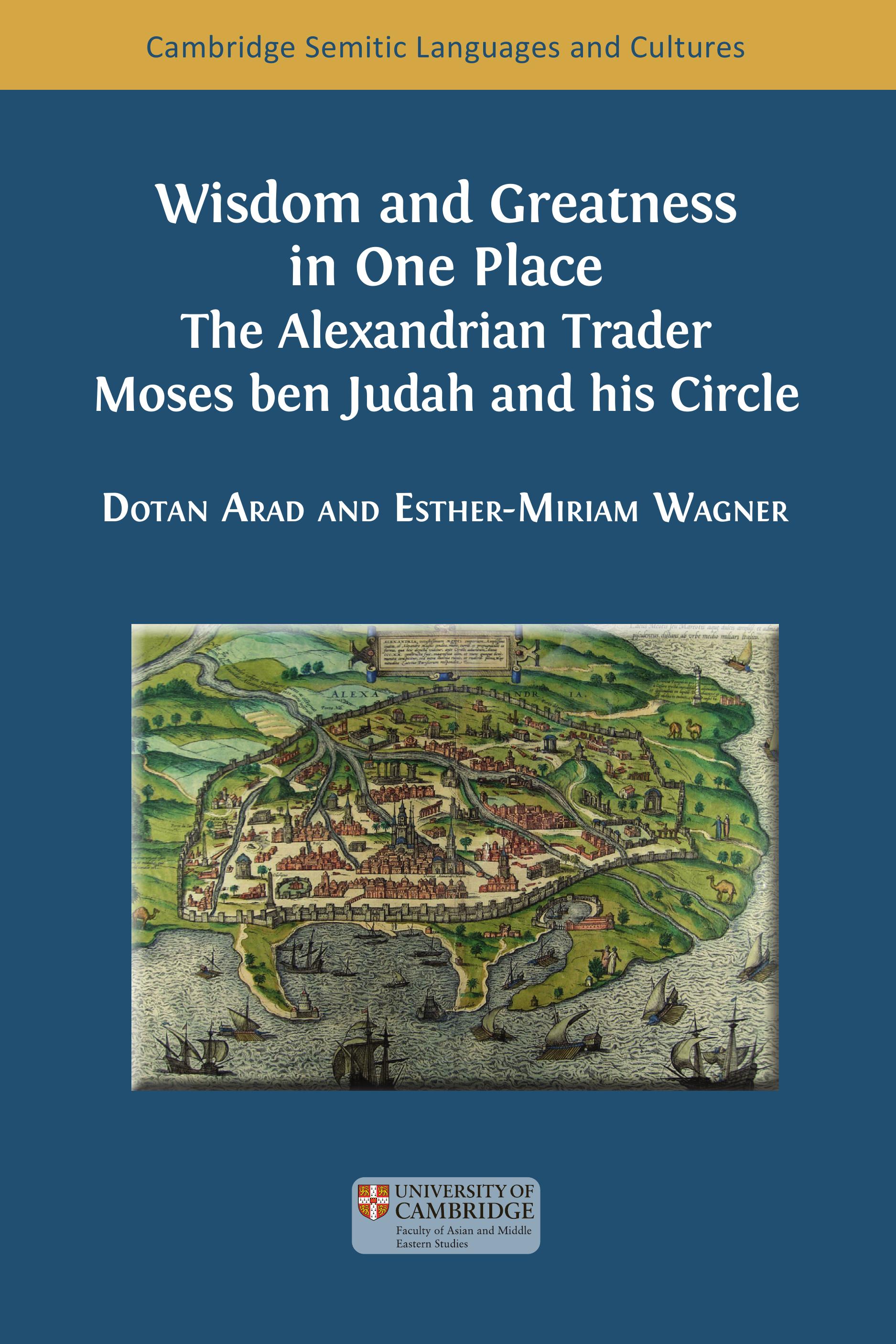
| Title | 'Wisdom and Greatness in one Place' |
|---|---|
| Subtitle | The Alexandrian Trader Moses ben Judah and his Circle |
| Contributor | Dotan Arad(opens in new tab)(author) |
| Esther-Miriam Wagner (author) | |
| DOI | https://doi.org/10.11647/OBP.0352(opens in new tab) |
| Landing page | https://www.openbookpublishers.com/books/10.11647/OBP.0352(opens in new tab) |
| License | https://creativecommons.org/licenses/by-nc/4.0/(opens in new tab) |
| Copyright | Dotan Arad; Esther-Miriam Wagner; |
| Publisher | Open Book Publishers |
| Publication place | Cambridge, UK |
| Published on | 2025-07-22 |
| Series |
|
| ISBN | 978-1-80511-070-5 (Paperback) |
| 978-1-80511-071-2 (Hardback) | |
| 978-1-80511-072-9 (PDF) | |
| Short abstract | The manuscript collections of the Bodleian Library contain a corpus of dozens of documents from the archive of Moses ben Judah. A leader of the Jewish community in Alexandria, he was also a prominent businessman and in contact with individuals from Cairo to Sicily. This collection of documents at the Bodleian likely did not emerge from the Cairo Genizah, but from another depository, and appears to have been buried at some point. |
| Long abstract | The manuscript collections of the Bodleian Library contain a corpus of dozens of documents from the archive of Moses ben Judah. A leader of the Jewish community in Alexandria, he was also a prominent businessman and in contact with individuals from Cairo to Sicily. This collection of documents at the Bodleian likely did not emerge from the Cairo Genizah, but from another depository, and appears to have been buried at some point. The documents, which include letters and deeds, shed light on the world of the Jewish elite of a Mediterranean city at the end of the Middle Ages, their communal and business life, connections between Jewish communities, and intellectual trends and tastes among educated Jews. They improve our understanding of the lives of Alexandrian Jews in the late Middle Ages and provide new data about the local leadership and its relations with the Nagidate (the central Jewish leadership) in Cairo, the cantors, the poll tax and its effects, and more. We hear about tensions within this society and the growing presence of European (Italian, Greek, Iberian, and conversos) Jews within the complex social mosaic of Egyptian Jewry in the late Mamluk period. The documents inform us about Alexandria’s Jewish community and the commercial networks of the Mediterranean world, in which Jews traded alongside Christians and Muslims. This volume makes an important contribution to the study of Judaeo-Arabic at a watershed moment. Sources from the late Mamluk period show Judaeo-Arabic at a linguistic border between Classical and Late Judaeo-Arabic. The volume will therefore further readers’ knowledge of historical linguistics of Arabic in general, and Judaeo-Arabic in particular. The phrase ‘Wisdom and Greatness in One Place’ in the title of the book is a quotation from the Babylonian Talmud (Giṭṭin 59a), the meaning of which is that it is rare to find combined in one man political leadership and intellectual pre-eminence. |
| Print length | 548 pages (x+538) |
| Language | English (Original) |
| Dimensions | 156 x 38 x 234 mm | 6.14" x 1.50" x 9.21" (Paperback) |
| 156 x 41 x 234 mm | 6.14" x 1.61" x 9.21" (Hardback) | |
| Weight | 1032g | 36.40oz (Paperback) |
| 1218g | 42.96oz (Hardback) | |
| OCLC Number | 1528868114 |
| LCCN | 2025465557 |
| THEMA |
|
| BIC |
|
| BISAC |
|
| LCC |
|
| Keywords |
|
Contents
- Dotan Arad
- Esther-Miriam Wagner
- Dotan Arad
- Esther-Miriam Wagner
- Dotan Arad
- Esther-Miriam Wagner
- Dotan Arad
- Esther-Miriam Wagner
- Dotan Arad
- Esther-Miriam Wagner
- Dotan Arad
- Esther-Miriam Wagner
- Dotan Arad
- Esther-Miriam Wagner
- Dotan Arad
- Esther-Miriam Wagner
- Dotan Arad
- Esther-Miriam Wagner
- Dotan Arad
- Esther-Miriam Wagner
- Dotan Arad
- Esther-Miriam Wagner
- Dotan Arad
- Esther-Miriam Wagner
- Dotan Arad
- Esther-Miriam Wagner
- Dotan Arad
- Esther-Miriam Wagner
- Dotan Arad
- Esther-Miriam Wagner
- Dotan Arad
- Esther-Miriam Wagner
- Dotan Arad
- Esther-Miriam Wagner
- Dotan Arad
- Esther-Miriam Wagner
- Dotan Arad
- Esther-Miriam Wagner
- Dotan Arad
- Esther-Miriam Wagner
- Dotan Arad
- Esther-Miriam Wagner
- Dotan Arad
- Esther-Miriam Wagner
- Dotan Arad
- Esther-Miriam Wagner
- Dotan Arad
- Esther-Miriam Wagner
- Dotan Arad
- Esther-Miriam Wagner
- Dotan Arad
- Esther-Miriam Wagner
- Dotan Arad
- Esther-Miriam Wagner
- Dotan Arad
- Esther-Miriam Wagner
- Dotan Arad
- Esther-Miriam Wagner
- Dotan Arad
- Esther-Miriam Wagner
- Dotan Arad
- Esther-Miriam Wagner
- Dotan Arad
- Esther-Miriam Wagner
- Dotan Arad
- Esther-Miriam Wagner
- Dotan Arad
- Esther-Miriam Wagner
- Dotan Arad
- Esther-Miriam Wagner
- Dotan Arad
- Esther-Miriam Wagner
- Dotan Arad
- Esther-Miriam Wagner
- Dotan Arad
- Esther-Miriam Wagner
- Dotan Arad
- Esther-Miriam Wagner
- Dotan Arad
- Esther-Miriam Wagner
- Dotan Arad
- Esther-Miriam Wagner
- Dotan Arad
- Esther-Miriam Wagner
- Dotan Arad
- Esther-Miriam Wagner
- Dotan Arad
- Esther-Miriam Wagner
- Dotan Arad
- Esther-Miriam Wagner
- Dotan Arad
- Esther-Miriam Wagner
- Dotan Arad
- Esther-Miriam Wagner
- Dotan Arad
- Esther-Miriam Wagner
Contributors
Dotan Arad
(author)Dr. Arad is a senior lecturer in the Israel and Golda Koschitzki department of Jewish History and Contemporary Jewry in Bar-Ilan University. Dotan has a PhD in Jewish History from the Hebrew University of Jerusalem. His research focuses on the Jews in Egypt, Syria and Palestine during the Mamluk and Early Ottoman period. Between 2012 and 2014 he published, with Prof. Shmuel Glick and other colleagues, a series of volumes containing responsa fragments of Jewish Sages in the Ottoman Empire, from the Cairo Genizah. His current research focuses on the Judeo Arabic letters of the Karaites in the Ottoman empire and on the social history of the Damascus and Cairo’s Jews during the Ottoman Period.
Esther-Miriam Wagner
(author)Esther-Miriam Wagner is the Executive Director of the Woolf Institute. She is a Fellow of St Edmund's College and teaches the MPhil in Middle Eastern Studies: Muslim-Jewish Relations at the University of Cambridge. Miriam has written broadly on sociolinguistics, historical linguistics of Judaeo-Arabic and Yiddish, scribal practice, and Jewish-Muslim relations in Egypt and Muslim Spain as reflected in the Genizah sources. Her books include Linguistic Variety of Judaeo-Arabic in Letters from the Cairo Genizah (2010), Scribes as Agents of Language Change (2013), Merchants of Innovations. The Languages of Traders (2016) and A Handbook and Reader of Ottoman Arabic (2021). Her work has been featured on TV and Radio programmes, such as on BBC3 The Essay, in History Magazine and in documentaries on the Cairo Genizah.