
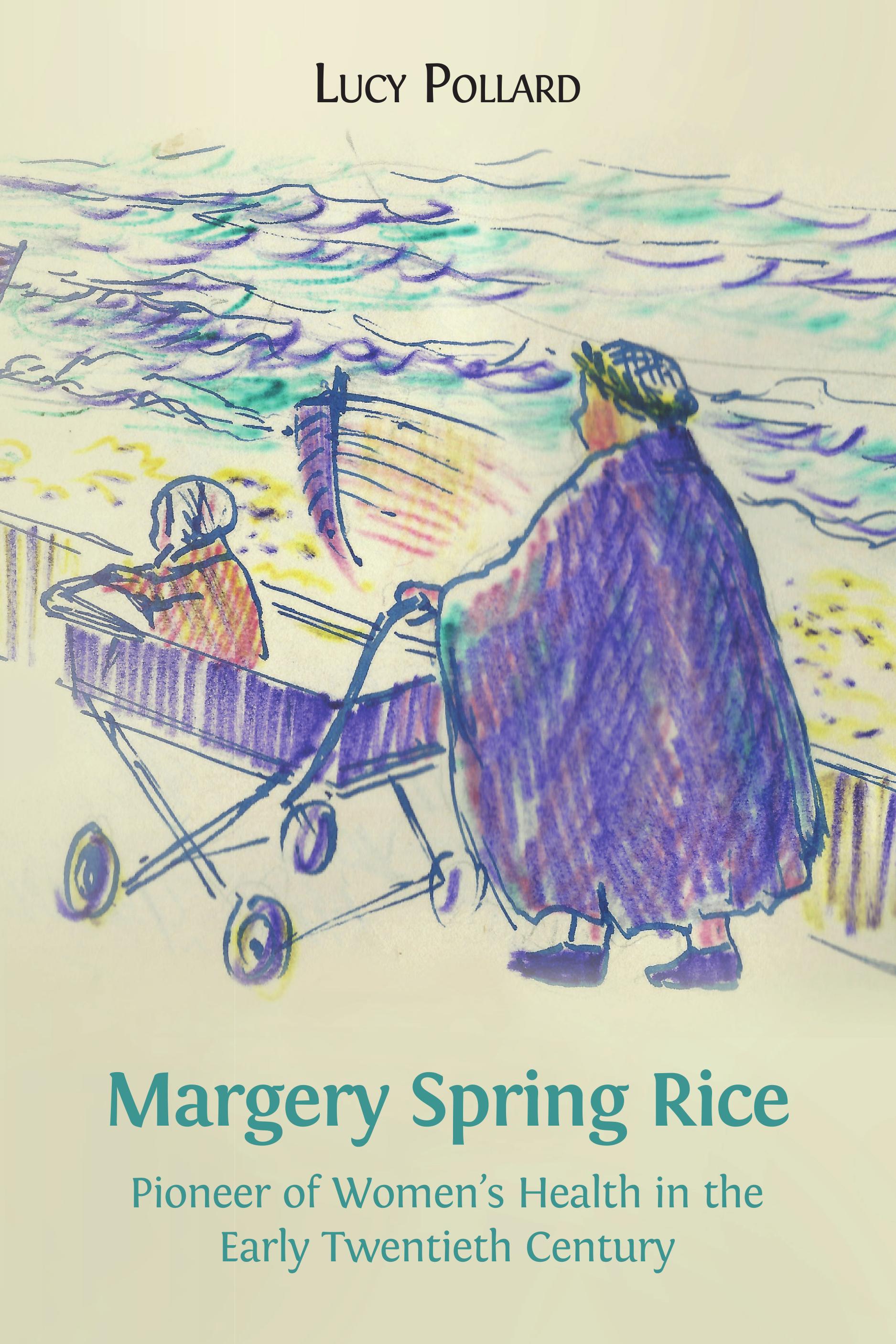
| Title | Margery Spring Rice |
|---|---|
| Subtitle | Pioneer of Women’s Health in the Early Twentieth Century |
| Contributor | Lucy Pollard (author) |
| DOI | https://doi.org/10.11647/OBP.0215(opens in new tab) |
| Landing page | https://www.openbookpublishers.com/books/10.11647/obp.0215(opens in new tab) |
| License | http://creativecommons.org/licenses/by/4.0/(opens in new tab) |
| Copyright | Lucy Pollard |
| Publisher | Open Book Publishers |
| Publication place | Cambridge, UK |
| Published on | 2020-04-23 |
| ISBN | 978-1-78374-881-5 (Paperback) |
| 978-1-78374-882-2 (Hardback) | |
| 978-1-78374-883-9 (PDF) | |
| 978-1-80064-620-9 (HTML) | |
| 978-1-78374-886-0 (XML) | |
| 978-1-78374-884-6 (EPUB) | |
| 978-1-78374-885-3 (MOBI) | |
| Short abstract | This book vividly presents the story of Margery Spring Rice, an instrumental figure in the movements of women’s health and family planning in the first half of the twentieth century. Margery Spring Rice, née Garrett, was born into a family of formidable female trailblazers – niece of physician and suffragist Elizabeth Garrett Anderson, and of Millicent Fawcett, a leading suffragist and campaigner for equal rights for women. Margery Spring Rice continued this legacy with her co-founding of the North Kensington birth control clinic in 1924, three years after Marie Stopes founded the first clinic in Britain. |
| Long abstract | This book vividly presents the story of Margery Spring Rice, an instrumental figure in the movements of women’s health and family planning in the first half of the twentieth century. Margery Spring Rice, née Garrett, was born into a family of formidable female trailblazers – niece of physician and suffragist Elizabeth Garrett Anderson, and of Millicent Fawcett, a leading suffragist and campaigner for equal rights for women. Margery Spring Rice continued this legacy with her co-founding of the North Kensington birth control clinic in 1924, three years after Marie Stopes founded the first clinic in Britain. Engaging and accessible, this biography weaves together Spring Rice’s personal and professional lives, adopting a chronological approach which highlights how the one impacted the other. Her life unfolds against the turbulent backdrop of the early twentieth century – a period which sees the entry of women into higher education, and the upheaval and societal upshots of two world wars. Within this context, Spring Rice emerges as a dynamic figure who dedicated her life to social causes, and whose actions time and again bear out her habitual belief that, contrary to the Shakespearian dictum, ‘valour is the better part of discretion’. This is the first biography of Margery Spring Rice, drawing extensively on letters, diaries and other archival material, and equipping the text with family trees and photographs. It will be of great interest to a range of social historians, especially those researching the birth control movement; female friendships, female philanthropists, and feminist activism in the twentieth century; and the history of medicine and public health. |
| Print length | 220 pages (xx+200) |
| Language | English (Original) |
| Dimensions | 156 x 15 x 234 mm | 6.14" x 0.60" x 9.21" (Paperback) |
| 156 x 19 x 234 mm | 6.14" x 0.75" x 9.21" (Hardback) | |
| Weight | 939g | 33.12oz (Paperback) |
| 1324g | 46.70oz (Hardback) | |
| Media | 27 illustrations |
| OCLC Number | 1152957827 |
| LCCN | 2020438733 |
| BIC |
|
| BISAC |
|
| LCC |
|
| Keywords |
|
Contents
- Cherished daughter (1887–1907)
- Lucy Pollard
- Independence (1907–1912)
- Lucy Pollard
- Loss (1912–1916)
- Lucy Pollard
- False Starts (1916–1924)
- Lucy Pollard
- Finding a Cause (1924–1931)
- Lucy Pollard
- A Single Woman (1931–1936)
- Lucy Pollard
- War Again (1936–1945)
- Lucy Pollard
- Matriarch (1945–1956)
- Lucy Pollard
- Running down (1956–1970)
- Lucy Pollard